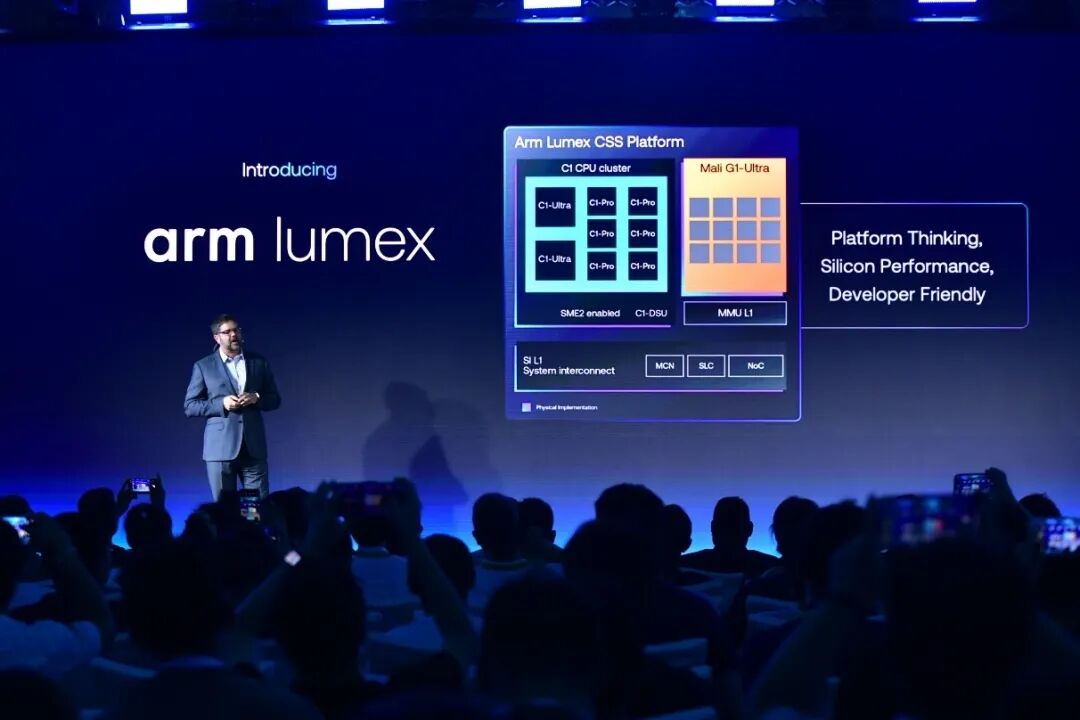
Arm Holdings Limited (NASDAQ: ARM, hereinafter referred to as Arm) today announced the launch of the new Arm® Lumex™ Compute Subsystem (CSS) platform, an advanced computing platform designed to accelerate the artificial intelligence (AI) experience for flagship smartphones and next-generation personal computers. The Lumex CSS platform integrates the highest performance Arm CPUs, GPUs, and system IP featuring second-generation Scalable Matrix Extension (SME2) technology, enabling ecosystem partners to bring AI devices to market faster while supporting a variety of rich experiences such as desktop-level mobile gaming, real-time translation, smart assistants, and personalized applications.
Chris Bergey, Senior Vice President and General Manager of Arm’s Client Line of Business, stated: “AI is no longer just a technical feature; it has become the foundational base for the next generation of mobile and consumer technology. With the Arm Lumex platform, we continuously enhance the edge AI experience to meet the growing demands and expectations of users. To this end, we are actively extending SME2 technology to every CPU platform. By 2030, SME and SME2 technologies are expected to add over 10 billion TOPS of computing power to more than 3 billion devices, bringing an exponential leap in edge AI performance.”
Partners can flexibly choose how to utilize Arm Lumex to create their system-on-chip (SoC) solutions. For example, they can directly adopt the platform delivered by Arm and leverage advanced physical implementation solutions customized for their needs, thus gaining the dual advantages of reduced time to market and rapid realization of performance value; alternatively, partners can configure the platform’s register transfer level (RTL) design according to their target market and complete the hardening of core modules themselves.
The new Arm Lumex platform includes the following core components:
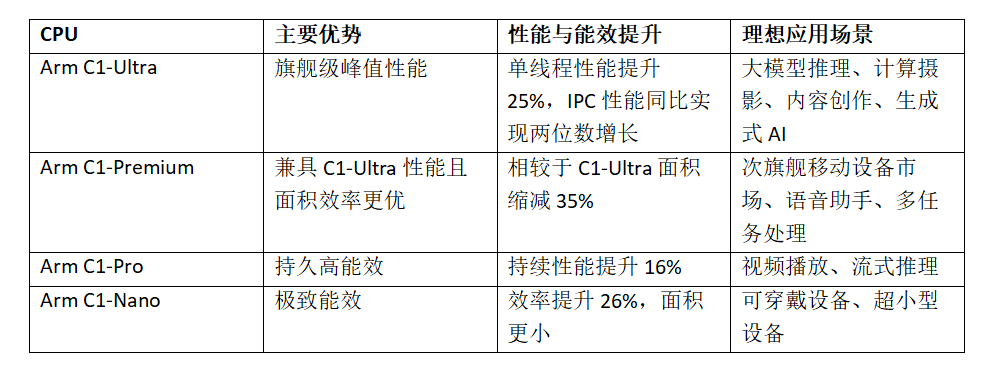
· Next-generation Armv9.3 CPU cluster with SME2 technology: including Arm C1-Ultra and Arm C1-Pro, supporting flagship devices
· Arm C1-Premium: designed for the upper mid-range market, offering top-notch area efficiency
· Arm Mali™ G1-Ultra GPU: equipped with next-generation ray tracing technology, enhancing overall AI performance while delivering advanced graphics and gaming experiences
· Arm C1-DSU: Arm’s most flexible, energy-efficient DynamIQ Shared Unit (DSU) with multiple power modes to date
· Physical implementation optimized for 3nm process nodes
· Deep integration across the software stack, providing developers using the KleidiAI software library with a seamless AI acceleration experience
CPUs with SME2 technology: Enabling AI acceleration across all scenarios
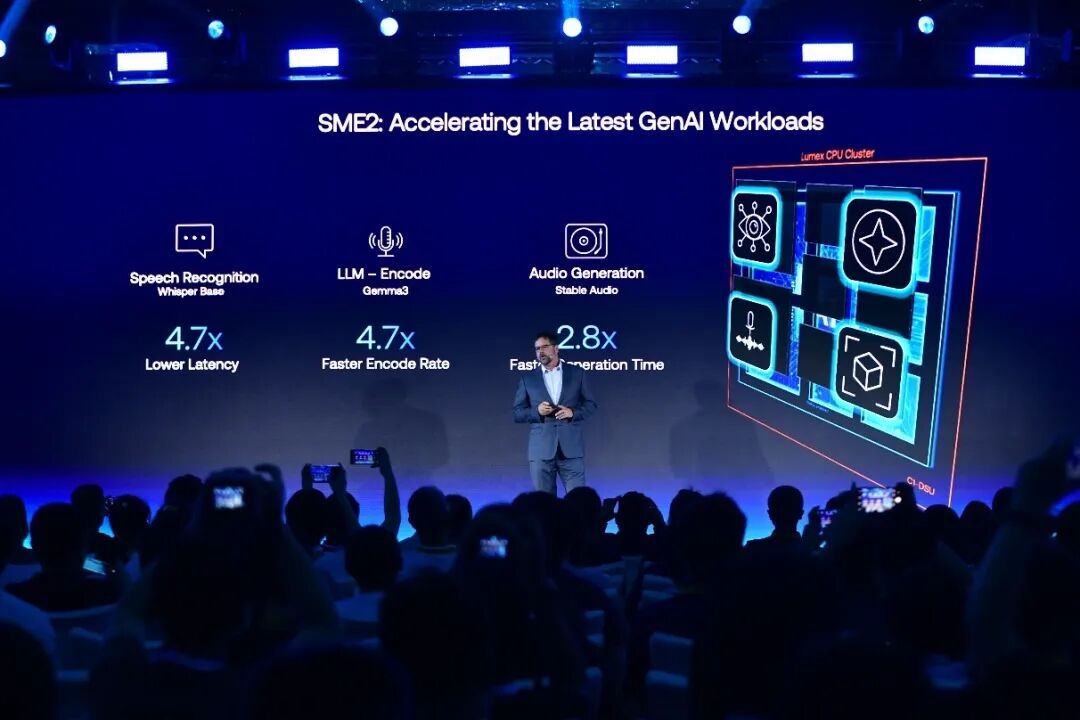
The Arm C1 CPU cluster with SME2 technology brings significant AI performance improvements for AI-driven tasks in real-world scenarios, including:
· Up to five times improvement in AI performance
· 4.7 times reduction in latency for voice workloads
· 2.8 times increase in audio generation speed
The leap in AI computing capability of the new Arm CPUs makes real-time edge AI inference a reality, providing users with a smoother and faster experience in various interactive scenarios such as audio generation, computer vision, and contextual assistants.
In practical scenarios, SME2 technology elevates response speed and operational efficiency to new levels. For example, in the “Smart Yoga Coach” demonstration application, thanks to SME2 technology, the text-to-speech generation speed improved by 2.4 times, meaning users can receive posture feedback and guidance instantly without worrying about battery life. Additionally, through a collaboration between Arm, Alipay, and vivo, the interaction response time of large language models (LLMs) was reduced by up to 40%, fully demonstrating that SME2 can provide terminal devices with a faster real-time generative AI experience.
The value of SME2 technology lies not only in speed improvements but also in unleashing AI-driven functionalities that traditional CPUs cannot achieve. For instance, running a neural camera denoising function on a single core with SME2 can achieve frame rates exceeding 120 frames per second (fps) at 1080P resolution or 30 fps at 4K resolution. This allows smartphone users to capture sharper, clearer images even in the darkest scenes, resulting in smoother operational interactions and richer user experiences on everyday devices.
Unlike cloud-first AI, which faces challenges such as latency, cost, and privacy issues, Lumex brings intelligence to the device side, enabling faster, safer, and always-available smart experiences locally. SME2 has already been widely adopted by leading ecosystem partners in the industry, including Alibaba, Alipay, Samsung System LSI, Tencent, and vivo.
Empowering architectural freedom across product tiers
Arm Lumex provides partners with ample freedom to achieve a flexible balance between peak performance, sustained energy efficiency, and chip area across various products, from high-end smartphones and PCs to emerging AI-first devices.
 Mali GPU: Delivering desktop-level gaming experiences and faster AI inference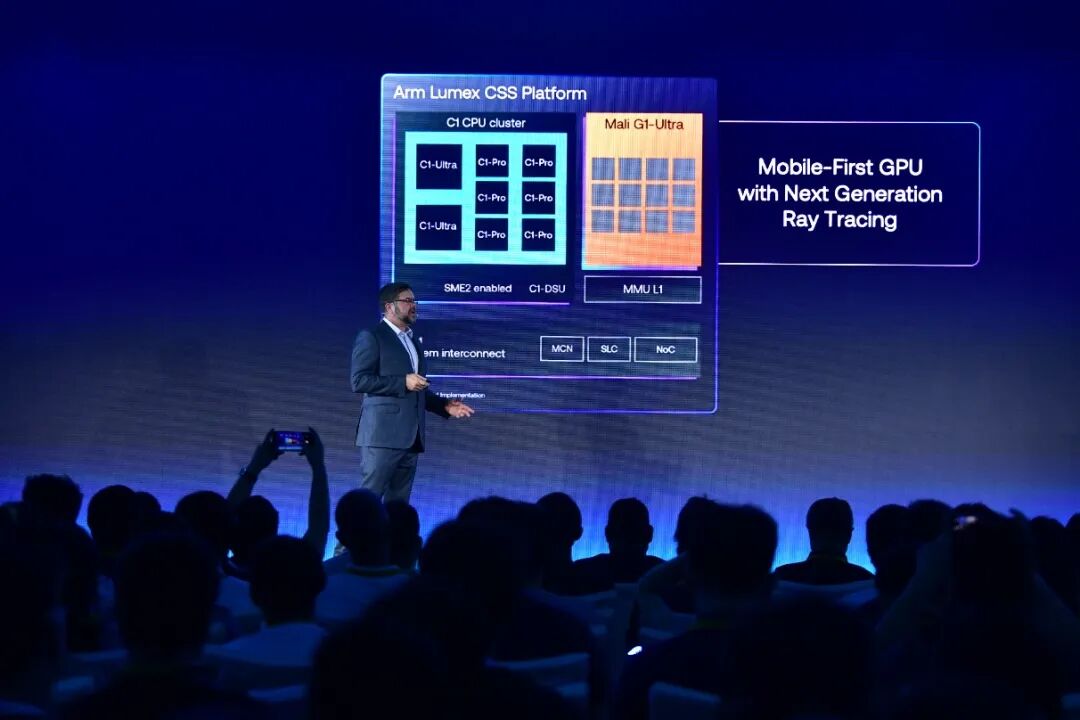
With the cumulative shipment of chips featuring Arm GPUs surpassing 12 billion units, Arm continues to maintain a core position in the mobile gaming experience domain. The new Arm Mali G1-Ultra GPU further breaks through the performance boundaries of mobile gaming, delivering high-fidelity, console-level graphics to mobile gamers. This breakthrough is attributed to the new second-generation Ray Tracing Unit (RTUv2) technology, which significantly enhances lighting, shadow, and reflection effects, doubling the ray tracing performance compared to the previous generation. In terms of AI workloads, the Mali G1-Ultra can boost inference performance by up to 20%, significantly enhancing the responsiveness of various real-time applications.
In various graphics benchmark tests, the Mali G1-Ultra achieved a 20% performance improvement over its predecessor, providing comprehensive performance enhancements for mainstream games such as “Escape from Tarkov: Infinite,” “Fortnite,” “Genshin Impact,” and “Honkai: Star Rail.” Meanwhile, the Mali G1-Premium and Mali G1-Pro GPUs also offer superior performance and energy efficiency for resource-constrained devices.
Developer-friendly edge AI solutions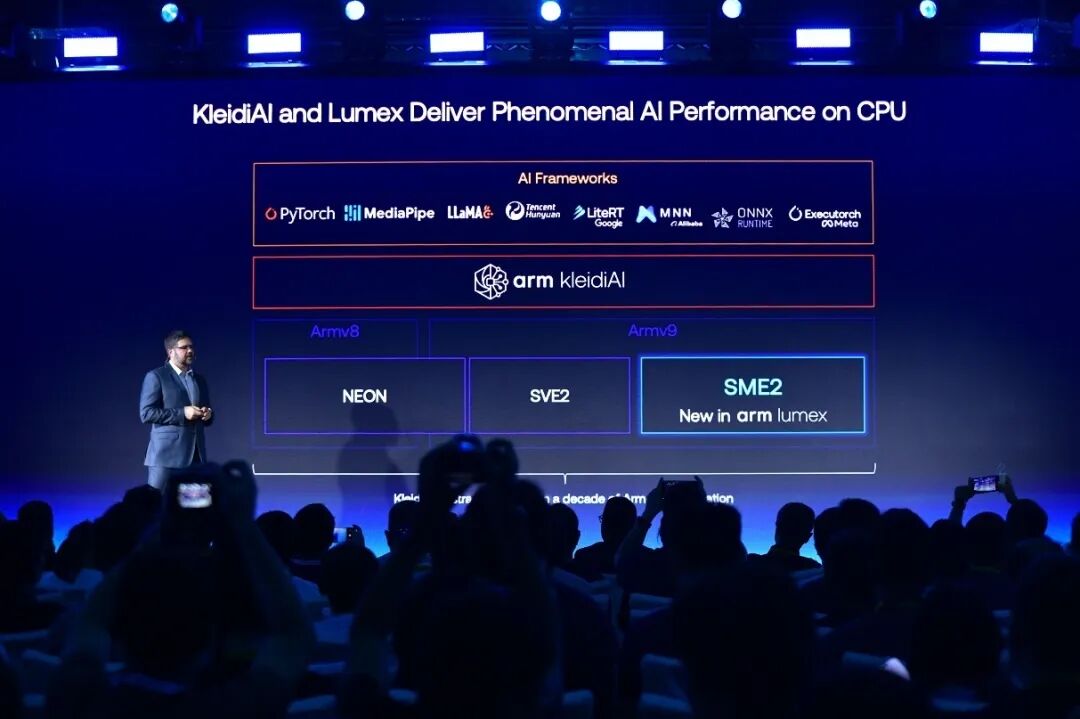
Developers can access an out-of-the-box AI development experience on the Arm Lumex platform. Through integration with KleidiAI and major mainstream frameworks, including PyTorch ExecuTorch, Google LiteRT, Alibaba MNN, and Microsoft ONNX Runtime, developers can automatically leverage SME2’s acceleration capabilities without modifying any code.
For developers needing to build cross-platform applications, Lumex brings new portability:
· Google applications such as Gmail, YouTube, and Google Photos now fully support SME2, allowing devices equipped with Lumex to run seamlessly upon launch
· Cross-platform portability means that optimizations built for Android can seamlessly extend to Windows and other operating systems using Arm architecture
· Partners like Alipay have successfully validated that, leveraging SME2 technology, large language models (LLMs) can run efficiently on terminal devices.
Leading tech companies such as Apple, Samsung, and MediaTek are actively integrating AI acceleration capabilities to drive edge AI towards faster and more efficient directions. Among them, Apple is leveraging this capability to provide core support for “Apple Intelligence”; Samsung and MediaTek are enhancing the responsiveness and operational efficiency of real-time AI applications such as translation, summarization, and personal assistants using Google Gemini.
Arm Lumex: Platform-level intelligence for the AI era
Arm Lumex is not only Arm’s most advanced CSS platform for the consumer computing market but also the cornerstone for unlocking a new era of intelligent AI experiences. Whether OEM manufacturers or developers, Lumex provides the necessary tools to help achieve personalized, privacy-preserving, and high-performance AI experiences in critical edge scenarios. As a platform designed for the AI era, Arm Lumex will become a new starting point for future mobile innovation.