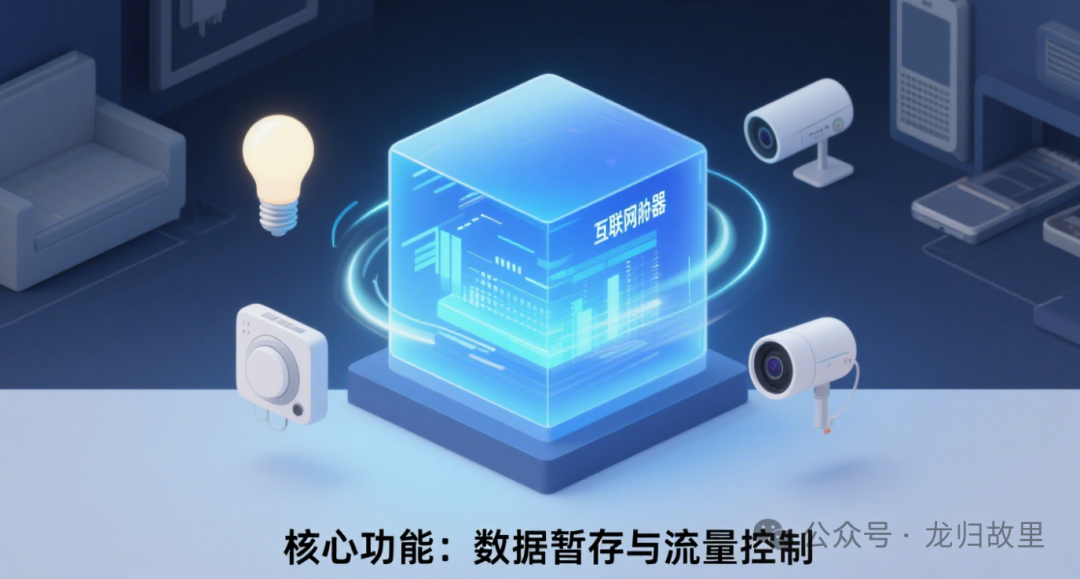
In Internet of Things (IoT) systems, data exchange between devices, gateways, and cloud platforms faces issues such as rate mismatches, network instability, and differences in computing resources. The IoT Buffer serves as a “mediator“ for data flow, temporarily storing and scheduling data to solve the coordination challenges of data transmission and processing, making it a core component for ensuring system stability and reliability.
1. Core Functions of IoT Buffers
The core value of IoT buffers lies incoordinating the imbalance between data production and consumption, with specific functions including:
1.Data Temporary Storage and Buffering
Temporarily storing real-time data generated by sensors and terminal devices (such as temperature, vibration, location, etc.) to prevent data loss due to network interruptions or cloud processing delays. For example, an outdoor weather sensor collects data every 100ms, but the network only supports transmitting 10 data points per second; the buffer can temporarily store excess data and send it gradually according to network capacity.
2.Traffic Smoothing and Rate Limiting
When devices report data in bulk (such as batch status synchronization when industrial equipment starts), the buffer can smooth out burst traffic to prevent the gateway or cloud platform from crashing due to overload. By setting a “maximum concurrent transmission rate“, peak data can be spread out over subsequent time periods for transmission.
3.Asynchronous Communication Coordination
Solving the “rhythm differences“ between devices and platforms: for example, low-power Bluetooth devices wake up once an hour to send data, while the cloud needs to process it in real-time; the buffer can temporarily store device data and push it actively when the cloud is free.
4.Data Verification and Preprocessing
Some buffers integrate lightweight computing capabilities to perform format verification on temporarily stored data (such as filtering out outliers), compression (such as converting JSON format to binary), or desensitization (such as removing device privacy information), reducing invalid data transmission.
5.Support for Resuming Interrupted Transfers
When the network connection is restored, the buffer can automatically resume the transmission of data that was not completed before the interruption based on stored metadata (such as data timestamps and transmission status), ensuring data integrity.
2. Typical Use Cases and Detailed Applications of IoT Buffers
1. Industrial Internet of Things (IIoT): Real-time Monitoring and Control
Scenario Characteristics: A large number of sensors (such as vibration sensors and pressure gauges) in factories generate data at high frequencies (millisecond level), but industrial buses (such as Modbus) or 5G networks may experience occasional delays, and edge gateway computing power is limited.
Buffer Usage:
•Deployment Location: Edge gateways with built-in buffer modules (such as memory buffers based on Redis).
•Core Configuration:
◦Capacity Setting: Based on the number of devices (such as 1000 sensors) and data frequency (10 data points / second), configure a buffer space that can store at least 5 minutes of data (1000×10×300=3,000,000 data points).
◦Refresh Mechanism: Use a “First In, First Out (FIFO)” strategy; when the buffer reaches 80% capacity, trigger edge computing nodes to prioritize processing critical data (such as device fault warning signals).
◦Cooperative Logic: The buffer interacts with the PLC (Programmable Logic Controller); when a “temperature threshold exceeded” signal appears in the buffered data, it immediately bypasses the queuing mechanism and directly pushes it to the control system to execute a shutdown command.
2. Smart Home: Device Interaction and Data Synchronization
Scenario Characteristics: Devices in homes (such as smart locks, temperature and humidity sensors, cameras) generate small but diverse amounts of data and rely on unstable networks like Wi-Fi/ZigBee, requiring timely response to commands (such as remote control of locks).
Buffer Usage:
•Deployment Location: Smart home gateways (such as Tuya smart gateway) with built-in lightweight buffers (based on SQLite local storage).
•Core Configuration:
◦Data Classification Storage: Mark “control commands“ (such as unlocking, turning on lights) as high priority and store them in a separate buffer queue (for priority transmission); mark “status reports“ (such as room temperature 25℃) as low priority and send them in batches periodically.
◦Offline Handling: When Wi-Fi is interrupted, the buffer records all operations (such as users turning on lights via a local panel) and synchronizes them to the cloud once the network is restored, ensuring that the APP status is consistent with the device.
◦Example Process: A user sends a APP command to “unlock” → the gateway buffer receives the command→ immediately issues it to the lock→ the lock executes and returns “success“→ the buffer synchronizes the result to the cloud→APP displays the unlock status.
3. Smart City: Traffic Flow and Public Facility Monitoring
Scenario Characteristics: Devices such as intersection cameras and streetlight sensors are widely distributed, relying on public network transmission, and data peaks are concentrated (for example, during rush hour, over 1000 vehicle recognition images are generated per second), putting pressure on cloud processing.
Buffer Usage:
•Deployment Location: Distributed buffer clusters deployed at regional edge nodes (such as street-level edge servers) (e.g., Kafka).
•Core Configuration:
◦Sharded Storage: Buffer partitions divided by region (such as east city and west city) to avoid overload on a single node.
◦Data Lifecycle Management: Set the buffer duration for traffic images to 24 hours (for post-event tracing), while real-time traffic statistics data is only buffered for 5 minutes (for real-time pushing to traffic signal control systems).
◦Traffic Control: When cloud processing capacity is saturated, the buffer automatically triggers “degraded transmission“ (such as only sending vehicle counts instead of complete images), and once the cloud is free, it will supplement high-definition data.
4. Medical IoT: Vital Sign Monitoring
Scenario Characteristics: Devices such as heart rate monitors and blood glucose meters in hospitals continuously generate high-priority data, and data loss may lead to medical risks, while also needing to comply with privacy protection regulations (such as HIPAA).
Buffer Usage:
•Deployment Location: Local embedded buffers in medical devices (such as non-volatile storage based on Flash) + gateway encrypted buffers.
•Core Configuration:
◦Redundant Backup: Local buffers and gateway buffers synchronize bidirectionally to prevent data loss due to device power outages.
◦Priority Classification: Mark emergency data such as “sudden heart rate drops” as P0 level, triggering immediate push (via 5G slice networks); routine data (such as hourly blood glucose values) is marked as P2 level and transmitted in batches hourly.
◦Privacy Protection: The buffer has a built-in encryption module (such as AES-256), and all temporarily stored data is encrypted, only decrypted when transmitted to the hospital’s internal network.
5. Agricultural IoT: Field Environment Monitoring
Scenario Characteristics: Agricultural sensors (soil moisture, light intensity) are mostly battery-powered, requiring low-power operation, and rely on long-distance but low-bandwidth networks like LoRa, with long data transmission intervals (such as every 30 minutes).
Buffer Usage:
•Deployment Location: Built-in micro-buffers in sensors (based on EEPROM) + base station-level buffers.
•Core Configuration:
◦Low Power Optimization: The sensor buffer only wakes the RF module to send data after accumulating 10 data points, reducing standby power consumption (extending battery life to over 3 years).
◦Data Compression: The buffer compresses continuous similar data (such as soil moisture stabilizing at 20%±1%) (such as only storing averages and time intervals), reducing transmission volume.
◦Resume Interrupted Transfers: The base station buffer records the timestamp of the last successful transmission from the sensor, and when the sensor reconnects, it only transmits new data after the breakpoint.
3. Key Selection Factors for IoT Buffers
1.Storage Medium: Memory buffers (such as Redis, suitable for high-frequency real-time data) vs disk buffers (such as SQLite, suitable for large capacity, low power consumption scenarios).
2.Capacity Planning: Must be calculated based on the number of devices, data frequency, and maximum disconnection duration (buffer capacity = number of devices × data frequency × maximum disconnection time ×1.2 redundancy factor).
3.Reliability: Industrial / medical scenarios must support power failure protection (such as using UPS or non-volatile storage) to avoid data loss.
4.Cooperative Capability: Must seamlessly integrate with edge computing and cloud platforms (for example, buffers that support MQTT protocol can directly connect to AWS IoT Core).
Although IoT buffers are “intermediate components“, they directly determine the data integrity, response speed, and stability of the entire system. In actual deployment, it is necessary to choose appropriate buffering strategies based on scenario characteristics (such as data priority, network conditions, and device capabilities) to maximize the value of IoT systems.
IGBT (Insulated Gate Bipolar Transistor) Function Usage and Application Scenarios ExplainedIoT Component Rectifier Bridge: From Basic Functions to Smart Scene Energy HubsIoT Component Transformer Functions, Usage, and Application ScenariosIoT Power Conversion DevicesCore IoT Components MOS Devices: From Smart Sockets to Medical Devices, Analyzing Their Full-Scene ApplicationsBuzzer: The Guardian of Safety in the IoT EraIntroduction to IoT Component Connectors and Their Functional Usage Scenarios