Account Name: Cat Brother Recently, Cat Brother attended the UNLOCKED summit held by Arm in Shanghai, where the brand new Arm Lumex Compute Subsystem (CSS) was officially released. For those interested in the mobile phone industry, this update is definitely worth discussing!What is Lumex CSS? In Cat Brother’s words, it is a complete “all-in-one package” prepared by Arm for chip manufacturers—featuring the new C1 series CPUs, G1 series GPUs, inter-core bus design, and other peripheral IPs all bundled together. The significance of this “one-stop service” is that it allows small and medium-sized manufacturers to quickly ride the wave of high-performance mobile chips. After all, developing an architecture from scratch is too costly; directly purchasing Arm’s official solutions is both worry-free and cost-effective!However, it is important to note that Lumex CSS is not a complete SoC solution. Key components like baseband and power management still need to be handled by the manufacturers themselves, so those who think they can create mobile phone chips just by buying a CSS can take a break.That said, the breakthroughs in performance from this new IP combination have certainly caught Cat Brother’s attention.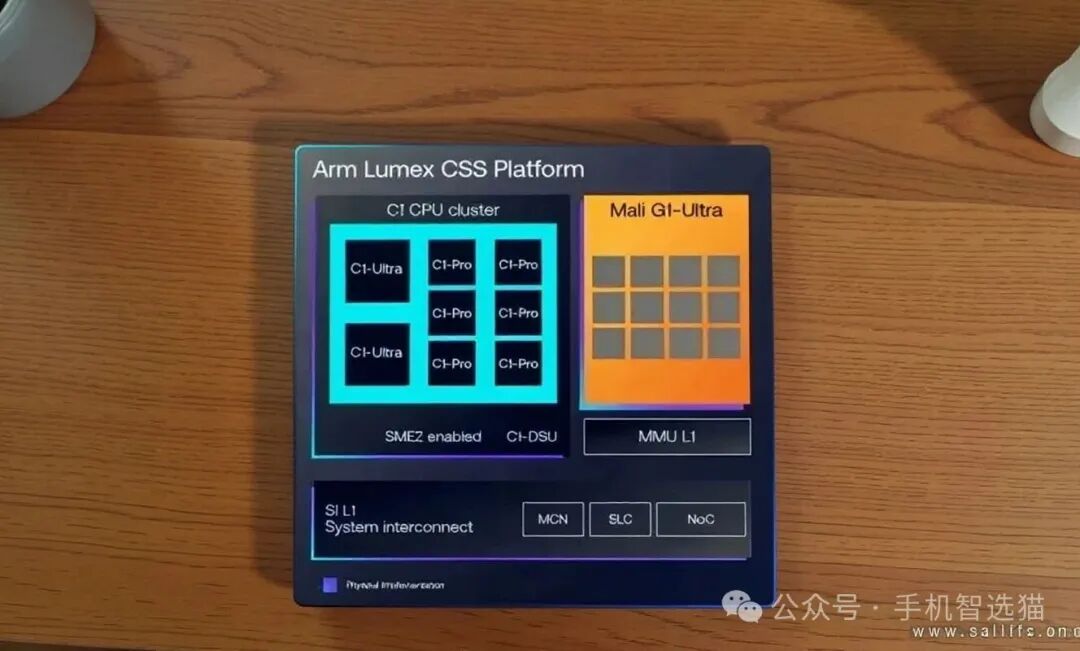 A Major Overhaul in Naming System, Emphasizing Simplicity The naming logic for this generation of Arm’s new products can be described as “returning to simplicity.” The CPU family directly presentsC1-Ultra, C1-Premium, C1-Pro, C1-Nano in four tiers, making it clear from flagship super cores to entry-level small cores. Especially with the previous “X925 big core” now renamed to C1-Ultra, the positioning is instantly clear. Interestingly, C1-Premium seems to have officially incorporated the “X4m sub-flagship big core” that MediaTek played with, indicating that Arm aims to capture the segmented market more precisely this time.On the GPU side,Mali G1 series also categorizes by core count, allowing combinations from 1 to 24 cores, corresponding to G1-Ultra, G1-Premium, and G1-Pro levels. Although specific grading standards have not been announced yet, the flexibility indicates that manufacturers will find it easier to create differentiated chips with precise specifications in the future.Performance Improvement is the Main Dish, but Timing is a Bit Subtle First, let’s look at the hard data for the CPU—C1-Ultra shows a 12% increase in IPC compared to the previous X925, with architectural efficiency improving by 26%. However, Arm has not disclosed specific data for the sub-flagship C1-Premium, leading Cat Brother to speculate that either the improvement is not impressive enough, or they want to leave some “creative space” for manufacturers.In contrast, the mid-rangeC1-Pro provides three solid data points: 26% energy savings at equivalent performance, 11% speed increase at equivalent power consumption, and a 16% performance boost at the same frequency. This indicates that while the new architecture may consume slightly more power, the energy efficiency ratio remains profitable. As for the small coreC1-Nano, although performance has only increased by 5.5%, energy efficiency has improved by 26% and it supports a new instruction set, making it a solid “energy-saving expert”.On the GPU side,G1-Ultra sees a 20% performance increase while single-frame power consumption decreases by 9%. However, due to the overall increase in computing power, total power consumption has actually risen by 9.2%. Fortunately, ray tracing performance has doubled, so when playing mobile games with ray tracing, the frame rate increase may exceed expectations!Flagship Devices Are More Powerful, but Small Screen Users Should Be Cautious According to Arm’s blueprint, next year’s flagship SoC will likely be a combination ofdual C1-Ultra + six C1-Pro. If manufacturers add two C1-Premium chips, the benchmark scores might skyrocket. However, Cat Brother must remind everyone that although IPC has increased, considering that manufacturers will likely continue to raise the clock frequency, the peak power consumption of flagship devices is expected to rise as well.But don’t panic! In daily use and gaming scenarios, thanks to the improved architectural efficiency, the actual operating frequency may be lower, potentially leading to better battery life. The real concern is for those low-end devices usingC1-Nano—with limited performance improvements and now even flagship platforms starting to abandon small cores, future software optimization may be “slacking off.” The neighboring Apple Watch has long stopped using pure small cores, and the “retirement wave” of small cores in low-power devices may be just around the corner.From Cat Brother’s perspective, this update from Arm seems to set a new benchmark for the industry: large manufacturers can continue to develop their own architectures, while small and medium-sized manufacturers now have the confidence to “overtake on the curve.” As for us consumers, we can just wait for next year’s new flagships to show off their muscles!