Recently, a major news story in the tech world is that Nvidia is set to acquire ARM, confirming months of rumors and causing a significant stir.
In the field of computer processors, Intel, Nvidia, and ARM have traditionally coexisted, each managing their own business segments. Intel dominates the traditional CPU market; Nvidia’s GPUs are the best choice for deep learning; and ARM CPUs are found in nearly all low-power electronic products. According to the current division of labor, a “Three Kingdoms” scenario could unfold, achieving a “three-body” balance.
If Nvidia successfully acquires ARM, then both the “training” and “deployment” processors in the field of artificial intelligence will belong to Nvidia. This is enough to send adrenaline surging among Nvidia’s shareholders, who are extremely excited. However, it is well known that technological monopolies are not beneficial, which is why many countries, including the United States and China, have antitrust laws. I believe the U.S. government will not invoke antitrust laws to block this acquisition. Technology knows no borders; if a monopolistic company can exploit other countries, why not? This is also the reason why investigations into monopolies involving companies like Google and Facebook have stalled.
This acquisition is not only detrimental to the technological ecosystem but also to the development of technology in China, as ARM will transition from a British company to an American one. What should we do? Even if this acquisition ultimately fails, it serves as a wake-up call. As many tech professionals suggest, the open-source instruction set architecture RISC-V is our solution.

I had heard of RISC-V long before, but my true understanding of RISC-V began in December 2019. In December 2019, Vadim Pisarevsky, who had been the head of the OpenCV technical team for 20 years, resigned from a high-ranking position at Intel and moved to Shenzhen to work full-time. I invited him to work in Shenzhen because the city has a large number of robotics and smart electronics companies, and OpenCV needs to closely integrate with the industry to gain support and give back to it. Based on this, we hit it off and established the OpenCV China team with the support of the Shenzhen Institute of Artificial Intelligence and Robotics. The strategy of the OpenCV China team is “OpenCV on Edge”.

Once Vadim settled in Shenzhen, he proposed the first development plan for the OpenCV China team: OpenCV should support RISC-V from the application software level. The reason is:ARM is gradually approaching a monopolistic position and may impose harsh requirements on customers in the future; as open-source software, OpenCV should actively support open-source architectures. Vadim is a humble and gentle technical expert, and looking back now, his insight is admirable. The issue we face is not whether ARM is monopolistic, but the terrifying monopoly of ARM+Nvidia.
We immediately took action and joined the “China Open Instruction Ecosystem (RISC-V) Alliance.” Thanks to the alliance’s secretary-general, Researcher Bao Yungang from the Institute of Computing Technology, Chinese Academy of Sciences, Vadim participated as the only foreigner in the alliance’s annual meeting in January 2020 and gave a keynote speech, announcing OpenCV’s support for RISC-V from the application software level. For more details, please click “Vadim Pisarevsky Invited to Attend the China RISC-V Alliance Annual Meeting and Give a Report.”
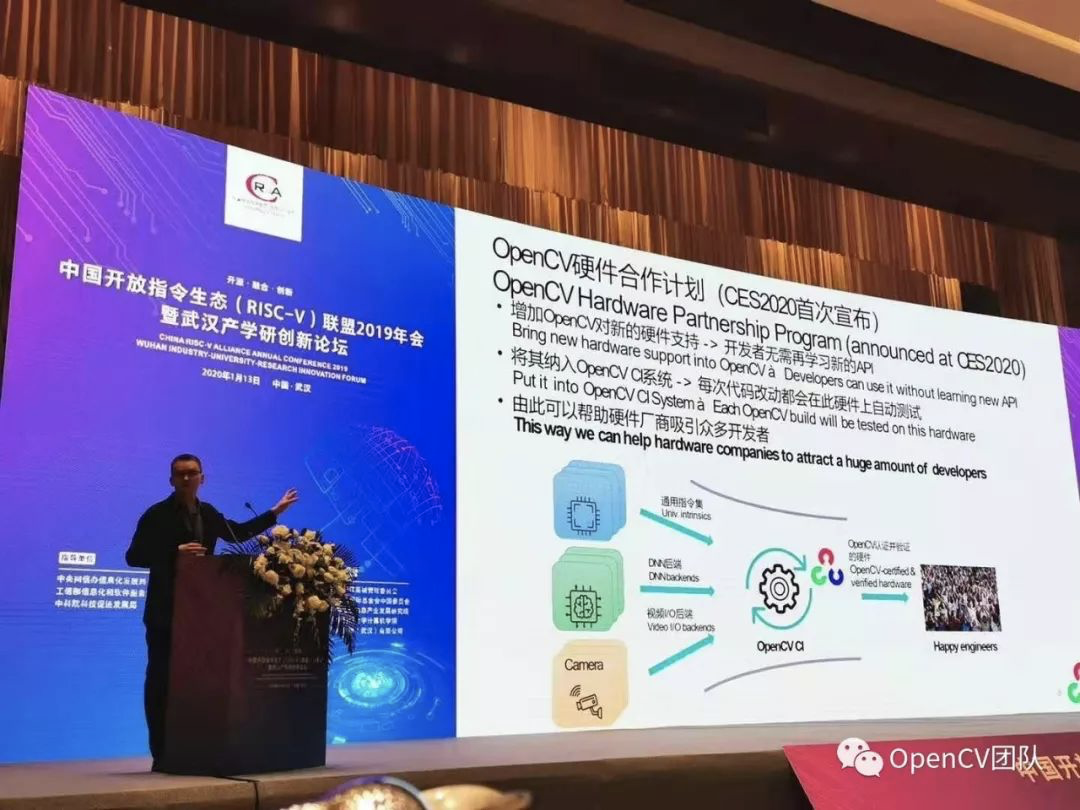
Now, the OpenCV China team has collaborated with Professor Xing Mingjie from the Software Institute of the Chinese Academy of Sciences to add RISC-V instruction support to OpenCV and optimize its efficiency on RISC-V. The high efficiency of OpenCV is due to a set of custom SIMD instructions called universal intrinsics, which can provide suggestions for the RISC-V instructions under discussion, and RISC-V can, in turn, enhance OpenCV’s universal intrinsics. In other words, we are proposing some SIMD instruction suggestions based on application needs to optimize the RISC-V standard. We are also collaborating with domestic companies related to RISC-V and welcome more research teams and enterprises to join!
The times have changed; open-source is a trend, a new “ism,” and a spirit. This spirit encourages contribution, ensures the unobstructed transmission of knowledge, and grants everyone the right to access knowledge. The open-source movement is like water (be water), rendering hegemonic blockades ineffective and shaping the business rules of modern society. Should we, as technology workers, reconsider our work from this perspective?

Webinar 1: OpenCV Overview
Webinar 2: Acceleration of OpenCV DNN on ARM
Webinar 3: Analysis of OpenCV Deep Learning Applications and Principles
Webinar 4: Google Programming Summer Camp 2020 OpenCV Text Recognition Project Development Sharing

The OpenCV China team was established in September 2019 with the support of the Shenzhen Institute of Artificial Intelligence and Robotics, for non-profit purposes, dedicated to the development, maintenance, and promotion of OpenCV.
Long press the QR code below to follow us for the latest updates