“The application scenarios of artificial intelligence have permeated various industries and will further reshape the cloud ecosystem. At the same time, we are entering a new era of Agent AI—systems that can operate autonomously on-site and achieve real-time responses. This industry is continuously expanding the application boundaries of artificial intelligence computing, while also raising higher demands for efficiency and latency,” said Chris Bergey, Senior Vice President and General Manager of the Edge Business Unit at Arm, in an interview during Arm Unlocked in Shanghai.
As he mentioned, with the scale of AI model parameters jumping from millions to trillions, the demand for computing power and memory bandwidth is growing exponentially. Even top-tier data centers are facing severe challenges in power consumption and heat dissipation. For mobile terminals with limited space and battery capacity, this pressure is even more pronounced. How to support the rapidly developing artificial intelligence applications within a limited power budget has become a critical question for the entire industry.
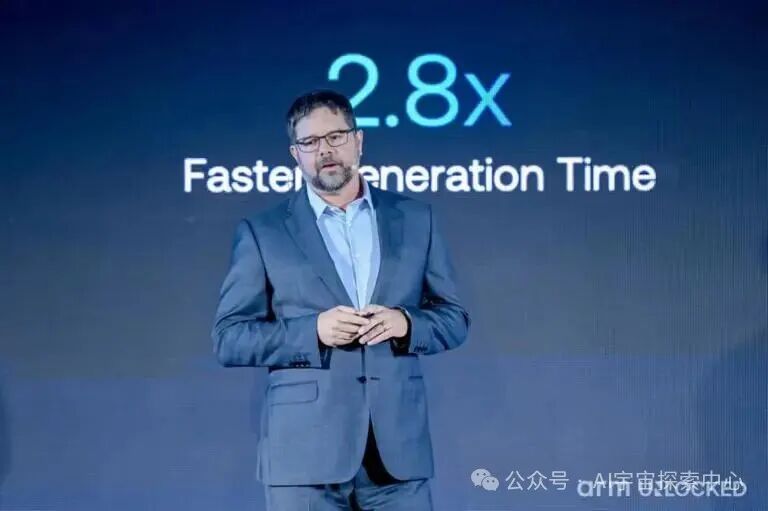
In response to this industry trend, Arm has officially launched the new Arm Lumex CSS platform. As a computing platform specifically designed to accelerate AI experiences for flagship smartphones and next-generation personal computers, the Lumex CSS platform leverages the Arm C1 CPU cluster equipped with the new SME2 technology, achieving up to five times the AI performance improvement.
According to Bergey, AI is currently driving a profound transformation in global industry patterns: traditional data centers are transitioning to “AI data centers” to optimize the adaptation for foundational model training and large-scale inference; automobiles are evolving from “software-defined” to “AI-defined,” upgrading in perception, automation, and personalized experiences; smartphones and PCs are becoming “AI companions” or “AI workstations,” integrating into users’ thinking, work, and creation; and the Internet of Things is becoming the “AI-enabled edge,” empowering devices like sensors and cameras. “These scenarios have extremely high requirements for performance, latency, power consumption, and flexibility.”
To help partners cope with the continuously evolving AI computing demands, Arm is constantly upgrading its product system: from IP to computing subsystems (CSS), and then to an “AI-first” computing platform. This “platform-first” product strategy integrates high-performance CPU/GPU hardware, KleidiAI software tools, and integrated libraries, creating an end-to-end platform from chips, software to tools. Based on excellent performance, energy efficiency, and scalability, this platform can significantly accelerate the product integration process for customers, reduce R&D complexity, and mitigate large-scale deployment risks, fully meeting diverse AI application scenarios.
Specifically for the smart terminal industry, to further empower partners, Arm has launched the new Arm Lumex CSS platform. “The Lumex CSS platform integrates the highest performance Arm CPU, GPU, and system IP equipped with second-generation Scalable Matrix Extension (SME2) technology, which not only helps ecosystem partners bring AI devices to market faster but also supports a variety of rich experiences such as desktop-level mobile gaming, real-time translation, intelligent assistants, and personalized applications,” said Bergey.
It is worth mentioning that SME2 can significantly enhance the response speed and operational efficiency of devices, while also unleashing AI-driven functionalities that traditional CPUs cannot achieve. Bergey cited an example where running a neural camera noise reduction function on a single core equipped with SME2 can achieve over 120 frames per second (fps) at 1080P resolution, or reach 30 fps at 4K resolution. This allows smartphone users to capture sharper and clearer images even in the darkest scenes, resulting in smoother operational interactions and richer user experiences on everyday devices.
Source | Global Network