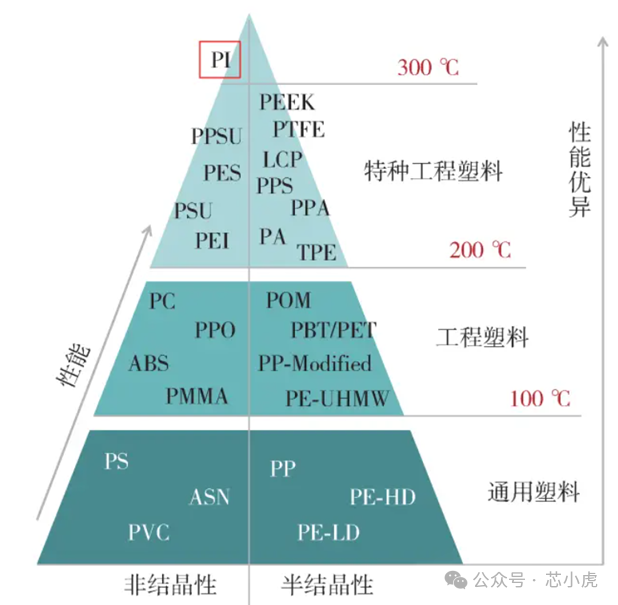
Hello, everyone! Today, let’s talk about a special material: the fighter jet of plastics—Polyimide (PI).
I won’t go into too much detail about the characteristics of Polyimide (PI); you can refer to previous materials:
Why Polyimide (PI) is Widely Used in High-End Semiconductor Fields
The Industrial Chain of Polyimide (PI)
1) Upstream
Binary anhydride PMDA, binary amine ODA, and other raw materials. The upstream part of special PI monomers has been localized, and the raw materials for PI films are PI monomers and PI slurries. PI monomers include dianhydride monomers and diamine monomers.
2) Midstream
PI films have excellent properties and are widely used in downstream applications. The product forms of Polyimide include films, foams, fibers, photosensitive Polyimide, and Polyimide-based composites, among which PI films account for over 70%, making them the most important product form in the Polyimide industry. The manufacturing of PI films involves production processes such as resin polymerization, casting, uniaxial stretching, imidization, and post-processing.
Applications of various types of PI films: thermal control PI films (high thermal conductivity graphite film precursor PI films), electronic PI films (PI films for electronic substrates, PI films for electronic printing), electrical PI films (corona-resistant PI films, Class C electrical PI films), aerospace PI films (Polyimide composite aluminum foil MAM).
3) Downstream
Common substrate films for FCCL include Polyimide films (PI), polyester (PET), polyethylene naphthalate (PEN), and liquid crystal polymer (LCP) among other polymer materials.
FPC, or flexible PCB, is mainly composed of eight categories of raw materials including flexible copper clad laminate (FCCL), cover films, components, shielding films, adhesive tapes, steel sheets, plating additives, and dry films, with flexible copper clad laminate (FCCL) being the most important substrate for producing FPC, accounting for 40%. All processing steps for FPC are completed on FCCL. Global FCCL production capacity is mainly concentrated in Japan, mainland China, South Korea, and Taiwan, with mainland China accounting for 21%, ranking third. FPC is made from Polyimide (PI) or polyester (PET) films as substrates, offering significant advantages over traditional rigid PCBs, such as high production efficiency, high wiring density, lightweight, thinness, foldability, and three-dimensional wiring, making it more aligned with the trends of intelligence, portability, and thinness in the downstream electronics industry. It can be widely used in aerospace, military, mobile communications, laptops, computers, digital cameras, and other fields or products, and is the fastest-growing category in the PCB industry in recent years.
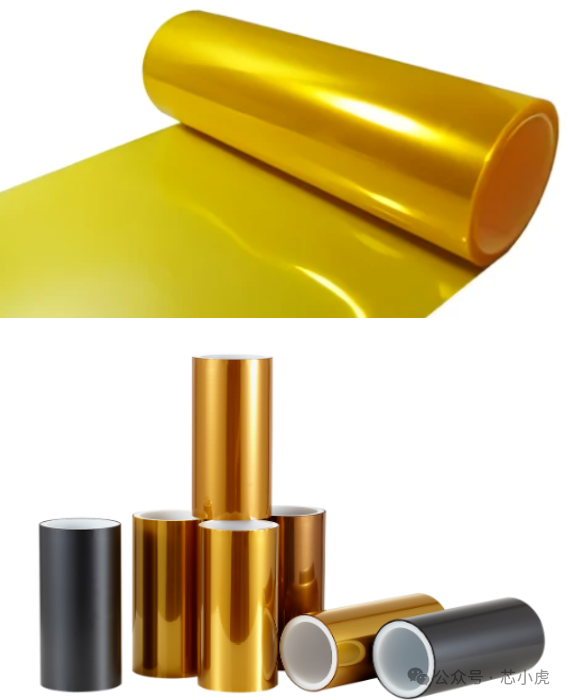
Application Scenarios of Polyimide (PI)
1) Growth in the Output Value of Flexible Circuit Boards (FPC) Promotes Continuous Expansion of the Electronic Grade PI Film Market
Flexible copper clad laminate (FCCL) is an important substrate for manufacturing flexible circuit boards (FPC). The global FCCL market size grew from $2.64 billion in 2014 to $4.48 billion in 2019. The demand for electronic grade PI films, as the main raw material for FCCL, has increased in tandem with FCCL, with global demand for PI films in the FCCL industry reaching 14,877.5 tons in 2019, and domestic demand reaching 4,869.0 tons. From the perspective of FPC output value, domestic FPC output value grew from 29.07 billion yuan in 2014 to 52.60 billion yuan in 2020, with a compound annual growth rate of 10.4%. The development of new electronic products downstream has injected new growth momentum into the FPC industry, with FPC output value expected to grow to 54.44 billion yuan in 2021, promoting continuous expansion of the electronic grade PI film market.
2) Rapid Development of Commercial Aerospace and Flexible Screens Drives Continuous Growth of the Special Grade PI Film Market
In the aerospace field, PI films are used as rocket protection materials due to their excellent weather resistance and radiation resistance. In 2019, the market size of the entire commercial aerospace industry chain exceeded 800 billion yuan, with a compound growth rate of 22.1%. Since the raw material cost of single-launch rockets can account for 35% of the total cost, the localization of raw materials will significantly reduce manufacturing costs, thereby promoting the growth of special grade PI films. In the flexible screen field, flexible CPI films are the screen cover materials used by most foldable phone manufacturers. As flexible displays continue to be commercialized, foldable phones are gradually becoming a new form of mobile phones. According to relevant forecasts, global shipments of foldable phones will reach 45.3 million units by 2024, with domestic shipments reaching 13.2 million units, while flexible covers, as the core component of foldable phones, will drive continuous growth of special grade PI films.
3) Rapid Momentum in Consumer Electronics Leads to Greater Demand for Thermal Conductive Grade PI Films
Thermal conductive graphite films are downstream products of thermal conductive grade PI films, mainly used in LED substrates, electronic component heat dissipation, etc., and are currently the mainstream heat dissipation materials used in the consumer electronics industry. In recent years, the domestic market size for thermal interface materials has gradually expanded, growing from 660 million yuan in 2014 to 1.27 billion yuan in 2020, with a compound growth rate of 9.9%. The drive of 5G technology will bring greater demand space for thermal conductive grade PI films.
4) Steady Growth in the Wind Power and High-Speed Rail Industries Expands the Scale of the Electrical Grade PI Film Industry
Electrical PI films are mainly used in high-grade insulation systems for variable frequency motors, generators, etc., ultimately applied in wind power generation and high-speed rail transportation. In the wind power industry, China is the largest wind power development market globally, with a cumulative installed capacity of 282 GW by the end of 2020, a year-on-year increase of 34.3%, accounting for 36% of the global cumulative installed capacity. Against the backdrop of advocating new energy, with the localization of the wind power industry chain, electrical PI films will have broader market prospects. In the high-speed rail transportation industry, China has the largest operational mileage of high-speed rail globally, accounting for over 60%.
If you have any comments or suggestions, feel free to leave a message or send a private message. If there are any inaccuracies, please feel free to point them out; I am also learning and growing.

*Disclaimer:This article is created by the original author. The content of the article represents their personal views, and our reprint is only for sharing and discussion, not representing our endorsement or agreement. If there are any objections or infringements, please contact us for deletion! Source: Internetmoqiehome
▌⊰Related Knowledge Navigation ⊱
Process Flow Diagram of CMOS in Semiconductor Manufacturing
What is Q-Time in Intelligent Manufacturing?
How to Understand Process Flow in Semiconductor Intelligent Manufacturing
What Stages Must a Semiconductor Chip Manufacturing FAB Go Through to Achieve Full Automation?
In batch operations, when does a semiconductor FAB use Lot? When does it use Batch?
▌Click on “Chip Little Tiger” below to follow me, and click the upper right “Set as Star” to share more chip knowledge and news
▌If you like it, please “like” + “look” ✿, thank you
▌For learning, communication, and cooperation, please scan the following to add, please note your name + position + company, thank you!

▌Semiconductor Industry Information Database, dedicated to those in need, thank you!