Click the star and follow ⭐️ to not miss exciting content
NB-IoT will not suddenly disappear, but will gradually retreat to specific niche areas. NB-IoT, Cat-1, LoRa, and RedCap will form a diversified pattern of “governance by division” in different scenarios and regions.
NB-IoT (Narrowband Internet of Things) was once regarded as a star technology in the IoT field, with expectations placed on its low cost, low power consumption, and wide coverage. The GSMA predicted that by 2025, 5G connections would only account for 14% of all cellular IoT connections, while NB-IoT and eMTC would remain the main carriers of IoT connections for a long time. However, in recent years, the popularity of NB-IoT has rapidly declined, with shipments experiencing negative growth for two consecutive years. Meanwhile, major global operators have shifted towards LTE-M, 5G RedCap, and satellite connections, prompting widespread industry discussions about the future development of NB-IoT—Is the outlook for NB-IoT concerning?
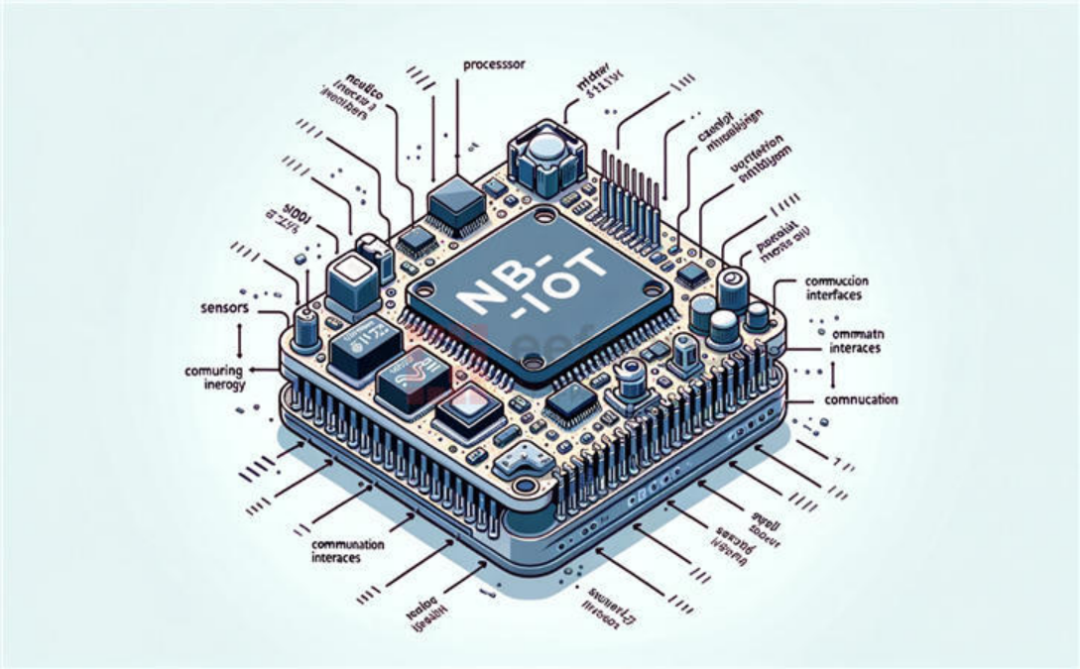
Image source: AI generated

What is NB-IoT?
NB-IoT is a low-power wide-area network (LPWAN) technology standardized by 3GPP, specifically designed for IoT applications. This technology utilizes narrow bandwidth (approximately 180 kHz, equivalent to 1/8 of a GSM channel) for communication, based on cellular networks and OFDM technology, simplifying and optimizing certain LTE characteristics while providing four core advantages: low power consumption, wide coverage, large capacity, and low cost.
In terms of applications, NB-IoT primarily targets scenarios such as remote metering, smart agriculture, smart parking, and smart tracking. These applications are characterized by small data volumes, a large number of devices, wide distribution, and sensitivity to power consumption. NB-IoT can be deployed on existing LTE networks or operate on dedicated networks, supporting smooth evolution, and thus has been widely applied in smart homes, wearable devices, smart cities, and intelligent transportation.
Its technical characteristics are reflected in the following aspects:
Ultra-low power consumption: Through energy-saving mechanisms such as PSM (Power Saving Mode) and eDRX (Extended Discontinuous Reception), terminals can enter deep sleep in inactive states, extending battery life to over 10 years. Typical sleep currents can drop to microamp levels, with some chips even below 1μA; during transmission, active currents typically range from 150 to 180mA, with peaks exceeding 300mA.
Wide coverage: Relying on narrowband transmission and retransmission mechanisms, NB-IoT’s link budget improves by about 20dB compared to traditional cellular systems, enabling coverage in signal blind spots such as basements and parking lots, making it suitable for IoT deployments in complex environments.
Data rate: NB-IoT is designed for low-rate, small data packet transmission. The downlink rate defined in 3GPP Release 13 is approximately 27kbps, and the uplink is 62.5kbps, with subsequent Releases 14/15 increasing downlink and uplink rates to 20-250kbps. Although actual application rates may be lower than theoretical values due to network conditions, they are sufficient to support metering and sensor data reporting needs.
Massive connectivity: NB-IoT supports tens of thousands or even hundreds of thousands of devices connecting simultaneously in a single cell through optimized channel structures and simplified signaling, meeting the connectivity needs of massive IoT terminals.

A Review of the Development History of NB-IoT
The origin of NB-IoT can be traced back to 2013 when Vodafone and Huawei began researching a new generation of narrowband communication standards, initially called NB-M2M.2014 was a key year for technological development: Huawei and Vodafone formally proposed the NB-M2M solution, and 3GPP initiated the “Cellular IoT” project, with the GERAN research group also including IoT in its agenda. Huawei acquired the UK company Neul that year and started chip development, laying the foundation for future leadership.
In 2015, NB-IoT entered the stage of technical integration and standardization. At that time, multiple solutions such as NB-M2M, NB-OFDMA, NB-CIoT, and NB-LTE coexisted, posing a risk of fragmentation. After several rounds of discussions, in May 2015, NB-M2M and NB-OFDMA merged into NB-CIoT, while NB-LTE was promoted by companies like Ericsson, ZTE, and Nokia. In July, NB-CIoT and NB-LTE merged to form a unified NB-IoT standard. In September, at the 3GPP RAN69 meeting, 3GPP officially named NB-IoT and passed resolutions such as “New work item: Narrowband IoT (NB-IoT)”, confirming its inclusion in the Rel-13 version, thus establishing a global unified standard.
2016 was the commercial launch year for NB-IoT. In June, at the 3GPP RAN 72 meeting held in Busan, South Korea, working groups RAN1 to RAN4 completed the freezing of the NB-IoT standard. Subsequently, the NB-IoT conformance testing standard was also completed in December of that year. During this period, Huawei and Vodafone opened the world’s first NB-IoT strategic laboratory and released the first commercial chip, Boudica 120. Chinese operators actively deployed NB-IoT, which first landed in scenarios such as water management and smart metering.
From 2017 to 2019, NB-IoT entered the stage of large-scale commercialization. In 2017, China Telecom announced the establishment of the world’s first and most extensive NB-IoT commercial network, while China Unicom built the largest metropolitan commercial network in the world in Shanghai. Huawei deployed over 500,000 base stations, with connections exceeding 10 million. That year, the commercial version of Boudica 120 was launched, further reducing terminal costs. NB-IoT applications expanded from smart metering and smart parking to smart cities, smart homes, and environmental monitoring, with the number of connections reaching 45 million by the end of 2017.
In 2020, NB-IoT was officially included in the 5G standard, marking the synchronization of its lifecycle with 5G, ensuring the long-term evolution of the technology. In 3GPP Rel-14 and subsequent versions, new features such as rate enhancement, improved mobility, and positioning capabilities were added to NB-IoT, continuously expanding its application scope.
By 2025, NB-IoT has become one of the mainstream technologies in the global IoT field, with a sustained high growth in connections, covering applications in smart cities, energy management, environmental monitoring, and more. Huawei and Vodafone have played a key role in technology proposals, standard formulation, laboratory opening, and commercial promotion. Compared to NB-LTE promoted by Ericsson, Nokia, and Intel, the NB-IoT ecosystem is more complete, gathering extensive participation from operators and chip manufacturers such as Qualcomm, Deutsche Telekom, China Mobile, China Unicom, and Bell, forming a complete industrial chain.
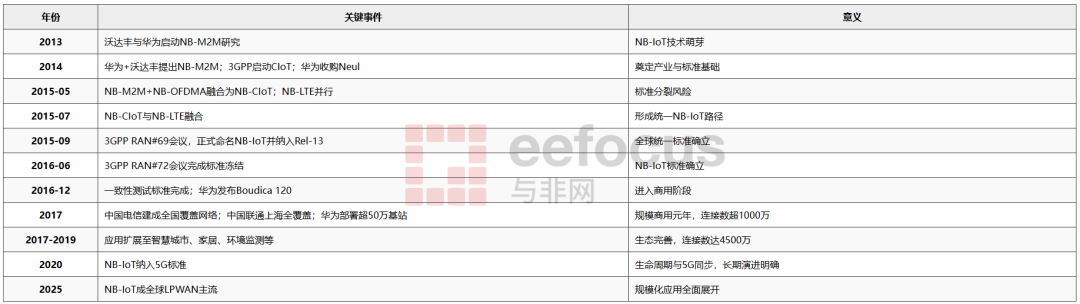
Key milestones in the development of NB-IoT, source: compiled by the Institute of Research
Click to follow and star the Eefocus website,
to receive 20 industry reports and industry research collections.

National Strategies for NB-IoT
In recent years, the global NB-IoT has entered a new stage of coexistence of differentiation and contraction. In policy-driven markets represented by China, coverage and connectivity scale continue to deepen; in market-driven economies represented by the United States, contraction or even withdrawal occurs due to poor commercial returns.
The most direct signal comes from operators’ strategic adjustments: AT&T plans to completely discontinue NB-IoT in the first quarter of 2025, shifting to LTE-M; Japan’s NTT DoCoMo closed NB-IoT as early as 2020; mainstream European operators are reducing new investments, redirecting more resources to 5G IoT and RedCap. The underlying reason is that the single connection ARPU of NB-IoT in Western markets is too low, and the return on investment in dedicated networks is insufficient, while LTE-M/5G RedCap is more attractive in terms of spectrum efficiency, business flexibility, and revenue potential. North America, with AT&T’s withdrawal as a turning point, is pushing existing devices to migrate to LTE-M/future RedCap; Verizon and T-Mobile still retain NB-IoT to cover ultra-low power long-life segments, but overall present a coexistence of multiple standards and value stratification. Europe maintains a “steady operation + value exploration” approach, with Vodafone, Deutsche Telekom, and others shifting from “network deployment” to “deep commercialization”, expanding cross-border roaming, adding industry solutions, and attempting to collaborate with 5G. Emerging markets (Latin America, Africa) view NB-IoT as a tool for low-cost coverage and rapid entry, focusing on agriculture, public utilities, and asset management, with the ecosystem still in cultivation but showing considerable growth momentum.
Entering 2025, regulatory logic shifts from “promoting a single technology” to “governing the entire IoT ecosystem”. The EU reshapes market order with technology-neutral horizontal regulations: data laws regulate industrial data access and sharing; RED coordination standards impose mandatory cybersecurity baselines on wireless products (such as banning default passwords); battery laws, RoHS, and REACH raise compliance thresholds for hardware and supply chains. Australia has also established a consumer IoT security baseline through the “Smart Device Security Standards”. These rules are not specifically aimed at NB-IoT, but have far-reaching impacts on its terminal design, platform data, and cross-border deployment, marking a maturity upgrade in policy.
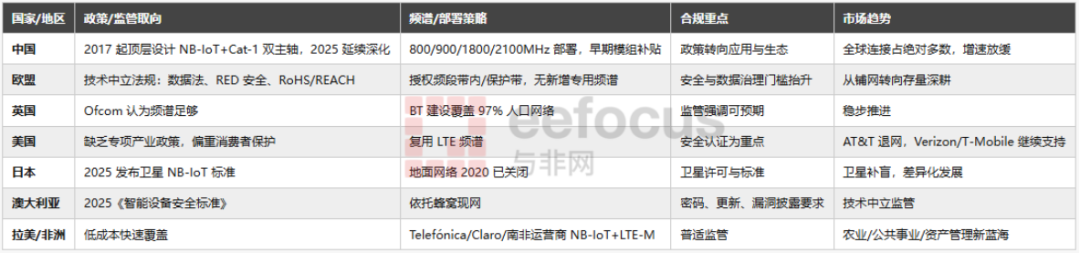
Comparison of NB-IoT policies in various countries, source: compiled by the Institute of Research
China occupies an overwhelming share (over 80% of connections) in the global NB-IoT ecosystem, forming a closed loop of “policy endorsement + scale effect + complete industrial chain”. Since 2017, the Ministry of Industry and Information Technology has clearly defined the “dual-axis” route of NB-IoT and 4G (including Cat-1) through top-level design, promoting the migration of 2G/3G IoT, along with early module subsidies and spectrum reallocation (800/900/1800/2100MHz), rapidly establishing a national network and achieving large-scale commercial use in scenarios such as metering, urban governance, and agriculture. However, in the past two years, the growth rate of NB-IoT shipments has slowed, and without new applications to drive it, shipments may stabilize or even decline, indicating a diminishing marginal effect of “policy-driven” growth.
In China’s “high/mid/low-speed collaborative” pattern, NB-IoT and Cat-1 are jointly recognized as the main forces after the retirement of 2G/3G: NB-IoT targets massive, low-power, static scenarios; Cat-1 takes on mid-speed wide-area applications; together with 5G, they form a layered supply. In contrast, LoRa has long been affected by institutional uncertainties in China (such as constraints on 470–510MHz and self-organizing network limitations), making it more suitable for private networks and park-like scenarios, and difficult to compete comprehensively with NB-IoT in public utility fields.
The differentiated paths of the three major operators in China regarding NB-IoT have basically taken shape: China Telecom relies on 800MHz coverage and “cloud-network integration”, leading in public utilities such as water, gas, and heat; China Mobile combines NB-IoT with the OneNET platform, emphasizing an open ecosystem and empowering small and medium enterprises; China Unicom focuses on key cities and industries, creating replicable industry benchmarks. These strategies have collectively promoted the formation of “Chinese scenarios and Chinese scale”, solidifying the domestic full-stack supply capability from chips and modules to cloud platforms.
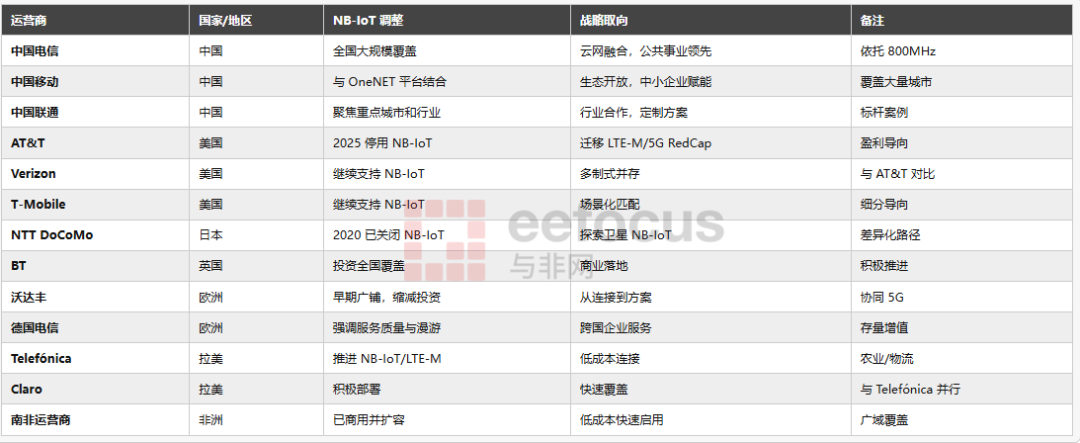
Comparison of major operators’ NB-IoT strategies, source: compiled by the Institute of Research
The author believes that the global positioning of NB-IoT is undergoing “convergence and reshaping”—solidifying its value in irreplaceable ultra-low power, long-life, static massive connection scenarios, yielding to LTE-M/RedCap and other “more monetizable” standards in developed markets, while maintaining scale in emerging markets and policy-driven markets led by China. For China, NB-IoT will shift from “scale expansion” to “deep cultivation and value operation”, with the key being to connect data factor markets with compliance, security, and industry know-how; for overseas markets, NB-IoT will resemble a “structural player”, operating stably in a few high-matching scenarios, and forming a multi-layered IoT connection landscape alongside other standards.
Scan to reply with the keyword “Internet” for industry groups and to receive reports


The Current Status of the NB-IoT Industry Chain and Chip Players
As NB-IoT transitions from a policy-driven rapid expansion phase to an adjustment phase, major chip and module manufacturers are reducing their reliance on single NB-IoT and shifting towards supporting multi-mode solutions. Although NB-IoT has long been included in the 5G standard, it is more of a technological inheritance rather than a focus of evolution, with mainstream equipment manufacturers like Huawei, Ericsson, and Nokia redirecting R&D resources towards 5G IoT. Alongside this, NB-IoT has exposed fragmentation issues in global deployments, with differences in frequency allocation, protocol implementation, and operational strategies across regions significantly increasing the complexity of device manufacturing and applications, making it difficult to achieve economies of scale and further weakening its global competitiveness. In contrast, the Chinese market remains active under the push of policies and industry applications, becoming the most important strategic battleground for NB-IoT.
The completeness of the industrial chain is a significant advantage of NB-IoT. From upstream chips to midstream modules, and then to terminals, operators, and cloud platforms, a relatively stable ecosystem has formed. In the chip segment, in addition to traditional giants, startups like Moxin Communication and Chip Wing Information are also rapidly growing, driving NB-IoT towards high integration and low cost. Modules, as a key segment, are continuously being launched by manufacturers such as Quectel, Fibocom, China Mobile IoT, Youfang Technology, Lierda, and Qijun, offering small-sized modules with main control functions at prices close to 2G modules, becoming important drivers for large-scale applications. Terminal products are currently mainly concentrated in the industry market, such as smart water meters, gas meters, locks, and positioning terminals, and are expected to expand into the consumer market as network coverage improves. In terms of operators, China Mobile, China Telecom, and China Unicom continue to increase NB-IoT network construction, with coverage becoming increasingly comprehensive, and enhancing user penetration through reasonable pricing strategies. On the cloud platform side, Alibaba Cloud, Huawei Cloud, and the three major operators’ own platforms such as OneNET, Tianyi Cloud, and Wo Cloud are all building closed-loop ecosystems, promoting the landing of NB-IoT in vertical industry applications.
According to estimates from the Science and Technology Committee of China Telecom, in the revenue distribution of the NB-IoT industrial chain, chips and terminal segments account for about 20% to 25%, network connections about 12% to 15%, platform services about 10% to 15%, while application solutions account for as high as 50% to 60%, indicating that the real value is more reflected in the application layer. Practices in the Chinese market have also verified this: smart water management, smart gas, smart electric vehicles, and smart fire protection have formed connection scales in the millions, providing stable growth support for NB-IoT.
In the chip segment, Huawei HiSilicon, as a core promoter of the NB-IoT standard, has long led the Chinese market with its Boudica series chips, known for their high performance, low power consumption, and high integration. The new generation of solutions to be released in 2024 will further strengthen its leading advantage. Qualcomm has secured a place globally with its MDM920x series, which supports NB-IoT/eMTC/2G multi-mode communication and features global frequency coverage and GNSS integration, suitable for cross-regional IoT applications. MediaTek has rapidly risen due to its high cost-performance ratio, with its MT2625 chip quickly landing in fields such as smart wearables and asset tracking due to ultra-low power consumption and compact design, promoting the popularization of NB-IoT in the consumer end. The Spring series from UNISOC has gained market share in large-scale scenarios such as smart metering and shared bicycles due to its cost advantages and stable performance, becoming a major competitor to HiSilicon. Nordic Semiconductor has launched the nRF91 series SiP, integrating NB-IoT/LTE-M with GNSS, emphasizing low power consumption and ease of development; ZTE Microelectronics, a subsidiary of ZTE Corporation, has also achieved applications in communication devices and IoT terminals. By 2023, Huawei HiSilicon, Qualcomm, and MediaTek together accounted for nearly 70% of the market share, with the NB-IoT chip market showing an oligopolistic structure.
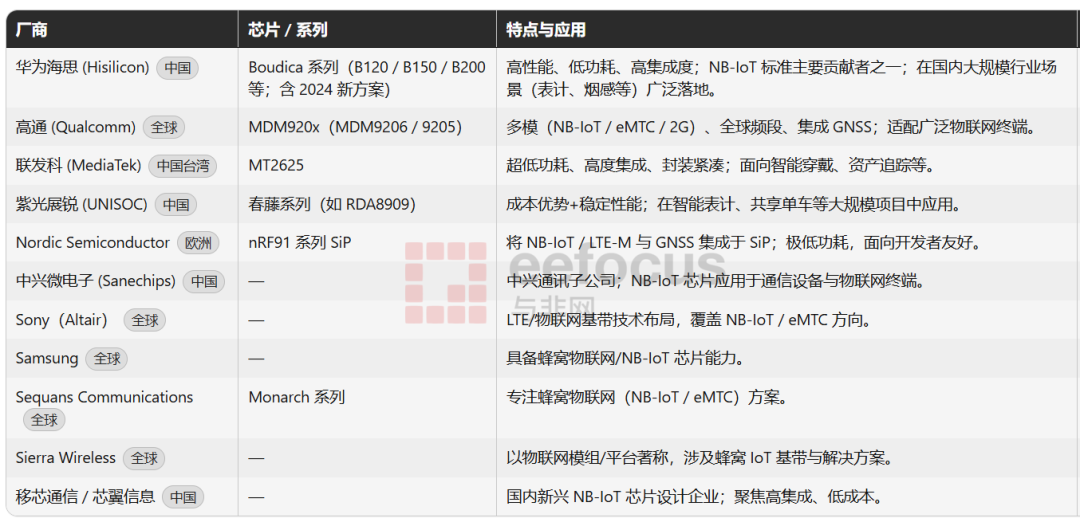
List of mainstream NB-IoT chip manufacturers, source: compiled by the Institute of Research (Note: In 2023, the combined share of Huawei HiSilicon, Qualcomm, and MediaTek is about 70%)

Who Will Replace It? Analysis of Competing Technologies to NB-IoT
In China, NB-IoT has been assigned a national strategic position from the beginning, rapidly achieving large-scale deployment in public utility scenarios such as smart water meters, gas meters, and electric meters under the strong promotion of policies and the three major operators. It can be said that NB-IoT has achieved a decisive leading advantage in domestic cellular IoT connections. As the “national team” of low-power wide-area networks (LPWAN), NB-IoT is designed to meet the needs of low power consumption, wide coverage, large connections, and low cost. Based on operator-licensed spectrum, NB-IoT can provide telecom-grade quality and security guarantees, achieving excellent deep coverage capabilities with a link budget of up to 164dB, allowing stable operation even in areas with poor signal environments such as underground wells and basements. At the same time, its high-density characteristic of supporting 100,000 device connections per sector makes it particularly suitable for projects in smart city construction that require a large number of terminals and high signal penetration.
However, as the industry enters 2025, the rapid rise of alternative technologies is beginning to shake NB-IoT’s position. The Cat-1 technology based on 4G LTE networks is becoming the de facto standard in the mid-speed IoT market. It supports up to 10Mbps downlink and 5Mbps uplink rates, with low latency, VoLTE voice, and mobility capabilities, perfectly filling the gap between NB-IoT (below 1Mbps) and Cat.4 and above technologies (above 10Mbps). More importantly, Cat-1 can directly reuse existing 4G base station resources, requiring no new network construction, resulting in very low deployment costs and time. Against the backdrop of accelerated retirement of 2G/3G networks, Cat-1 has been explicitly designated as the “successor” for mid-speed IoT services, and with its performance and cost advantages, it is rapidly replacing NB-IoT in mid-speed, mobile scenarios such as shared bicycles, POS machines, vehicle-mounted terminals, and wearable devices, facing almost no competition.
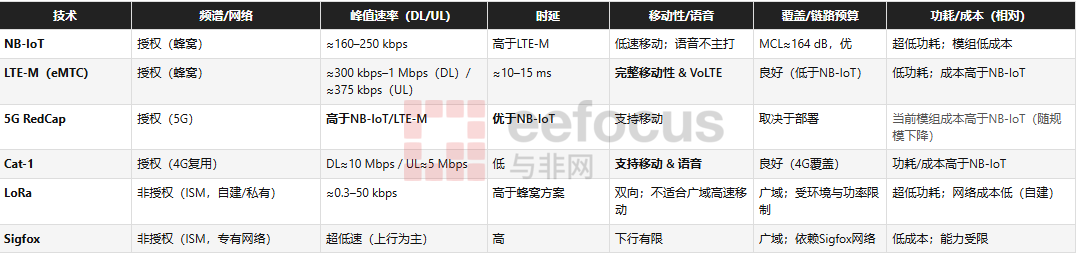
Key indicators comparison of competing technologies to NB-IoT, source: compiled by the Institute of Research
Alongside Cat-1, LTE-M (eMTC) is also accelerating its encroachment into NB-IoT’s market space. LTE-M offers higher data rates (uplink up to 375Kbps, downlink up to 1Mbps), lower latency (10-15 milliseconds), and supports mobility and voice call functions, surpassing NB-IoT across most performance metrics. Although its power consumption and module costs are relatively higher, these disadvantages are diminishing with scaled development. The American operator AT&T has already announced the discontinuation of the NB-IoT network in the first quarter of 2025, shifting to LTE-M, a decision that serves as a global bellwether and highlights the direct competition between NB-IoT and LTE-M in many application scenarios. Meanwhile, 5G RedCap (Reduced Capability), as a lightweight version of 5G, is becoming a focal point of industry attention. It offers higher data rates and lower latency than NB-IoT at a lower cost and complexity than standard 5G NR, making it particularly suitable for mid-speed scenarios such as industrial sensors, video surveillance, and smart wearables. Although the current module costs of RedCap are still higher than those of NB-IoT, its advantages will gradually emerge as the ecosystem matures and scales expand. For many operators that are hesitant or have abandoned NB-IoT, RedCap is undoubtedly an important direction for the evolution of IoT.
In addition to cellular technologies, non-licensed spectrum solutions such as LoRa and Sigfox are also encroaching on NB-IoT’s survival space. LoRa operates in the ISM band, allowing users to build networks at low costs, offering high flexibility and autonomy. Its terminal battery life can last over ten years, and data is entirely controlled by the enterprise itself, making it highly attractive in data-sensitive industries. Although its coverage and rate are not as good as NB-IoT, it remains irreplaceable in scenarios where deployment locations are dispersed, such as smart parks, agriculture, animal husbandry, and industrial monitoring, where there is a desire to avoid ongoing operator fees. Sigfox features ultra-low power consumption and low cost, but its one-way communication capability and ecosystem development limitations significantly reduce its competitiveness compared to LoRa. Overall, NB-IoT, Cat-1, LTE-M, RedCap, and LoRa are forming a pattern of coexistence of division and competition.
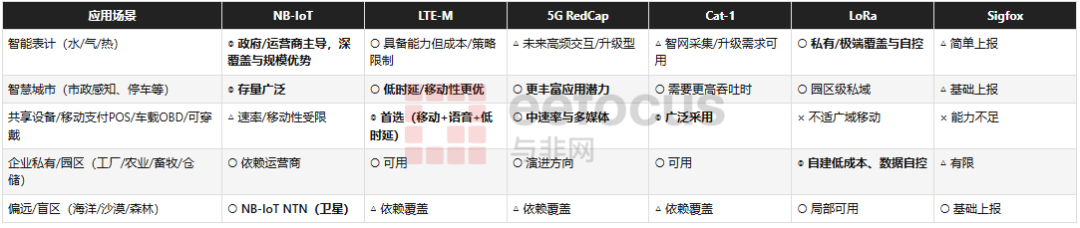
Major application scenarios and comparative analysis, source: compiled by the Institute of Research
In specific application scenarios, this differentiation is particularly evident. Smart metering is the earliest and largest application market for LPWAN technology. NB-IoT has become the preferred choice in urban-level water, electricity, and gas meter renovation projects due to unified operation and telecom-grade guarantees from operators. Predictions indicate that by 2026, the penetration rate of smart meters will exceed 90%, with NB-IoT being a major driving force. However, LoRa, with its self-organizing network and flexible deployment advantages, remains competitive in projects in mountainous areas or those with high coverage and data autonomy requirements, likely resulting in a long-term coexistence ratio of about 7:3 or 8:2 between the two. While Cat-1 does not have advantages in power consumption and cost, it is gradually emerging in scenarios requiring frequent interactions and firmware upgrades, such as grid collection terminals. In mid-speed and mobile scenarios, Cat-1 is almost the only winner, covering widely demanded markets such as shared bicycles, mobile payment POS machines, vehicle-mounted OBDs, and children’s and elderly positioning watches. NB-IoT cannot meet the speed and mobility requirements in these fields, while LoRa is not suitable for wide-area mobility. As for the fragmented enterprise market, LoRa still firmly occupies a place, from agricultural sensors to industrial monitoring, where low-cost privatized deployment and data autonomy make it difficult to replace.

Regional market differences and strategies, source: compiled by the Institute of Research
Regional differences further amplify the differentiation between NB-IoT and other technologies. In China, government top-level design and operator promotion ensure NB-IoT’s leading position, which is almost unshakeable in smart metering and smart municipal fields. However, in overseas markets such as the United States and Europe, operators are more inclined to deploy LTE-M and RedCap, leading to a rapid decline in the presence of NB-IoT, which has become a marginalized role. The resulting situation is that NB-IoT remains a policy-driven king in China, while Cat-1 becomes the fastest-growing successor, LoRa maintains solid survival in the global enterprise market, and RedCap represents the future evolution direction.

Conclusion
NB-IoT will not suddenly disappear
The development history of NB-IoT is a typical product of the interplay between technology and policy. As a key component of the 3GPP standard system for mMTC (massive machine-type communication), it was once expected to “unify the low-power wide-area network of the IoT” and achieved large-scale landing in the Chinese market. With its wide coverage, low power consumption, low cost, and massive connectivity features, NB-IoT has established irreplaceable value in public utility scenarios such as smart water management, gas, street lighting, and smoke detection, becoming a core pillar of China’s IoT infrastructure. However, against the backdrop of diversified global technological evolution, its market position is undergoing dramatic reconstruction.
From a regional perspective, China is the largest “ballast stone” for NB-IoT. The vast connection scale, mature industrial chain, and policy promotion give NB-IoT long-term vitality domestically. However, in North America, AT&T’s announcement to discontinue the NB-IoT network in 2025 and shift to LTE-M and RedCap sends a strong signal: in markets that prioritize commercial logic, the cost-effectiveness and expansion potential of NB-IoT are insufficient to support its independent development. European operators exhibit a pragmatic attitude, preferring to continue utilizing existing networks in the stock market while cautiously observing new generations of IoT technologies. Emerging markets, due to their sensitivity to cost and coverage, still maintain high interest in NB-IoT, becoming potential sources of future incremental growth.
From a competitive landscape perspective, Cat-1, LoRa, and 5G RedCap are increasingly encroaching on NB-IoT’s survival space. Cat-1, leveraging its technological maturity and the opportunity presented by the retirement of 2G/3G, has become the most vibrant alternative. According to the author, the current domestic Cat-1 module combined with five years of data fees has reached an astonishingly low level, posing a significant challenge to NB-IoT modules; LoRa, relying on flexible deployment and enterprise private network advantages, demonstrates strong resilience in vertical scenarios; RedCap, with its natural synergy with 5G, shows potential for long-term replacement of NB-IoT. Thus, the role of NB-IoT is shifting from “main standard” to “supplementary technology”, increasingly relying on the positioning of mMTC integrated with 5G rather than independently supporting the future IoT landscape.
From a technical perspective, the inherent shortcomings of NB-IoT in terms of rate and latency determine its difficulty in supporting high-computing-demand scenarios such as AI and big data. Its industrial chain also still faces issues of compatibility and insufficient maturity, limiting broader expansion. In the long run, it may play a more “transitional” role, bridging the gap from 2G/3G IoT to 5G IoT, with its historical value perhaps outweighing its future potential.
For industry participants, understanding this trend is particularly important. Equipment manufacturers should actively layout multi-mode and next-generation technologies to avoid being bound by a single technology; enterprise users need to carefully assess the applicability of NB-IoT when initiating new projects and choose based on the operational strategies of target market operators; investors should reassess the long-term value of related companies. The case of NB-IoT illustrates that even technologies enshrined in standards and supported by policies can still be marginalized if they fail to continuously match market demands and economic value.
The author believes that while NB-IoT has indeed seen a decline in popularity in recent years, it does not lack a future. Firstly, 3GPP has included it in the 5G standard, which means its technical lifecycle is extended at the standard level. NB-IoT terminals can directly connect to the 5G core network, complementing eMBB and uRLLC, and continue to provide value in static, low-speed, large-scale connection scenarios. Secondly, satellite IoT based on NB-IoT (NB-IoT NTN) is emerging, capable of covering areas without ground networks such as oceans, deserts, and forests, applicable in logistics tracking, environmental monitoring, and emergency rescue, opening new application boundaries for NB-IoT. Finally, the strong push for NB-IoT in the Chinese market may be related to ensuring the technology’s autonomy and controllability.
In summary, NB-IoT will not suddenly disappear but will gradually retreat to specific niche areas, such as smart water meters and gas meters, where cost sensitivity and performance requirements are low; at the same time, it will seek new growth points through integration with 5G and satellite IoT. Ultimately, NB-IoT, Cat-1, LoRa, and RedCap will form a diversified pattern of “governance by division” in different scenarios and regions.
END
Note: The cover image of this article comes from freepik, self-made by the author, and publicly authorized media materials.
Industry Community


Please like

Please share

Please recommend