
China’s information industry started relatively late. Currently, most of the core software/hardware technologies used in important railway information infrastructure come from foreign vendors, resulting in a high degree of dependence on foreign technology. As a critical national infrastructure, the safety of its information systems is related to national security, making the localization of core components essential.
The innovation in information technology applications mainly covers the localization work in areas such as basic software/hardware, application software, information security, cloud services, virtualization services, and system integration. Currently, the localization replacement work for information technology has been promoted in industries such as government, finance, telecommunications, and electricity, and the railway industry’s key information system localization replacement work is also following suit.
 The existing basic hardware in the railway industry is mostly provided by foreign manufacturers, with mainstream servers in use being primarily x86 architecture products, and their CPUs belonging to the Intel series; the operating systems predominantly use Linux or Windows Server series, and the development of related information system applications is conducted in conjunction with foreign commercial or open-source technologies. In terms of cloud platform and virtualization construction, foreign virtualization technology systems are also adopted. Therefore, the existing environment poses uncontrollable risks from the perspectives of technology architecture, ecosystem, industrial system, and information security. This article explores the solution for the localization replacement of railway industry information systems based on domestic virtual cloud platforms and domestic operating systems.
1 Railway Localization Virtual Cloud Platform Construction Plan
1.1 Existing Environment Replacement
The construction of a domestic virtual cloud platform is a massive system engineering project. Throughout the construction process, hardware is the foundation of the platform, and the technology route is the key link. It is necessary to comprehensively consider development prospects, ecological expansion, stability, reliability, and continuity of development, while also fully considering the relationship between construction needs and the existing environment. The existing environment and the design platform’s corresponding replacement relationship studied in this article is shown in Figure 1.
The existing basic hardware in the railway industry is mostly provided by foreign manufacturers, with mainstream servers in use being primarily x86 architecture products, and their CPUs belonging to the Intel series; the operating systems predominantly use Linux or Windows Server series, and the development of related information system applications is conducted in conjunction with foreign commercial or open-source technologies. In terms of cloud platform and virtualization construction, foreign virtualization technology systems are also adopted. Therefore, the existing environment poses uncontrollable risks from the perspectives of technology architecture, ecosystem, industrial system, and information security. This article explores the solution for the localization replacement of railway industry information systems based on domestic virtual cloud platforms and domestic operating systems.
1 Railway Localization Virtual Cloud Platform Construction Plan
1.1 Existing Environment Replacement
The construction of a domestic virtual cloud platform is a massive system engineering project. Throughout the construction process, hardware is the foundation of the platform, and the technology route is the key link. It is necessary to comprehensively consider development prospects, ecological expansion, stability, reliability, and continuity of development, while also fully considering the relationship between construction needs and the existing environment. The existing environment and the design platform’s corresponding replacement relationship studied in this article is shown in Figure 1.
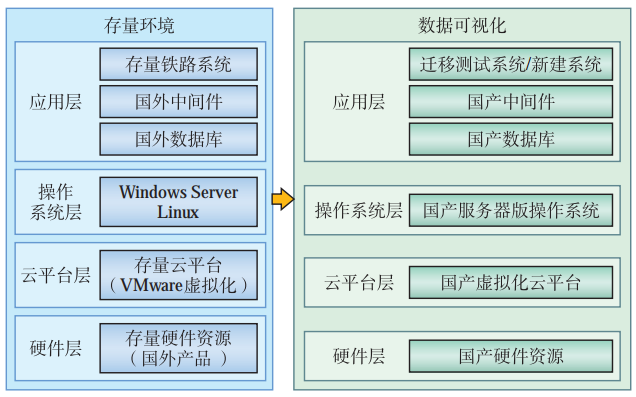
Figure 1 The Corresponding Replacement Relationship Between Existing Environment and Design Platform
This layer completes the foundation of the domestic virtual cloud platform, namely the replacement at the hardware level. The selection of hardware and architecture is primarily based on the domestic CPU technology route. Currently, there are mainly RISC instruction set and CISC instruction set. Under the RISC instruction set, there are several domestic CPU providers to choose from; under the CISC instruction set, there are also domestic manufacturers available. Through UnixBench CPU performance testing under the same parameter conditions, Stream memory performance testing, and Iozone disk read and write performance testing, while considering the current existing environment, this article selects domestic x86 series servers as the hardware-level replacement for the domestic virtual cloud platform after detailed research and practice.
1.1.2 Virtual Cloud Platform Layer
The domestic virtual environment replaces the existing environment of VMware at this layer, utilizing virtualization advantages to support the management of existing heterogeneous x86 resources.
Currently, there are multiple companies in China that can provide technical support for virtual cloud platforms. Virtualization selection should focus on compatibility, coexistence, and portability at the virtualization layer. Compatibility mainly refers to the fact that due to the different technical architectures used by current domestic chips and the uncertain future development trends of chip architectures, the selected virtualization software must be compatible with the current platform system while avoiding risks; coexistence is to prevent the operational maintenance difficulties and resource utilization efficiency decline caused by multi-cloud islands and decentralized management, so virtualization software that can manage existing platforms should be selected; portability involves virtual machine and application migration, system migration and architecture are related, while application migration involves reconstruction and recompilation, which entails a significant workload, and related tools are not mature, with few replicable experiences; therefore, it is necessary to choose vendors with strong technical support capabilities and rich experience.
1.1.3 Operating System Layer
This layer considers the technical strength of operating system vendors, usage scale, technical support intensity, and the overall activity of the ecosystem, replacing the existing Linux and Windows Server operating systems with domestic operating systems, completing the replacement at the operating system layer. After research and a series of trials with related software and middleware, the Kylin operating system V10 version has shown good trial results.
This layer considers the technology route of applications to be migrated, and comprehensively assesses the migration technology plan, selecting application systems with strong technical support and detailed technical documentation as pilot projects.
This article selects typical examples from the existing railway information systems for adaptability testing and replacement, gradually carrying out subsequent platform switching work based on summarizing experiences. New systems should be developed and tested directly on fully domestically produced platforms.
1.2 Cloud Platform Logical Architecture
The cloud platform logical architecture follows a hierarchical design concept, combining the research results of corresponding replacement selections mentioned earlier. Based on the functions carried by each layer, the virtual cloud platform is divided into infrastructure layer, Infrastructure as a Service (IaaS) layer, Platform as a Service (PaaS) layer, and Software as a Service (SaaS) layer, as shown in Figure 2.
In addition, existing cloud platforms need to be included in management. Different from the domestic virtual cloud platform, this is referred to as heterogeneous cloud. On top of this, a cloud management platform is designed to provide operation and maintenance, management, monitoring, and other services for the entire virtual cloud platform.
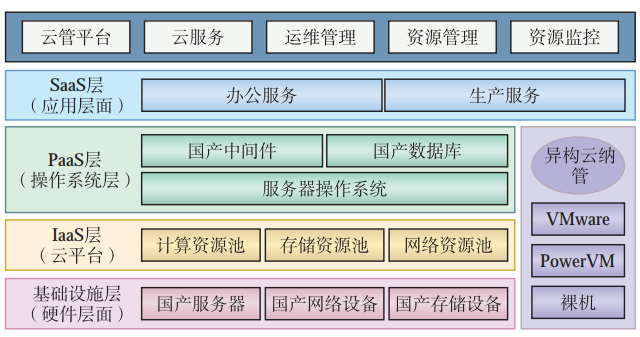
Figure 2 Cloud Platform Logical Architecture
(1) The infrastructure layer uses domestically produced servers based on x86 architecture. This layer is the physical resource layer of the entire platform, the cornerstone of platform construction, determining the cloud platform’s infrastructure, the total amount of resources it can provide, and the direction of subsequent expansions.
(2) The IaaS layer is based on domestic virtualization technology, integrating the resources of the infrastructure layer virtually, allocating and dividing them according to configuration requirements. This layer can perform functions such as configuring virtual servers (domestic operating systems), virtual network division, and virtual storage allocation. Virtualization is the foundation of cloud platform construction, managing hardware resources below and carrying application systems above, serving as the base for digitalization.
(3) The PaaS layer configures domestic operating system virtual machines based on the virtualization of the IaaS layer, while also providing services such as domestic databases and middleware.
(4) The SaaS layer is the service layer, where service providers deploy applications and provide external services. Most SaaS layer applications can be accessed directly through web browsers, without the need to install client software, making it efficient and quick while reducing user costs.
1.3 Cloud Platform Technical Architecture
This domestic virtual cloud platform is a software-defined cloud platform, defining computing, storage, and network infrastructure as virtualized units through software. After high flexibility modular combinations, it achieves a lightweight and convenient elastic infrastructure with certain linear scalability, overall realizing a modular cloud platform with multiple cores and management of existing resources. The technical architecture is shown in Figure 3.
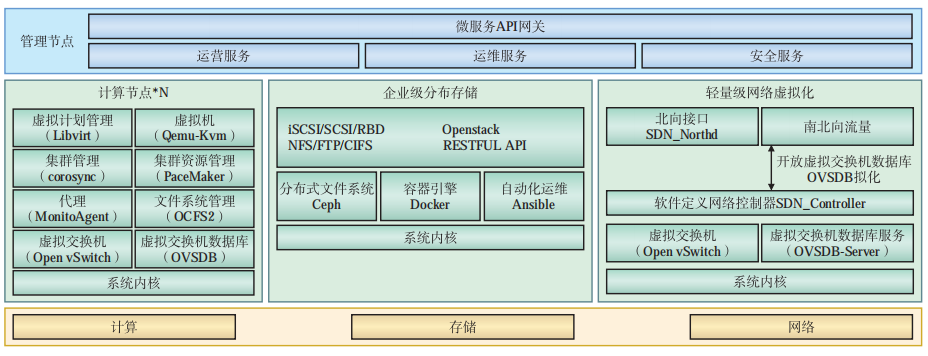
Figure 3 Cloud Platform Technical Architecture
(1) Management Node: Covers a centralized management platform for computing, storage, network, security, operation and maintenance, and users, covering various resource fine-tuning adjustment functions to enhance usage and operation efficiency.
(2) Distributed Storage: Storage is compatible with the Ceph open-source community, capable of achieving enterprise-level distributed storage for various I/O scenarios.
(3) Computing Node: The core of the virtual cloud platform, used to deploy the virtualization engine, realizing the foundation of the virtual cloud, achieving full compatibility in the field of domestically produced hardware and operating systems.
(4) Virtualized Network: The network is designed based on mainstream Open vSwitch virtual switching, separating forwarding and control using software-defined networking (SDN) technology.
The completed cloud platform has complete, comprehensive, and flexible technical characteristics. Its logic is a unified cloud management platform, adopting a unified interface, forming a two-level construction architecture of “overall control platform + various resource sub-service platforms”, where the primary control platform is responsible for overall scheduling, and the secondary service platform is the overall framework for resource allocation and scheduling. It achieves seamless management at the resource level, meaning unified management of heterogeneous cloud resources such as computing resources, storage resources, network resources, database resources, middleware resources, security resources, and backup resources; at the business level, it achieves unified operation of business services, meaning unified non-differentiated management of heterogeneous cloud resource applications, monitoring, and early warning within the cloud management platform.
2 Application Adaptation and Migration Plan
After the platform is built, it is necessary to design adaptation and migration plans for various fields (operating systems, databases, middleware, etc.) related to the application systems.
It is recommended to choose systems with good technical support and active ecosystems for operating systems; for application migration, different degrees of modification or reconstruction need to be conducted based on development languages, technology stacks, and other technical routes; middleware should consider vendors with large user bases, good compatibility, and strong technical support; databases should consider the compatibility between target databases and existing databases.
2.1 Adaptation and Migration Route
In actual adaptation and migration, application system migration needs to consider the differences in CPU architecture of the hardware servers used, the differences in virtual levels brought by virtualization, and the differences caused by different operations and technology stacks. The adaptation and migration route is shown in Figure 4.
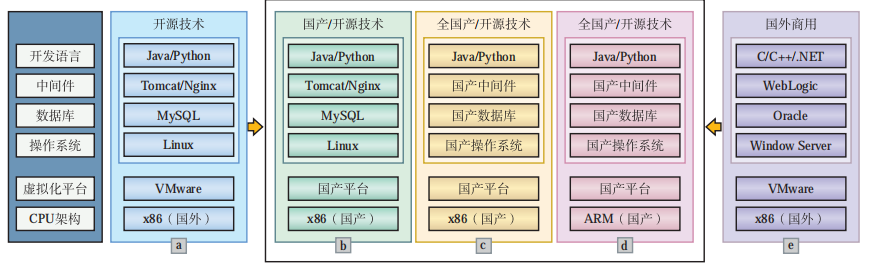
Figure 4 Adaptation and Migration Route
This article categorizes the migration routes into two lines based on the architectures of operating systems and applications to be migrated, virtual cloud platforms, operating systems, and open-source or not, summarizing them into five framework combinations (marked as a to e). Line 1: Choose one domestic architecture from frameworks b, c, or d for migration; Line 2: Choose one domestic architecture from frameworks b, c, or d for migration.
In Line 1, when the x86 architecture Linux system chooses to migrate to frameworks b or c, migration tools can be used for overall virtual machine migration, followed by further detailed adjustments. When migrating to the ARM architecture-based framework d, re-adaptation and deployment are required before subsequent migration, and generally, applications do not need to be reconstructed. In Line 2, when migrating Windows series server systems based on x86 architecture to frameworks b, c, or d, virtual machine migration requires re-adaptation of the system, and associated applications need to be gradually reconstructed or completely rewritten. Therefore, migration and adaptation under the Windows system is more challenging and costly overall. This article suggests choosing Line 1 for the initial construction of domestic replacement to reduce adaptation difficulty and cost, shortening the construction period.
2.2 Application Migration Plan
In the initial phase of application migration, it is advisable to select simple applications with minimal business impact and strong technical support as pilot projects, proceeding in phases based on business importance and difficulty. For business systems with front-end and back-end components, the migration should first be conducted for the front-end and middleware, followed by database migration, and finally back-end migration and deployment. This article divides the migration process into several phases: research phase, front-end and middleware migration, database migration, back-end application migration, and online testing.
(1) The preliminary research work needs to comprehensively analyze the application scale, resource demand, business access volume, development language, dependent components, existing environment, etc., to consider the overall migration difficulty, decompose and organize the migration plan, and mobilize technical resources for all-round support, especially ensuring that existing business operations are not affected.
(2) Regarding middleware, there are several domestic middleware options available. During migration, developers need to compare middleware configuration parameters to set parameters and adjust them during subsequent testing.
(3) For databases, the focus is primarily on migrating the existing Oracle database, using migration tools to migrate database objects such as tables and indexes, completing verifications and code changes in the database part of the system.
(4) During application migration, different migration plans should be formulated based on the development language. For Java and PHP languages, only recompilation is needed for adaptation; for Python and GO languages, minor changes are required, involving plugins, dependencies, and library files; for C and C++ languages, the workload is larger, and portions involving libraries and components generally need to be redeveloped. The difficulty of migration varies depending on the operating system under which the application runs, and specific responses need to be made according to the actual situation.
(5) In the verification testing and trial operation phase, after migration is completed, it is necessary to test the integrity of the migration and whether the business can operate stably. Technical personnel need to conduct multidimensional testing of the migrated applications.
3 Application Implementation
This article uses the domestic virtual cloud platform of China Railway Lanzhou Bureau Group Co., Ltd. (referred to as Lanzhou Bureau Group Company) as the basis for testing on domestically produced hardware and the domestic Kylin server operating system. The overall effect of the Lanzhou Bureau Group Company’s domestic virtual cloud platform is presented in Figure 5.
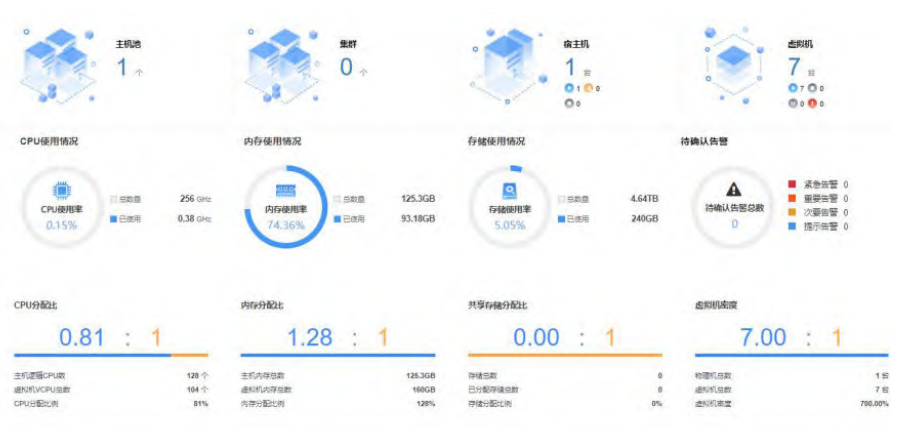
Figure 5 Overall Effect of Domestic Virtualization Cloud Platform
Figure 5 visually displays the current resource usage status of the cloud platform, including total host pool, total clusters, virtual device overview, various resource status, equipment health status, and other information. The virtual cloud platform achieves unified management of all resources in the data center, realizing resource allocation and scheduling based on policies, ensuring business continuity, and fully supporting the management and operation of information systems.
3.2 Application Migration Results
This article selects the network office system of Lanzhou Bureau Group Company as a migration test case. This office system is developed using Java language (JDK version 1.8) + JSP, utilizing a War package for migration and compilation. Through the steps shown in Table 1 for domestic replacement and adjustments made by researchers, the migration of the network office system has been successfully achieved.
Table 1 Detailed Comparison of Network Office System Before and After Migration
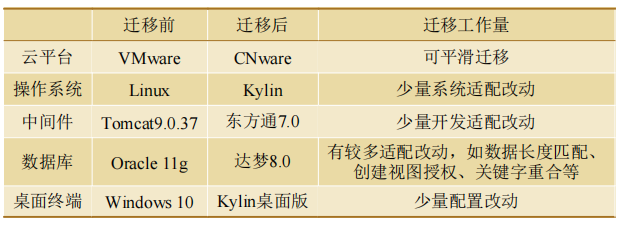
The testing phase was conducted on the domestic virtual platform Kylin desktop version, and the browsers used for testing were all domestic browsers. The testing access was smooth, and all functions of the office system were normal. The testing results met expectations, achieving phased success in application system migration, overall realizing a fully autonomous domestic application migration from IaaS to SaaS.
This article studies the localization replacement of railway information systems from the perspectives of domestic hardware selection, virtual cloud platform research, and adaptation migration of existing application services. Based on domestic CPUs and mainstream domestic server operating systems, it researches domestic virtual cloud platforms and deep adaptation of information systems, providing technical experience support for building self-controlled, secure, and reliable localization replacement of information systems in the railway industry. In future research, it will also focus on co-building multi-core platforms, achieving management of multiple cores in one cloud, and the management and migration of old platforms, providing reliable references for in-depth exploration of domestic virtual cloud platforms.
Source: New Industrial Network, originally published in “Railway Computer Applications” June 2023, Authors: Qiao Wei, Zhang Ruijian, Jiang Songnian, Wang Wei, Yin Chunlei from the Information Technology Institute of China Railway Lanzhou Bureau Group Co., Ltd. If there is any infringement, please contact for deletion.
For more materials on enterprise digital transformation, smart factories, industrial internet, data governance, etc., please leave a message on the WeChat public account a001
Follow Ningbo’s integration of industry and information, and learn more about industry dynamics
1. Technical Innovation of Intelligent Factories in Discrete Industries
2. Sharing | Six Stages of Digital Transformation for Traditional Enterprises
3. Sharing | Overall Solution for Smart Factory Construction
4. Expert View | Digital Transformation of Industrial Enterprises is the Main Battlefield for Promoting Intelligent Manufacturing in the Next Five Years
5. Sharing | Planning and Construction of Digitalized and Intelligent Workshops
6. Sharing | Smart Factories Based on Industrial Internet Platforms
7. Sharing | Industrial Digitalization/Intelligentization 2030
8. Sharing | Comprehensive Interpretation of Smart Factories
9. Sharing | Smart Factories, Digital Workshops – Key Elements of New Intelligent Manufacturing Models
10. Sharing | After reading this article, even outsiders understand ERP, APS, and MES
Welcome to Join Knowledge Community (Scan the QR code below)~~~