The previous article briefly introduced the host layer of the BLE protocol stack.An Overview of the BLE Protocol Stack (Part I)This article will provide a brief introduction to the controller layer, which mainly includes the link layer and the physical layer.
- Physical Layer
The physical layer primarily implements data transmission and reception in the 2.4 GHz band through GFSK modulation.The physical layer can support 40 channels, with a 2 MHz interval between each channel. In BLE 5.0, only three channels can be used for broadcasting, namely 37, 38, and 39. However, after BLE 5.0, due to the introduction of extended advertising, other data channels can also be used for auxiliary broadcasting. Channels 37, 38, and 39 are referred to as primary channels, while the other data channels are called secondary channels.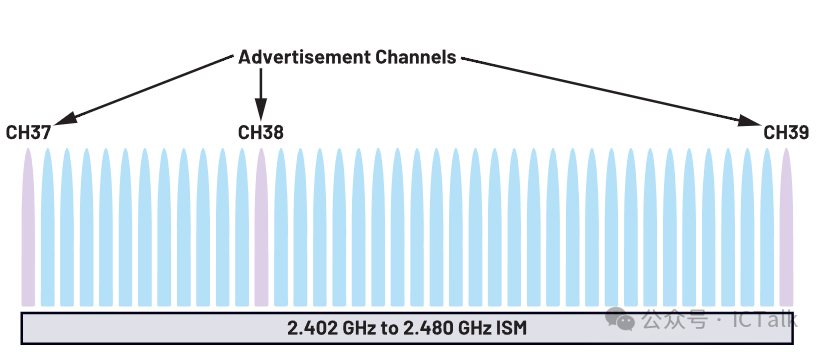 After BLE 5.0, BLE can support three different PHYs: 1M PHY, 2M PHY, and coded PHY. The coded PHY supports two data rates: 125 kbps and 500 kbps.
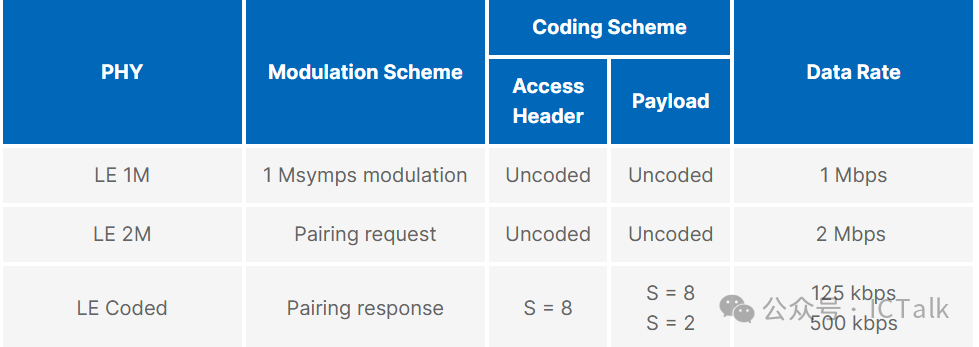 The packet format for 1M PHY is as follows:
 The packet format for 2M PHY is as follows:
 The packet format for 125K PHY is as follows:
 The packet format for 500K PHY is as follows:
- Link Layer
The link layer is primarily responsible for scanning, advertising, establishing, and maintaining connections. It also controls frequency hopping.The link layer has several main state transitions (the isochronous and synchronization states will not be discussed here).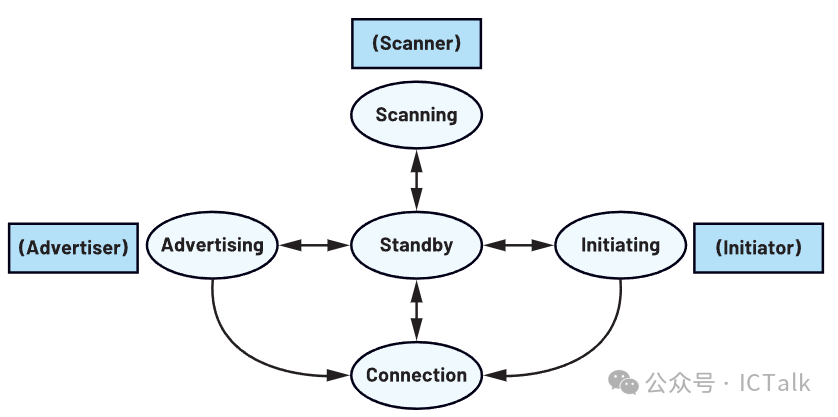
- In standby state, the link layer neither sends nor receives packets.
- In advertising state, the link layer sends advertising packets while listening for devices requesting additional information.
- In scanning state, the link layer listens to advertisers and may request more information from them.
- In initiating state, it receives packets from the advertiser and establishes a connection by responding to these packets.
- In connection state, the device has established a connection with another device.
The packet format for advertising physical channel is as follows: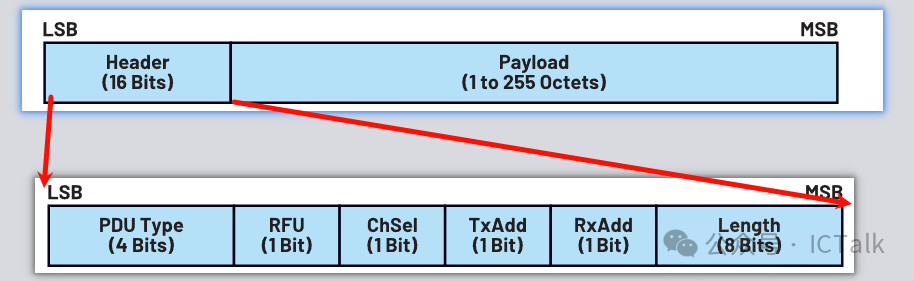 The packet format for data physical channel is as follows:
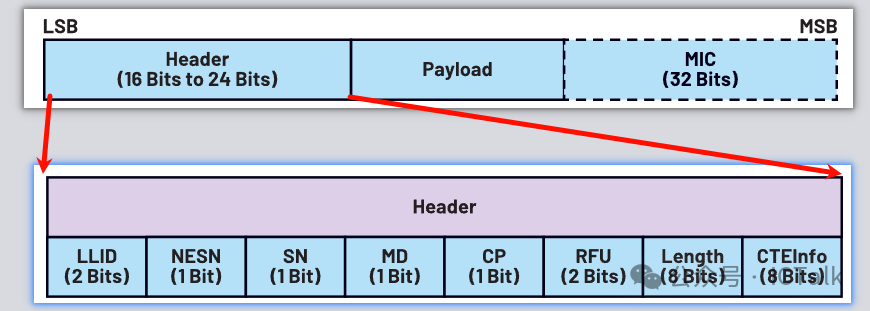 In connection state, data interaction is primarily conducted through the data physical channel’s packet format.The BLE protocol is relatively simpler than the Wi-Fi protocol, but BLE has a wide range of applications in low power and low data rate scenarios. In the future, we will further dissect the BLE protocol and its implementation in chips.End!