


LoRaWAN Open/Close Sensors are low-power, long-range wireless devices used to detect and report the open or closed status of doors, windows, gates, cabinets, or other movable objects. These sensors utilize the LoRaWAN (Long Range Wide Area Network) protocol to transmit status data over long distances (typically up to several kilometers) while consuming very little power, making them ideal for applications that require extended battery life and remote deployment. The sensor typically consists of a reed switch or Hall effect sensor that changes state when the magnetic field is interrupted (e.g., when a door opens). It transmits status updates to a centralized LoRaWAN gateway, which relays the information to a network server or cloud platform for monitoring, analysis, and alerts. LoRaWAN open/close sensors are widely used in smart buildings, industrial automation, logistics, retail, agriculture, and asset security, providing real-time visibility and enhanced operational control in dispersed and hard-to-reach environments.
01
The Trillion-Dollar Market Behind a 4.6% CAGR
As IoT technology rapidly penetrates various sectors, LoRaWAN open/close sensors, as core sensing devices in the low-power wide-area network domain, are experiencing continuous market expansion. According to an authoritative report by Global Info Research published in 2025, the global revenue for LoRaWAN open/close sensors reached$352 million in 2024, and with the surge in demand from downstream sectors such as smart buildings and industrial automation, this figure is expected to climb to$485 million by 2031, maintaining a stable compound annual growth rate (CAGR) of4.6% from 2025 to 2031. This robust growth trend not only highlights the strong vitality of the industry but also provides clear market signals for corporate strategies and investor decisions—LoRaWAN open/close sensors have become an undeniable “potential stock” in the low-power IoT sector.
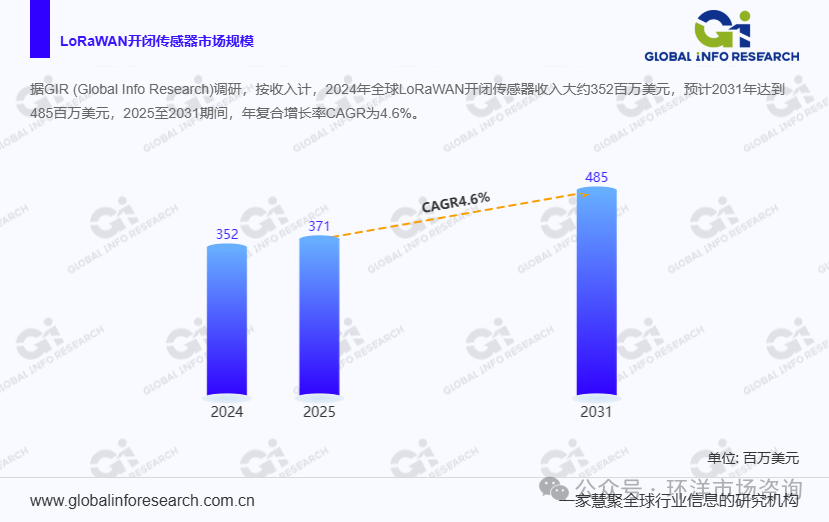
LoRaWAN Open/Close Sensors Perfectly Solve Deployment Challenges in Dispersed Scenarios with Their Core Advantages of “Long Range + Low Power”. Their transmission distance can reach several kilometers, and battery life is significantly extended, enabling efficient sensing in scenarios such as monitoring doors and windows in smart buildings, detecting equipment status in industrial workshops, and tracking goods in logistics warehouses. This characteristic of “wide coverage and long endurance” is the core driving force behind the continuous expansion of the market scale.
02
Two Product Types Driving Six Core Areas
From a product perspective, the global LoRaWAN open/close sensor market is mainly divided into two subcategories: Magnetic Contact Sensors and Hall Effect Sensors. Magnetic contact sensors rely on reed switches for state detection, characterized by low cost and high reliability, widely used in cost-sensitive and relatively stable environments; Hall effect sensors, on the other hand, operate based on the Hall effect principle, offering stronger anti-interference capabilities and faster response times, making them more suitable for industrial automation and asset security monitoring in harsh environments where performance is critical. Both product types have their advantages, collectively meeting diverse needs in different scenarios and forming a complementary product landscape that provides solid support for comprehensive market coverage.
From a downstream application perspective, the report focuses on six core areas, each exhibiting considerable growth potential. Smart buildings are the primary application scenario, with the proliferation of green buildings and smart security concepts leading to a surge in demand for real-time monitoring of critical locations such as door and window statuses and elevator cabin doors, becoming a major source of sensor demand; Industrial automation allows LoRaWAN open/close sensors to achieve remote status monitoring of production equipment cabinet doors and storage cabinet doors, helping enterprises reduce costs and increase efficiency; Logistics utilizes sensors to track the status of container doors during the transportation process, ensuring cargo safety; additionally, the monitoring of cold chain cabinet doors in the retail sector, status detection of greenhouse ventilation openings in the agriculture sector, outdoor equipment cabinet door theft monitoring in the asset security sector, and other emerging scenario demands collectively form the “diverse engines” of market growth, driving the deep penetration of LoRaWAN open/close sensors across various industries.
03
Leading Manufacturers Compete, Technology and Layout Become Key
The global LoRaWAN open/close sensor market gathers numerous strong manufacturers, who, leveraging technological research and development, product layout, and market channel advantages, jointly dominate the industry’s development direction. Key companies mentioned in the report include EAMS Technologies, Dragino, Milesight, Abeeway, Adeunis, Browan, Netvox, DecentLabs, Elsys, IMBuildings, Laird, MClimate, Watteco, Polysense, Synetica, Talkpool, Tektelic, Planet Technology, etc. These manufacturers continuously innovate in product specifications and performance, such as optimizing sensor power consumption and enhancing data transmission stability, while actively expanding into downstream application scenarios, offering customized solutions for different industries.
From a competitive perspective, leading manufacturers occupy a significant market share through technology patent layouts, industry chain integration, and global market expansion. At the same time, the industry also sees mergers and acquisitions and new entrants, with some companies acquiring small technology firms to supplement core technologies, while new entrants seek breakthroughs with differentiated products for specific scenarios. This competitive landscape not only drives the overall technological advancement of the industry but also injects new vitality into the market. For CEOs, understanding the dynamics, product strategies, and market layouts of leading manufacturers is a key prerequisite for formulating their competitive strategies.
04
Multi-Regional Collaborative Growth, Emerging Market Potential Highlighted
The Global Info Research report provides a detailed breakdown of market sizes across major global regions, covering North America, Europe, Asia-Pacific, South America, the Middle East, and Africa, offering precise guidance for corporate regional layouts. Currently, North America and Europe, benefiting from the early adoption of IoT technology and the mature development of smart buildings and industrial automation, are the primary markets for global LoRaWAN open/close sensors, leading in both revenue and sales. Companies in these two regions have high performance requirements for sensors and are willing to pay a premium for quality products, driving the development of the high-end market.
The Asia-Pacific region exhibits the strongest growth potential, with countries like China, Japan, South Korea, and India increasing investments in smart cities and intelligent manufacturing, rapidly driving the demand for LoRaWAN open/close sensors. Furthermore, although the current market size in South America, the Middle East, and Africa is relatively small, with the advancement of infrastructure construction and the gradual penetration of IoT technology, these regions will also become important contributors to market growth in the future. For companies, understanding the market characteristics and growth rhythms of different regions and formulating differentiated regional strategies will be key to capturing market share.
05
Driving Factors and Development Trends Leading the Future of the Industry
The development of the global LoRaWAN open/close sensor market benefits from multiple driving factors while facing some challenges. From the driving factors, firstly, policies promoting smart cities, intelligent manufacturing, and smart agriculture provide a broad policy environment for sensor applications; secondly, continuous advancements in IoT technology, especially the optimization of the LoRaWAN protocol and the proliferation of gateway devices, have lowered deployment costs and usage thresholds for sensors; finally, the increasing urgency of enterprises to enhance operational efficiency and ensure asset security provides sustained momentum for market demand for sensors.
From the challenges, the industry faces issues such as non-unified technical standards, inadequate network infrastructure in some regions, and price pressures due to intensified market competition. However, overall, the opportunities for industry development far outweigh the challenges, and a clear development trend is emerging: first, products are evolving towards low power consumption, high reliability, and miniaturization to meet the demands of more complex scenarios; second, application scenarios are expanding in diversity and depth, extending from simple status detection to value-added services such as data analysis and intelligent alerts; third, collaboration across the industry chain is strengthening, with closer cooperation between sensor manufacturers, gateway manufacturers, and cloud platform service providers, forming a complete IoT solution. These trends will lead the industry to continue healthy development, bringing new opportunities for enterprises and investors.
All data and analysis in this article are sourced from Global Info Research’s 2025 report titled “2025 Global Market Overview of LoRaWAN Open/Close Sensors: Overall Scale, Major Manufacturers, Key Regions, Product and Application Segmentation Research Report”. As a professional institution deeply engaged in global industry information and providing market strategy support for enterprises, Global Info Research adheres to the philosophy of “Positioning Globally, Gathering Value Wisely”. Its report not only covers historical data from 2020 to 2024 but also provides precise forecasts for market size from 2025 to 2031, with statistical dimensions including sales, prices, revenues, and market shares, offering users comprehensive and detailed market information.
For CEOs, this report can help them clearly understand the global market landscape, competitor dynamics, and downstream demand changes, providing decision-making basis for corporate strategic planning, product development, and market expansion; for marketing managers, the regional market analysis and application scenario breakdown in the report can assist in formulating precise marketing plans and enhancing market promotion efficiency; for investors, the market growth trends, performance of leading companies, and industry development potential presented in the report can provide authoritative references for investment decisions, reducing investment risks. This report can be seen as a “compass” for enterprises to seize opportunities in the LoRaWAN open/close sensor market and respond to market challenges, as well as a “golden key” for investors to explore industry value and achieve asset appreciation.
Global Info Research

Global Info Research
WeChat/Phone: 176 6505 2062
Email: [email protected]
Website: https://www.globalinforesearch.com.cn