A group of actors gathers on stage to take their bows. They are dressed as fixed characters from the popular 18th-century French farce—improvisational comedy (commedia dell’arte). All the actors play their respective roles, interacting gracefully—except for the clown Pierrot, who stands in the center of the stage, seemingly afflicted by unrequited love. Dressed in a shimmering white outfit, he stands quietly, smiling faintly, with a vacant gaze. We cannot read his expression. He is an actor who refuses to perform, shrouded in mystery. Watteau is fascinated by the blurred lines between life and theater, reality and performance. Pierrot leads us to ponder what we become when we step out of our assigned roles.
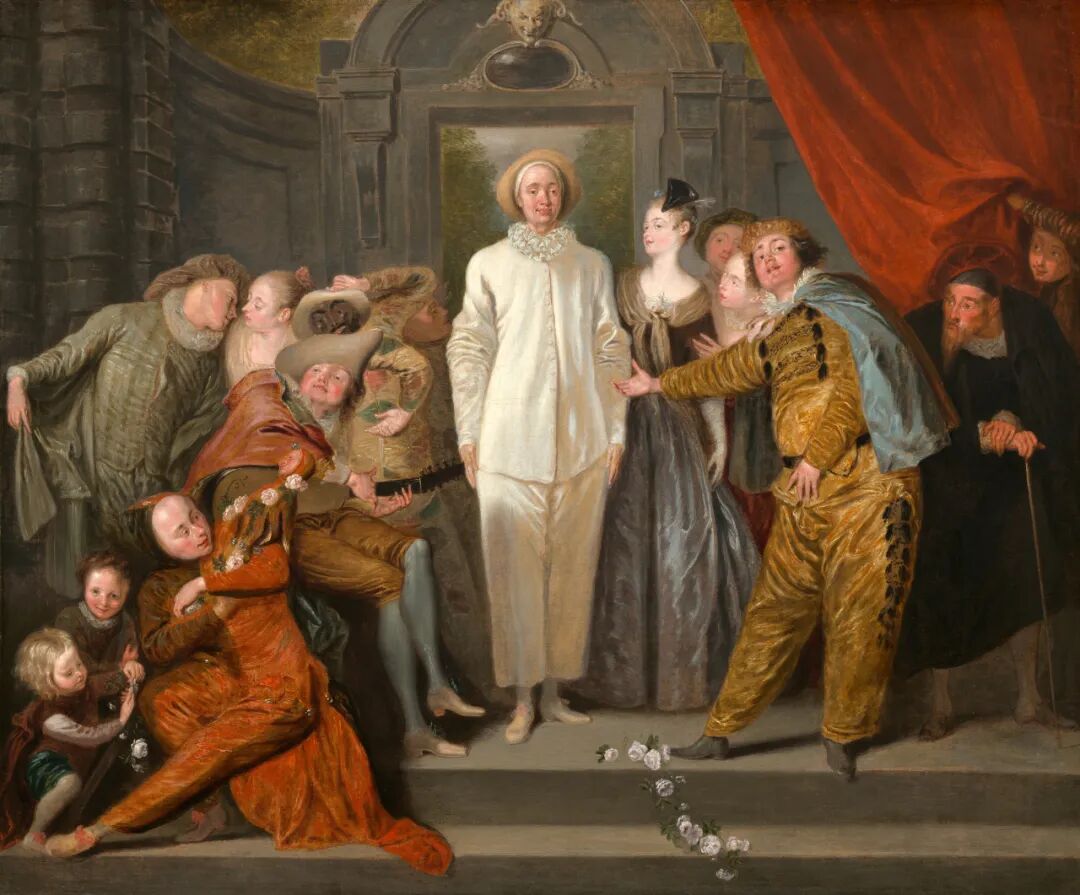 The Italian Comedians
Antoine Watteau
Artist, French, 1684 – 1721
Indifferent One: People often marvel at my indifference. All the outrage I provoke does not affect me in the slightest. My heart has completely dried up; I do not know what a friend is, but I have no enemies either. I am neither a philanthropist nor a misanthrope. Most importantly, I am dressed in expensive, smooth velvet; if I see myself as a beautiful, elegant cat, living only for myself, this comparison is indeed somewhat appropriate. Life, for me, is a luxurious restaurant where I enjoy bread all alone. My unique quality is that I never feel bored. My limbs seem to be made of something like plaster of Paris, quite pliable. Wherever I am, my various gestures appear extremely calm and composed, which is simply my special nature. I am like a candle, mocking myself with my flame, always standing at the same height and depth. Do not think I am without feelings—that would be a grave mistake. But my oddity and uniqueness lie in the fact that my feelings are senseless, while my senselessness is rich in emotion, a state perhaps only I can understand. When I extend my arms, they can exist in the stillness of their extension, like silence itself; my moonlit face reveals a kind of joyful weariness, a kind of frustration seemingly caused by my own mockery. Is my heart not like a cold sun, and my nerves like fiery yet purely imaginary lines? And am I not always enveloped by a sense of alienation? I have never done anything bad, nor have I done anything good; sometimes I even seem like a puppet to myself. But the life I have not lived stands like a magnificent, green giant tree in the doubts of my dark blue sky; I doubt that I am the most soulful soulless being from ancient times to the present, an unspoken charming phrase, a kiss never given nor received, a kiss so sweet it could make one die; I am the most tedious, unceasing toil, or the petrified water that has never flowed, rolling down my cheeks like pearls, appearing both melancholic and humorous; I am a dove shot with an arrow, bleeding as it falls from the golden sky, or a sinful piety, a tedious posture, like a warehouse filled with various pleasures and all the vitality contained in a life rich in action. For the murder I have had the fortune to commit against myself, I have never dared to feel a shred of regret; this may sound contradictory, for how could a person as indifferent as I have even the slightest understanding of such a brilliant celebration, or observe the parade of victory—just as we cannot imagine the desire to achieve a goal when we awaken from a long slumber; or after a long period of barrenness, in what form can we conceive the longing for the love we speak of? My way of opening and closing my eyes reminds one of raising and lowering the theater curtain, during which an elegant, exquisite tragedy is performed. Oh, if only I could once—just once—act a bit rudely, it would successfully reveal my bourgeois tendencies. The trickster seems to think it is now his turn to speak. Whether people notice me or whether I have the opportunity to assert my existence is of no concern to me; if so, it is most natural to exit at this moment, that is to say, I announce my departure. If I were a tulip, a rose, a carnation, or a cluster of oleander, I would emit the fragrance of dreams, as well as that futile scent: futilely convincing myself that my exit might have some significance, rather than merely being a habit cultivated since childhood.
Trickster: I love the act of expressing myself so much that every lady immediately believes in me; my trickery has even successfully deceived myself. My betrayal is my happiness. A trickster is braver than any honest person. In my view, my masterful deception—seemingly not lacking in cleverness—brings more joy to some people; if I were honest with them, they would be less happy. For this reason, I consider myself a sage.
Sentimental Person: When the indifferent one dismisses my efforts with a smile, he also indulges in self-pity, which renders his own smile futile, this smile is as vast as a prairie, composed solely of the palest beauty. I return home with flowers, loosely tying them into a bouquet, striding like a brave traveler, yet standing dazed as if lulled to sleep, like a person who sees his beloved, that moment feels like being enchanted. The flowers in the vase are very happy because they were picked in her name—the name of the person who rejected my loyal confession; she rejected me because those confessions were the pleas, outpourings, and nonsense of a sentimental person. But how satisfied I am! In my unrequited longing lies a beautiful harmony and a coherent ocean, of which she knows nothing; this ignorance makes me love her even more, and these flowers before me! If someone saw me talking to them, he would surely think I was mad. I bend down to them; I immediately jump back, as if these innocent, charming things fill me with fear. Oh, sentiment, how ridiculous your posture is! But sentiment turns me into a rolling ring, a dancing light sphere. I am a carefree sphere; I tremble and flicker with fleeting thoughts, without any need to do so, they play tricks on me like a group of children—when children play, the streets, squares, houses, stairs, and the whole world belong to them. Is my sentimentality toying with me? One moment I am very happy, the next I am wounded, insulted, harmed, and crushed by the colors of these flowers; sometimes they give me strength, sometimes they confuse me. But what difference does it make? What is she doing at this moment? Undoubtedly, without her, a sentimental person could never continue to live peacefully, for without this unique her, he could not be so sentimental, and among all impossibilities, being sentimental is the most impossible. In summary, I am the kind of person who accepts myself to a degree close to completeness. If you have even the slightest interest in understanding me, even if only partially, it is necessary to grasp this point.
Clown(looking very solemn): Sentimental person, it is easy for you to understand. The indifferent one is greater and more meaningful than you. The sentimental person is laughed at. But in the face of indifference, people stand petrified, staring at that unpleasant eternity. The trickster provokes anger, but at the same time, he also evokes a certain admiration. I am the embodiment of smoothness, dedicated to balancing temperaments, thus providing equal rights among various personalities. My talent for making people laugh is a virtue, the greatness of which lies in the belief that no one could ever appreciate it. I am laughed at mainly because of my solemn appearance. People think this is unintentional, but it is, of course, intentional. But my profession, my mission is primarily to use all my skills to make my audience believe I am actually a fool. I provide them with an illusion, making them think that authenticity and innocence still exist. Whenever I present my carefully maintained disheveled appearance from head to toe, they should feel pleased; this disarray is indeed an artistic achievement. My appearance reminds people of the natural state of things, for example: an orphan. They think I am wonderful, but for myself, I am not like that at all. To be fair, I must be glad that I have the ability to awaken that joyful state, after all, it allows me to make a living.
All Four Together(holding hands and walking forward): We are more similar to each other than you might imagine, only differing in subtle ways. All colors, sounds, words, and personalities are interconnected. We live, and thus in every detail, we are similar to each other, only our ways of expressing ourselves differ, and thus we are perceived differently.
—The End—
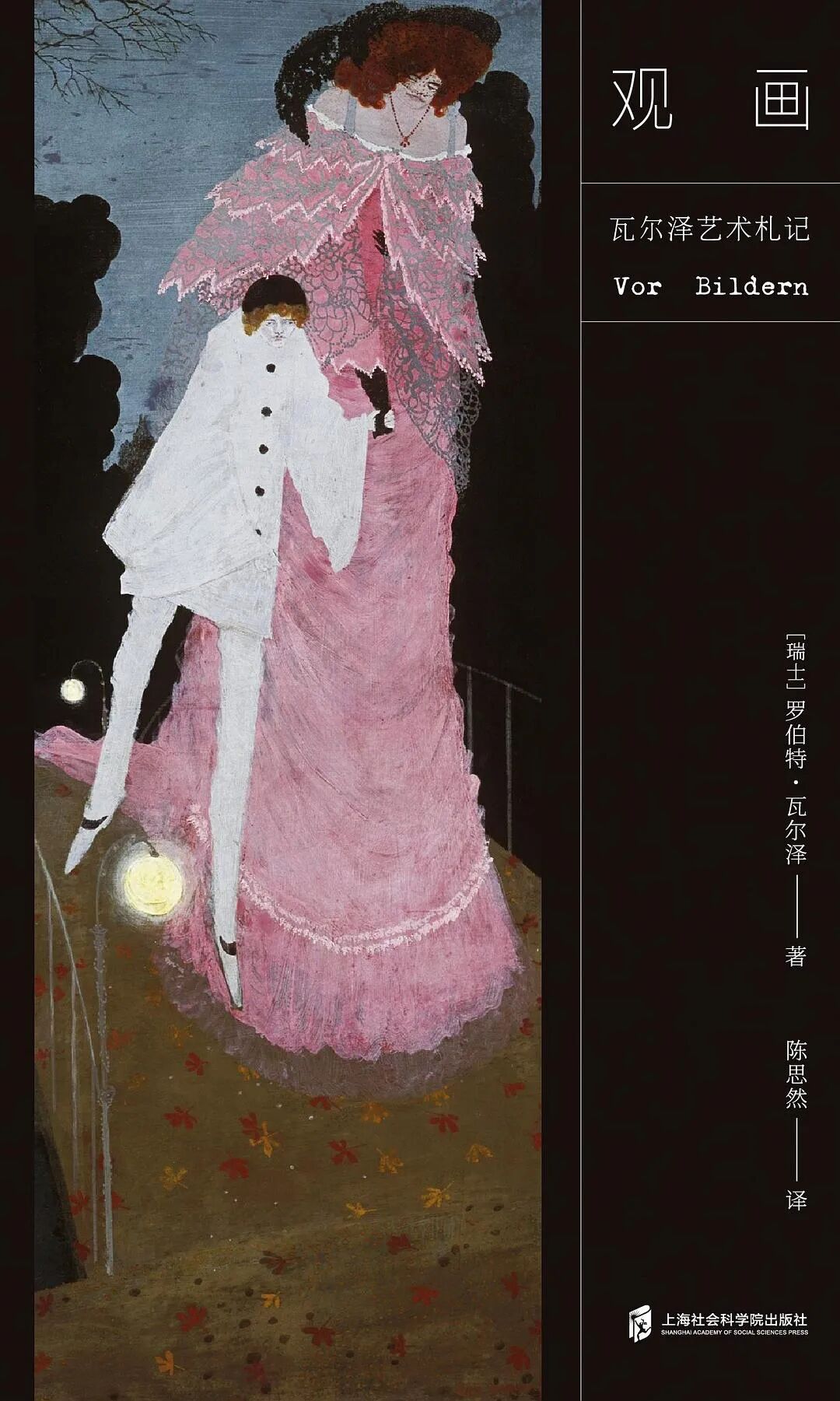
Excerpt from “On Painting”
Author: [Switzerland] Robert WalserPublisher: Shanghai Academy of Social Sciences PressProduced by: BaidyaSubtitle: Walser’s Art NotesOriginal Title: Vor Bildern: Geschichten und GedichteTranslator: Chen SiranPublication Year: 2024-10Series: Baidya Art Book
Recommended Reading
Mishima Yukio | Offering of the Genji (a one-act play)