 Click on the top “Xinhua News Release” to subscribe!
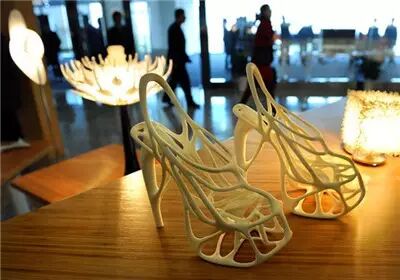
↑This is a shoe-shaped craft produced by 3D printing displayed in the exhibition hall of the China 3D Printing Research Institute. (Photo by Xinhua reporter Sun Can)
Xinhua News Information, Beijing, March 1 The Shared Group, a steel casting enterprise located in the Ningxia Hui Autonomous Region of northwest China, is reshaping Chinese manufacturing using new 3D printing technology.
”In the past, I worked in a noisy and dusty workshop, and my clothes had to be washed almost every day. Now, I just need to move my fingers in a workshop with constant temperature and humidity,” said Zhang Chao, a worker who was trained to move from the casting workshop to the 3D printing workshop, engaging in sand printing.
In this company, 3D printing technology replaces the four processes of mold making, shaping, core making, and box assembly in the sand casting manufacturing process with a single step, significantly improving the quality and efficiency of castings. The precision has increased from a maximum of ±1 millimeter to about 0.2 millimeters. The scrap rate for the production of engine cylinder heads, a major challenge in the casting industry, has dropped from an average of 30% to below 5%, and the production time for medium-speed diesel engine bodies has been reduced from 8 days to 1 day.
”3D printing is changing history,” said Meng Qingwen, deputy director of the 3D Industry Center of the Shared Group.
This state-owned enterprise, established in 1966, has revitalized itself through innovation, achieving revolutionary breakthroughs in 3D printing in the casting industry. Currently, 60%-70% of the products produced by the company are sold to more than 10 countries and regions in Asia, Europe, and America. Renowned international companies such as General Electric, Mazak, and Siemens are among its clients.
In early February, Premier Li Keqiang visited the Shared Group and stated that 3D printing has transformed casting products from “clumsy and rough” to “elegant and refined.” Li Keqiang noted that there is significant potential for using disruptive new technologies to transform traditional industries.
In May of last year, the State Council issued “Made in China 2025,” deploying a comprehensive strategy to promote the manufacturing powerhouse initiative. This is the action plan for the first decade of China’s strategy to become a manufacturing powerhouse.
”The launch of ‘Made in China 2025’ has strengthened our confidence in transformation. The discussions on new and old kinetic energy conversion and ‘Internet Plus’ during the Premier’s visit have greatly encouraged our R&D team and solidified our determination to pursue an innovative transformation path,” said Peng Fan.
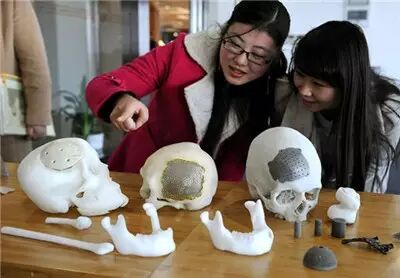
↑Two visitors are viewing 3D printed medical bone repair materials in the exhibition hall of the China 3D Printing Research Institute. (Photo by Xinhua reporter Sun Can)
In addition to the casting industry, 3D printing technology is also widely applied in automotive manufacturing, home appliances, biomedical, and aerospace fields in China. From the cockpit window frame of the C919 large passenger aircraft to the antenna support of the “Pujian No. 1” satellite, significant progress has been made in the application of 3D printing technology in China.
Due to the sluggish international economic situation, many traditional manufacturing enterprises in China are facing difficulties due to overcapacity and low-end products. Industry insiders believe that utilizing technological innovations such as 3D printing to achieve transformation may become a way out for these enterprises.
A report released by the McKinsey Global Institute in the fall of 2015 stated that innovation will be the decisive factor for whether China can maintain economic growth in the next decade. By 2025, the contribution of innovation activities in the service and manufacturing sectors to China’s economy is expected to reach $1-2.2 trillion annually.
Professor Lin Feng from Tsinghua University’s Center for Biomanufacturing and Rapid Prototyping stated that, unlike traditional manufacturing technologies, 3D printing is a process of additive manufacturing, where products are made by stacking materials under computer control.
“Traditional manufacturing methods are like building a cave, requiring the removal of excess soil; whereas 3D printing is like building a house, stacking bricks, allowing for high degrees of freedom,” Lin Feng said.
Currently, cities such as Nanjing, Wuhan, Zhuhai, Qingdao, Chengdu, and Wuxi have established or are in the process of establishing 3D technology innovation centers and industrial parks. Several universities, including Tsinghua University, Beihang University, and Xi’an Jiaotong University, also have 3D printing R&D laboratories.
Among them, Beihang University has already manufactured more than 50 specifications and hundreds of large key components using 3D printing technology, which have been practically applied in over ten types of equipment engineering, including aircraft, spacecraft, gas turbines, and steam turbines, making China a country that has mastered the 3D printing technology for large key metal components and successfully applied it in engineering.
Academician of the Chinese Academy of Engineering and Professor Lu Bingheng from Xi’an Jiaotong University stated that the widespread development of 3D printing technology can promote the high-end development of China’s manufacturing industry and support the transformation and upgrading of traditional manufacturing.
A report released by the World Intellectual Property Organization at the end of last year showed that since 2005, one-quarter of global patent applications in the fields of 3D printing and robotics engineering have come from China, the highest in the world.
Analysts expect that at the upcoming National People’s Congress, representatives and committee members will discuss the topic of technological innovation driving the transformation of the manufacturing industry, contributing ideas for achieving the goals of “Made in China 2025.” (Reporters Lv Qiuping, He Chenyang, and intern Liu Xiaotong also contributed to this article)
关注新华社发布微信公众账号①点击微信右上角的“+”,“添加朋友”中进入“查找公众号”,输 “ 新华社发布”或“xinhuashefabu1”,搜索号码关注。②点击文章右上角,查看公共账号,添加关注 Click below “Read the original text” to see more↓↓↓