Editor’s Note
Large scientific research instruments are powerful tools for achieving original breakthroughs in research, and open sharing has opened up new avenues for technological innovation. To promote the sharing and service level of large instruments at our university to a new height, allowing the investment in ‘instruments’ to ultimately demonstrate broader and greater effects and value in ‘intelligence’, the Laboratory and Equipment Management Office’s WeChat public account will successively launch the ‘Big Instruments Talk’ series of reports, aimed at helping users inside and outside the university gain a deeper understanding of the large scientific research instruments and equipment at the university, and to promote sharing and cooperation.

PART
NO.1

Big Instruments Sketch
Diabetes patients often need to use needles to inject insulin and regularly take blood samples to measure glucose levels. However, ordinary needles are often long and have a large diameter, making it easy to injure blood vessels and skin nerves during injection, causing pain. The inconvenience of self-injection and the pain of needle insertion become a psychological and physical burden that accompanies the disease. How can we make the injection process more convenient and less painful? Microneedle drug delivery is a new and effective solution.
Generally speaking, microneedles are less than 1500 micrometers in length, with diameters mostly ranging from 50 to 500 micrometers, enabling minimally invasive and stable drug release. The smart transdermal insulin delivery system developed by Professor Gu Zhen’s team at Zhejiang University’s School of Pharmacy adopts a drug delivery array composed of microneedles with a diameter approximately the thickness of a human hair. This precise drug delivery device not only significantly reduces pain but also allows for more accurate timing and dosage of drug release. Researcher Yu Jicheng from Zhejiang University’s School of Pharmacy added, “Microneedles are already very small, but we can further refine their structure based on treatment needs. For example, we can design holes or grooves on the microneedles to load nanoparticles, hydrogels, or even cells as drug delivery media, achieving precise delivery at the micron scale.”
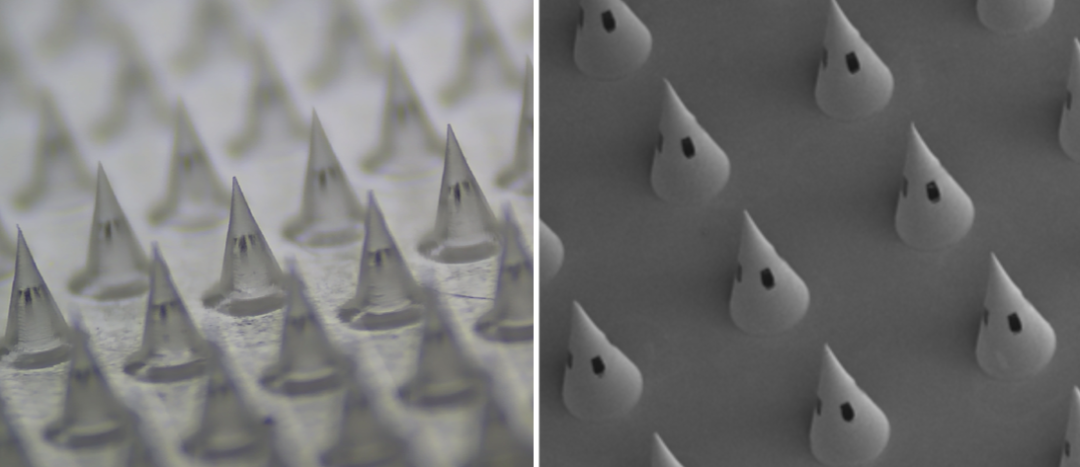
Figure / Microneedle device with micron-level channels
How are such high-precision micro parts manufactured? Traditional manufacturing methods, mainly micro-injection molding or CNC machining, have long processing cycles and lower precision, making it difficult to form complex three-dimensional structures in one piece. However, Projection Micro-Stereolithography (PμSL) 3D printing technology can efficiently and flexibly create micro-scale complex three-dimensional structures, meeting fine and diverse production needs.
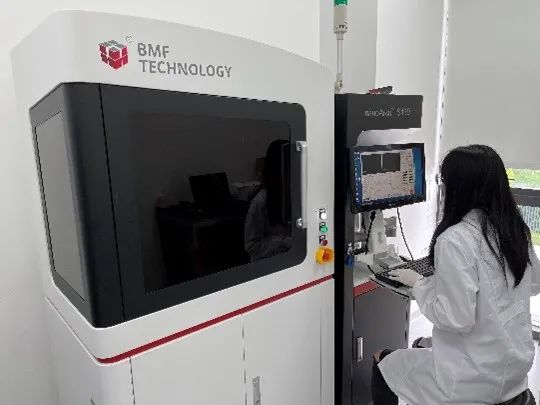
To meet research needs, in September 2022, the ‘Intelligent Medicine Laboratory’ at Zhejiang University’s School of Pharmacy introduced the research-grade ultra-high precision micro-scale 3D printer nanoArch S130. The device employs Projection Micro-Stereolithography (PμSL) technology. In the more familiar laser cutting technology, materials exposed to light quickly melt and vaporize, with light acting like a sharp knife sculpting solid materials. In PμSL technology, the light causes liquid materials to quickly polymerize and solidify, thus forming specific shapes.
The device consists of a CNC part and a chamber, with printing taking place inside the chamber. A light source of a certain wavelength illuminates the liquid tank below according to the path in the image, solidifying a layer of material in a specific area of the surface. Then, the lifting platform descends a certain distance, and after covering the solidified layer with another layer of liquid material, the second layer scanning begins. This process continues layer by layer until a complex three-dimensional structure is formed.
The device is entirely gray and looks no different from ordinary office equipment, but the printing accuracy reaches 2 micrometers. 2 micrometers is approximately 1/30 the diameter of a human hair, a scale that is imperceptible to the naked eye in our daily lives. However, in the precision manufacturing industry and research fields, minor differences can have significant impacts, as a micron difference may determine the performance of a product and affect the success or failure of a research project.
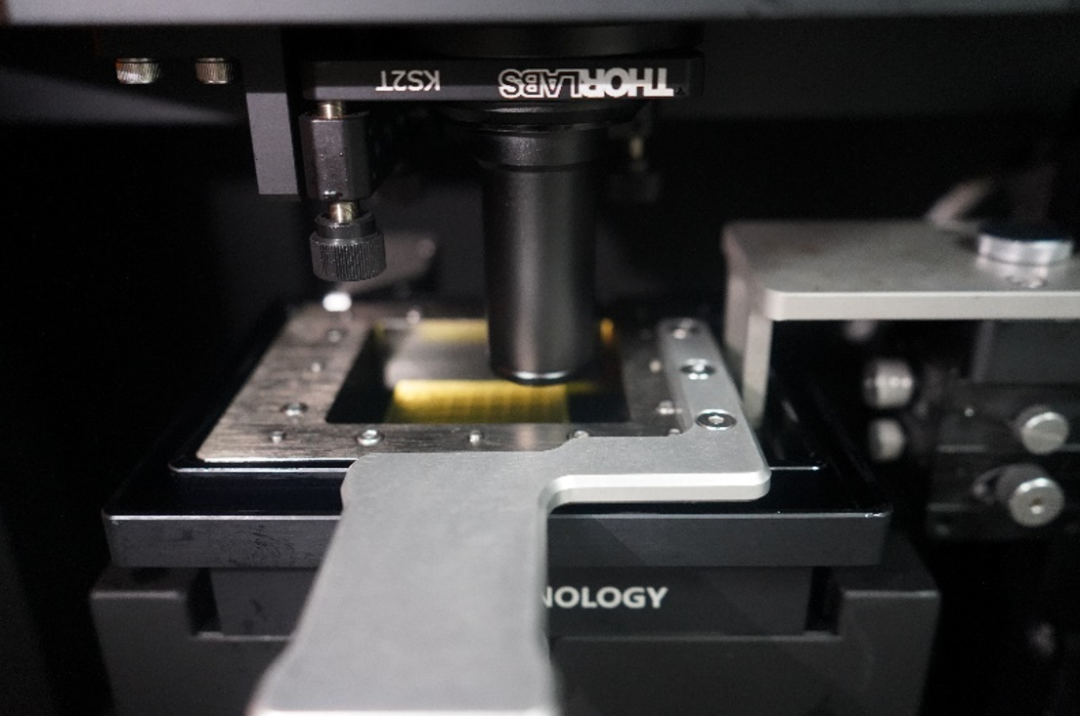
Figure / Internal view of the device
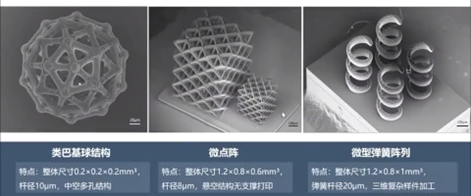
Figure / Case study of printing complex three-dimensional structures
To gain a deeper understanding of the features and functions of the ultra-high precision micro-scale 3D printer, we interviewed Yu Jicheng from Zhejiang University’s School of Pharmacy and Zhang Wentao, the technical head of the device, to hear their insights.
PART
NO.2
Big Instruments Up Close

Question: What was the background and opportunity for introducing this equipment?
Answer: Biomedical engineering and drug delivery are currently at the forefront of disciplines, combining theories from multiple fields such as biology, mechanics, materials, chemistry, and physics. Conducting research in this direction meets the national requirements for innovation-driven, high-quality biomedical research that benefits the people, promotes the clinical translation of biomedical technologies, and enhances our university’s international competitiveness in the drug delivery field. Currently, in the field of drug delivery, designing and processing micro-nano scale (referring to the scale between nanometers and micrometers) three-dimensional structures is a challenge and hotspot internationally, such as transdermal devices, microfluidic chips, cell scaffolds, and tissue engineering.
Before introducing the equipment, we had to find some precision machining companies to manufacture micro-precision parts through methods like metal etching. In this case, the processing costs are high, and the cycles are long because we could only order microneedles of uniform size without achieving diversification and personalization, and the preparation precision could not meet the continuously evolving research needs.
In September 2022, we introduced the ‘nanoArch S130 processing system’, which can balance ultra-high processing precision and macro processing dimensions, with high processing efficiency, low processing costs, and a wide range of material options, making it very suitable for processing the micro-scale complex three-dimensional structures required in the biomedical engineering field, which can well meet the needs of drug delivery research.
Question: What is the working principle of this equipment?
Answer: The nanoArch S130 processing system uses Projection Micro-Stereolithography (PμSL) technology, employing the principle of photopolymerization. Any material that can undergo photopolymerization can serve as the ‘raw material’ for this 3D printer, with common materials being liquid photopolymer resins.
First, a three-dimensional structural model is built using modeling software, and slicing software will slice the three-dimensional model into a series of two-dimensional images with a certain layer thickness. Then, the PμSL 3D printing system will project each layer pattern onto the surface of the printing material for exposure, solidifying a layer of material in a specific area. After one layer is completed, a cross-section of the part is generated. Then, the lifting platform descends a certain distance, covering the solidified layer with another layer of liquid material, and the second layer scanning begins. The second solidified layer is stacked on the previous solidified layer, layer upon layer, ultimately forming the required three-dimensional structure. After removing the prototype, final curing and processes such as polishing, electroplating, or painting can be applied to obtain the required product.
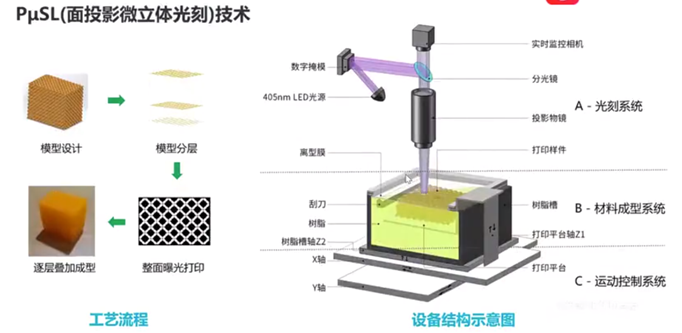
Figure / Illustration of Projection Micro-Stereolithography (PμSL) technology

Question: What unique and advanced features does this equipment have?
Answer: Currently, the nanoArch S130 has a significant competitive advantage in the globally recognized DLP photopolymerization 3D printing technology, ranking first in printing precision and layer thickness among DLP photopolymerization 3D printing devices in the country, and leading globally.
This device has an ultra-high printing precision of 2μm and an ultra-low printing layer thickness of 5μm, capable of producing various fine three-dimensional structures. Meanwhile, the size of the printed samples can reach 50mm(L) × 50mm(W) × 10mm(H), allowing for printing of both micro-scale and macro samples, thus achieving ultra-high precision large-format sample production, making it very suitable for scientific research and application innovation in universities and research institutions.
In addition, the system supports the molding and printing of various resin materials and provides customers with an open material platform for the development of new materials and new processes.
Question: What experiments do you plan to conduct using it?
Answer: We plan to utilize the precise micro-nano processing capabilities of the nanoArch S130, combined with diverse material choices and post-processing techniques, to achieve unique and efficient drug delivery at the cellular, tissue, and organ levels.
Question: Will there be any secondary modifications and R&D involved with the equipment?
Answer: The printing parameters of the nanoArch S130 processing system are open, allowing researchers to flexibly design printing parameters based on their design characteristics, material properties, and application needs.
For example, since any material that can undergo photopolymerization can serve as the ‘raw material’ for this 3D printer, we will actively explore multifunctional materials that can be used for high-precision 3D printing beyond commercial photopolymer materials, and independently develop functional materials. Developing new materials involves adjustments and modifications to the instrument’s light source, printing platform, and other hardware to meet different printing requirements.
Question: What new possibilities can this equipment bring to scientific research?
Answer: The nanoArch S130 can effectively serve research directions in our university’s biomedical field. For example, traditional microneedles, microfluidic chips, and tissue scaffolds have overall dimensions in the millimeter to tens of millimeters range, with feature sizes in the tens to hundreds of micrometers. Utilizing the flexible processing characteristics of this system for three-dimensional complex microstructures, we can flexibly control the size/direction/arrangement of microneedles, the width/height/multi-layer distribution of microchannels, and the morphology/pore size of scaffolds, better serving innovative research in related fields.
Question: What other fields can research be conducted on this instrument?
Answer: In addition to drug delivery, it can also be used in precision optics, tissue engineering, multifunctional materials, high-definition displays, microfluidic devices, micro-nano optical devices, micro-nano sensors, micro-nano electronics, and biochips.
Question: What is the status of the open sharing of this equipment? How can one contact to use it?
Answer: We hope to strengthen cooperation and communication with academic partners. Since the equipment was officially put into use in the fall of 2022, we have already undertaken thousands of hours of printing tasks. On this basis, we hope to continue improving utilization rates, opening it up for students and social users, and we hope to collaborate with relevant units on more research through this new experimental platform.
If you need to use this instrument, you can contact Teacher Zhang from the ‘Intelligent Medicine Laboratory’ instrument platform at [email protected].
THE END
Content Source: Comprehensive Management Office
Text: Xu Jiachen
Today’s Editor: Zhong Chuchu