Soil is the natural environment for plant growth, containing a rich porous structure. As a substitute for soil, hydrogels can directly provide water, nutrients, air, and support for root systems. However, hydrogel cultivation media lack a refined porous structure. Recently, researchers from the School of Materials Science and Engineering at Donghua University, including Researcher Men Yongjun from the National Key Laboratory of Advanced Fibers, achieved a breakthrough by using 3D printing technology to construct a new strategy for the porous structure of hydrogel plant cultivation media.This strategy employs a direct ink writing (DIW) 3D printer and a polyvinyl alcohol/carbomer composite ink to print structures with adjustable and precisely distributed pores, with planting experiments showing enhanced effects on plant growth. This strategy not only provides a practical solution for the porous structure of soil-free hydrogel cultivation media but also opens new avenues for the application of 3D printing technology in agriculture or plant fields. The related work was published in the Chemical Engineering Journal under the title “3D-printed hydrogel substrates with tailored pore architectures enhance root development and elicit species-specific growth responses.” The first author is Li Junfu, a master’s student from the 2022 class at the School of Materials Science and Engineering, Donghua University.
Hydrogel substrates with customized pore structures can promote root development and induce species-specific growth responses.
Pores not only provide a suitable living environment for soil organisms and microorganisms but also serve as transport channels for gases, water, and nutrients. Recently reported hydrogel plant cultivation media often use a ball stacking method to construct pores, providing a breathable structure for plant root growth. However, stacked pores lack precise dimensions and control, prompting researchers to utilize DIW 3D printing technology with polyvinyl alcohol/carbomer (PC) hydrogels to print plant cultivation media structures with precise pore sizes. This DIW printer is low-cost and easy to operate, reducing the overall cost of the strategy. The PC hydrogel material has a low solid content (minimum of 2.23%), excellent rheological properties, and a freeze-thaw crosslinking method, ensuring the accuracy of the printed structures. Importantly, compared to non-porous structures, the “porous” hydrogel cultivation medium increased the number of root tips in tomato plants by 86.7% and root length by 140%.
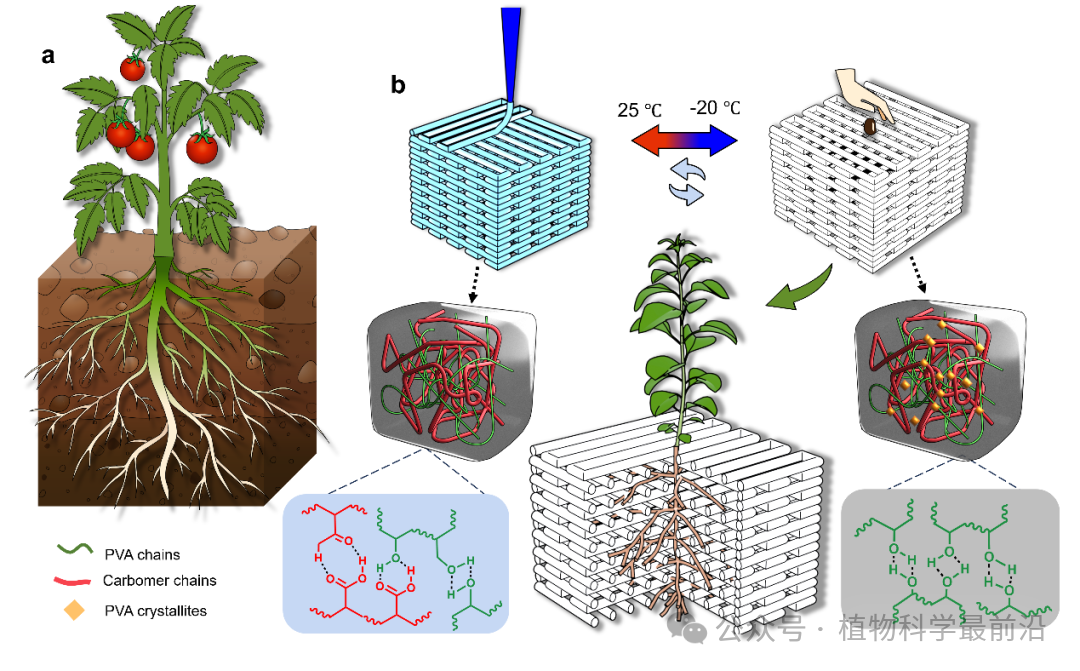
(a) Tomato plants growing in traditional soil; (b) Schematic diagram of PC hydrogel printing, crosslinking, and plant cultivation process.
Rotational rheometer and actual printing performance tests demonstrated the excellent printing performance of PC ink. Rheological performance tests showed that PC ink exhibits shear-thinning, yield stress, and thixotropic properties, indicating that PC ink is a non-Newtonian fluid with yield characteristics. In practical printing tests, compatibility tests indicated that PC ink maintains its non-fusion advantage even at close distances. Suspension tests showed that PC ink lines remain stable at a spacing of 16mm. The successful passage of PC ink through different inner diameter nozzles and the excellent printed structures confirm the outstanding printing performance of this ink.
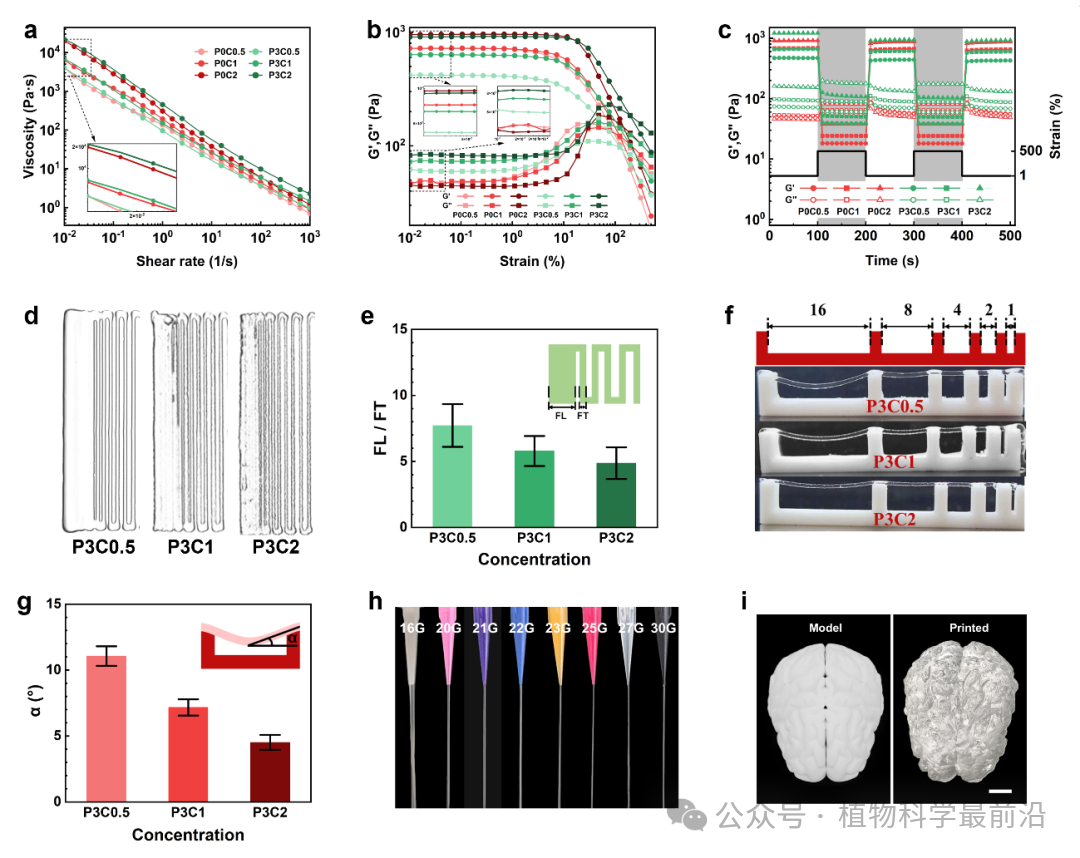
(a) Viscosity of inks with different carbomer contents as a function of shear rate; (b) G’ and G