In the past, we were accustomed to viewing AI as a passive tool, such as chatbots or image generators, where we provided explicit instructions, and it executed corresponding tasks. Once the task was completed, the conversation would end. This model is essentially a “question-and-answer” mechanism.
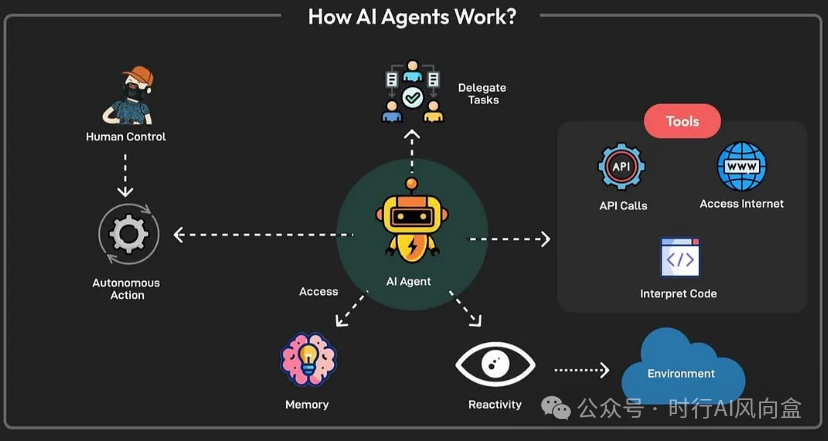
However, AI Agents are fundamentally different. Their core lies in autonomy and goal orientation. A complete AI Agent system typically includes the following key components:
-
Perception: The ability to perceive the external environment through various sensors and data sources (such as text, images, code, API interfaces, etc.) like a human.
-
Planning: Upon receiving a task objective, it can autonomously decompose complex tasks into a series of executable subtasks and formulate a detailed action plan.
-
Action: Based on the planned steps, it calls external tools or executes internal logic to complete the task.
-
Memory: It possesses long-term and short-term memory capabilities, allowing it to store historical information and learning experiences to improve future decisions and actions.
-
Reflection: During task execution, it can self-evaluate and reflect; if it encounters errors or failures, it can autonomously make adjustments and corrections to ensure the achievement of the final goal.
In simple terms, you no longer need to tell it, “Please help me generate an image” or “Please help me write a piece of code,” but rather you can give it a broader goal, such as “Help me organize a company annual meeting.” The AI Agent will autonomously break down this goal: for example, first booking the venue, then designing the event process, contacting suppliers, and finally producing promotional materials to complete the entire task. All processes require minimal human intervention; it acts like a capable digital employee, able to independently and efficiently complete complex tasks.
AI Agents are not an entirely new concept. In 1986, one of the pioneers in the field of artificial intelligence, Marvin Minsky, proposed a revolutionary idea in his book The Society of Mind: human intelligence is not controlled by a single, powerful “brain,” but rather emerges from countless simple, unconscious agents working together. Each “agent” is responsible for a very simple task, such as recognizing a shape or moving an object, while complex intelligent behavior is the result of the collaboration of these simple agents. This theory directly provided the theoretical basis for later developments in multi-agent systems and modular agent architectures. In the 1990s, with the development of distributed artificial intelligence and object-oriented programming, the concept of agents began to become more concrete. Researchers started to attempt to build software entities with autonomy and proactivity. However, it was not until the emergence of large models that AI Agents truly gained powerful language understanding, reasoning, and generation capabilities, allowing them to transition from the laboratory to practical applications.
If a single agent is already powerful enough, then multiple agents working together will be an inevitable trend for future development. This is akin to having different departments within a company, each with its own expertise, collaborating to complete a large project.
For example, in film production, a multi-agent system could consist of the following agents:
-
Script Agent: Responsible for generating the script based on the director’s ideas and continuously optimizing it.
-
Visual Agent: Responsible for transforming the scenes in the script into storyboard images and generating concept art.
-
Editing Agent: Responsible for automatically editing footage and compositing effects based on the script and the outputs of the Visual Agent.
This multi-agent collaborative model will greatly enhance the complexity and efficiency of tasks, potentially achieving grand projects that humans cannot complete. Experts predict that in the future, we will see collaborative teams composed of robots and AI models that can autonomously complete complex tasks such as building car factories and manufacturing rockets without human intervention.
 According to the latest market research report, the AI Agent market is experiencing exponential growth, with an expected market size of $216.8 billion by 2035 and a compound annual growth rate of over 40%.