3D-Printed Biomimetic Vascular Scaffold for Sustained Release of PDGFB-LG4 Fusion Protein Promotes Bone Regeneration
Advanced Science ( IF 14.3 ) Pub Date : 2025-03-27 , DOI: 10.1002/advs.202414362
Jiahua Duan, Gaofei Qian, Huikang Zhang, Feifan Wang, Qiang Tian, Dong Lei, Jianning Zhao
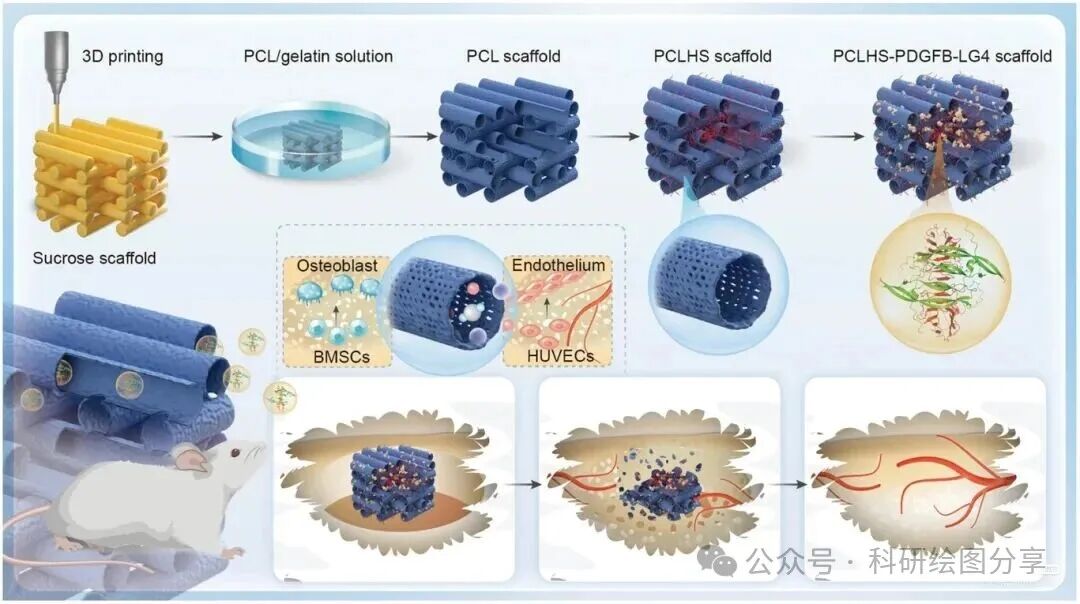
The 3D-printed biomimetic vascular scaffold crosslinked with heparan sulfate is used for the sustained release of PDGFB-LG4 fusion protein to promote bone regeneration.
A central focus of bone tissue engineering is the construction of a vascular system to provide nutrients for cell survival, remove metabolic waste, and accelerate tissue regeneration. Platelet-derived growth factor-BB (PDGFB) has the ability to stimulate angiogenesis and bone regeneration; however, its clinical application is hindered by side effects and low efficacy due to suboptimal delivery systems. In this study, a biomimetic vascular scaffold crosslinked with heparan sulfate (HS) was developed for the sustained delivery of PDGFB-LG4 fusion protein, targeting the regeneration of critical-sized bone defects. The scaffold features a vascular-like layered structure design, incorporating a custom 3D framework, multi-branch microchannels, and permeable porous walls to facilitate mass exchange and cell infiltration. Compared to PDGFB, PDGFB-LG4 exhibited superior osteoinductive and angiogenic activity. In a cranial defect model, the composite scaffold (PCLHS-PDGFB-LG4) significantly enhanced angiogenesis and bone regeneration, demonstrating higher efficacy at lower doses compared to PDGFB. This approach may be applicable to other growth factors and gelatin-based materials, showing broad potential in regenerative medicine.
Disclaimer:
This article is for research illustration purposes only!!! If there is any infringement, please contact us for deletion or other handling.
This article may contain subjective conclusions from the authors of the literature and does not represent the views of the editors. There may be omissions and errors in the text, and we welcome criticism and correction.