According to the latest information revealed, the competition for flagship chips in 2026 will escalate once again. Based on leaks from a well-known digital blogger, MediaTek’s Dimensity 9600 has completed its design tape-out and is expected to enter mass production by the end of next year, utilizing TSMC’s latest 2nm process technology. This signifies a transition from the 3nm era to a new 2nm era for flagship chips, bringing disruptive improvements in performance and energy efficiency for smartphones.
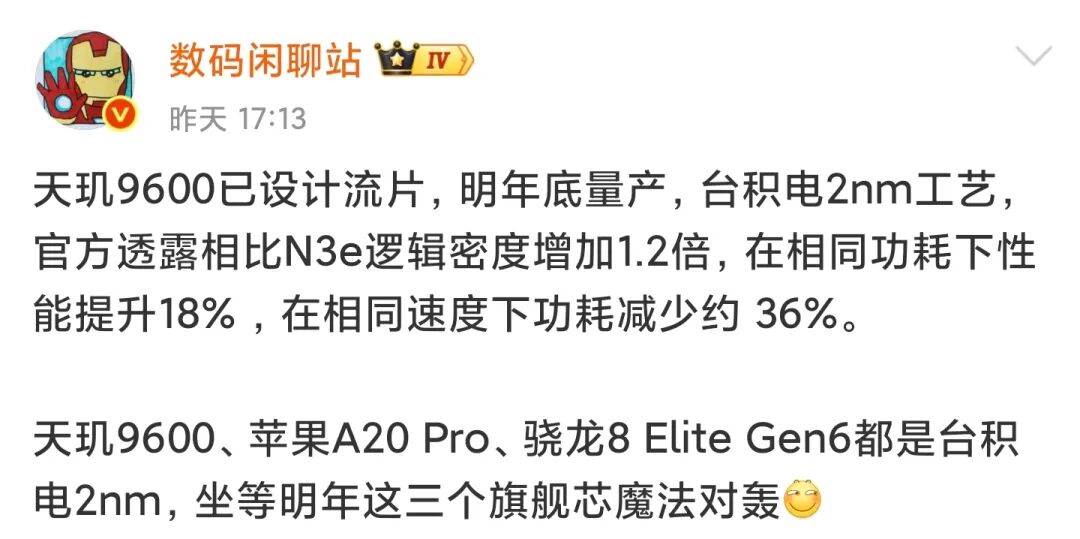
It has been revealed that compared to the current N3e 3nm process, TSMC’s 2nm process improves transistor density by 1.2 times. This enhancement allows for a performance increase of up to 18% under the same power consumption conditions, while power consumption can be reduced by approximately 36% for the same performance level. For smartphones, this not only means stronger computing power and AI performance but also brings substantial improvements in battery life. The balance between high performance and long battery life in future flagship phones is expected to achieve a qualitative leap due to the breakthrough of the 2nm process.
In addition to the Dimensity 9600, Apple’s A20 Pro and Qualcomm’s Snapdragon 8 Elite Gen6 will also adopt TSMC’s 2nm process simultaneously. The competition among these three flagship chips is bound to ignite an unprecedented “chip war” next year. Apple, with its powerful self-developed architecture and ecosystem optimization, may continue to lead in single-core performance and energy efficiency; Qualcomm will leverage GPU and AI acceleration capabilities to maintain its strength in the Android flagship camp; while MediaTek’s Dimensity 9600 is expected to further narrow the gap with Qualcomm through its high cost-performance and energy efficiency advantages, and even surpass it in certain areas.
However, it is regrettable that due to the restrictions of new sanctions, Xiaomi’s self-developed Xuanjie O2 chip cannot utilize the latest 2nm process and will still be produced based on TSMC’s 3nm process. Although 3nm is still considered advanced, it will inevitably lag behind the 2nm in terms of performance release and energy efficiency. This poses a challenge for the development pace of Xiaomi’s self-developed chips and indicates that Xiaomi may be at a certain disadvantage in the chip aspect during next year’s flagship battle.
Overall, the mass production of TSMC’s 2nm process will become the core driving force behind the performance leap of flagship smartphones in 2026. The competition among the Dimensity 9600, Apple A20 Pro, and Snapdragon 8 Elite Gen6 will not only determine the performance landscape of next year’s flagship devices but will also propel the entire smartphone industry into a new round of technological competition.