💥💥💞💞Welcome to this blog❤️❤️💥💥
🏆 Blogger’s Advantage:🌞🌞🌞The blog content aims to be logically coherent and clear for the convenience of readers.
⛳️Motto:Those who travel a hundred miles are halfway at ninety.
💥1 Overview
Smart Battery Charging: Optimizing SOC Using PID Controller
Explore the capability of utilizing a PID controller for smart battery charging in MATLAB, efficiently maximizing the State of Charge (SOC). This MATLAB program equipped with a PID controller unleashes the potential of smart battery charging. Witness how proportional, integral, and derivative control harmoniously adjusts the charging current to precisely reach your desired SOC. Experience a dynamic simulation that considers safety limits and voltage variations.
Research on optimizing SOC for smart battery charging using PID controller
Background Introduction
Batteries are increasingly used in modern electronic devices and electric vehicles, and smart battery charging technology plays a crucial role in enhancing battery life and performance. During the charging process, the State of Charge (SOC) of the battery is a key parameter. The PID controller (Proportional-Integral-Derivative Controller) is widely used in various control systems due to its simplicity and effectiveness, optimizing the SOC during the battery charging process for more efficient and safer charging.
Research on Optimizing SOC for Smart Battery Charging Using PID Controller
Abstract
This study aims to explore how to utilize a PID (Proportional-Integral-Derivative) controller to optimize the SOC (State of Charge) during the battery charging process, improving charging efficiency, extending battery life, and ensuring charging safety. By establishing a mathematical model of the battery, designing a PID controller, and conducting simulation experiments in the MATLAB/Simulink environment, the effectiveness of the PID controller in optimizing SOC has been verified.
1. Introduction
With the popularity of electric vehicles and portable electronic devices, smart battery charging technology has become key to enhancing battery performance and lifespan. SOC, as an important indicator for assessing the remaining battery capacity, requires precise control to prevent overcharging, undercharging, and optimize charging efficiency. The PID controller is widely used in various control systems due to its simplicity and effectiveness; this study introduces it into the battery charging process to achieve optimized SOC control.
2. Battery Model Establishment
To accurately simulate the battery charging process, this study adopts equivalent circuit models (such as Rint model or Thevenin model) to describe the dynamic characteristics of the battery. These models can reflect the voltage and current responses of the battery under different SOC and charge-discharge conditions, providing a foundation for the design of the PID controller.
3. PID Controller Design
3.1 PID Control Principle
The PID controller adjusts the control quantity through three components: Proportional (P), Integral (I), and Derivative (D), to reduce system error and improve stability. During the battery charging process, the PID controller dynamically adjusts the charging current and voltage based on the difference between the current SOC and the target SOC, achieving precise SOC control.
3.2 PID Parameter Tuning
Tuning the PID parameters is crucial in controller design. This study employs classical methods (such as Ziegler-Nichols method) and modern intelligent optimization algorithms (such as Particle Swarm Optimization, Genetic Algorithms, etc.) to tune the PID parameters. By comparing the effects of parameters tuned by different methods on SOC optimization, the optimal parameter configuration is selected.
4. Simulation Experiments
4.1 Simulation Environment Setup
Set up the simulation environment for the battery model and PID controller in the MATLAB/Simulink environment. Set the initial SOC, capacity, voltage, and other parameters of the battery, and define the target SOC during the charging process.
4.2 Charging Process Simulation
Simulate the charging process under different operating conditions, including constant current charging phase and constant voltage charging phase. The PID controller dynamically adjusts the charging current and voltage, observing the changes in SOC.
4.3 Result Analysis
- SOC Changes: The PID controller can adjust the charging parameters in real-time according to the battery state, allowing SOC to rise smoothly to the target value, avoiding overcharging and undercharging.
- Charging Efficiency: Compared to traditional constant current charging methods, the PID controller can shorten charging time while ensuring charging efficiency.
- Battery Temperature: Experimental results show that the battery temperature during charging is controlled within a safe range, helping to extend the battery’s cycle life.
5. Discussion
5.1 Impact of PID Parameters on SOC Control
Appropriate PID parameters can significantly improve the control accuracy of SOC. Parameters tuned by intelligent optimization algorithms perform better than traditional methods, responding more quickly to system changes and reducing overshoot.
5.2 Comparison of PID Controller with Other Control Methods
Compared to other advanced control methods such as Model Predictive Control (MPC) and Fuzzy Control, the PID controller has advantages of simplicity in implementation and low computational load. Although it may not be as precise as other methods in some complex conditions, it meets the needs in most practical application scenarios.
5.3 Challenges and Solutions in Practical Applications
In practical applications, uncertainties in battery models and variations in environmental temperature may affect the accuracy of SOC estimation. To address these issues, adaptive control algorithms and multi-sensor fusion technologies can be combined to improve the robustness of the system.
6. Conclusion and Outlook
6.1 Research Conclusion
This study verifies the effectiveness of the PID controller in optimizing SOC during the battery charging process through simulation experiments. Appropriate PID parameters can significantly improve SOC control accuracy and charging efficiency while ensuring charging safety.
6.2 Future Outlook
Future research can further optimize the parameter tuning methods of the PID controller, validating them with more battery models and practical application scenarios. Additionally, exploring AI-based adaptive PID control algorithms can further enhance the intelligence level of charging systems.
📚2 Operation Results
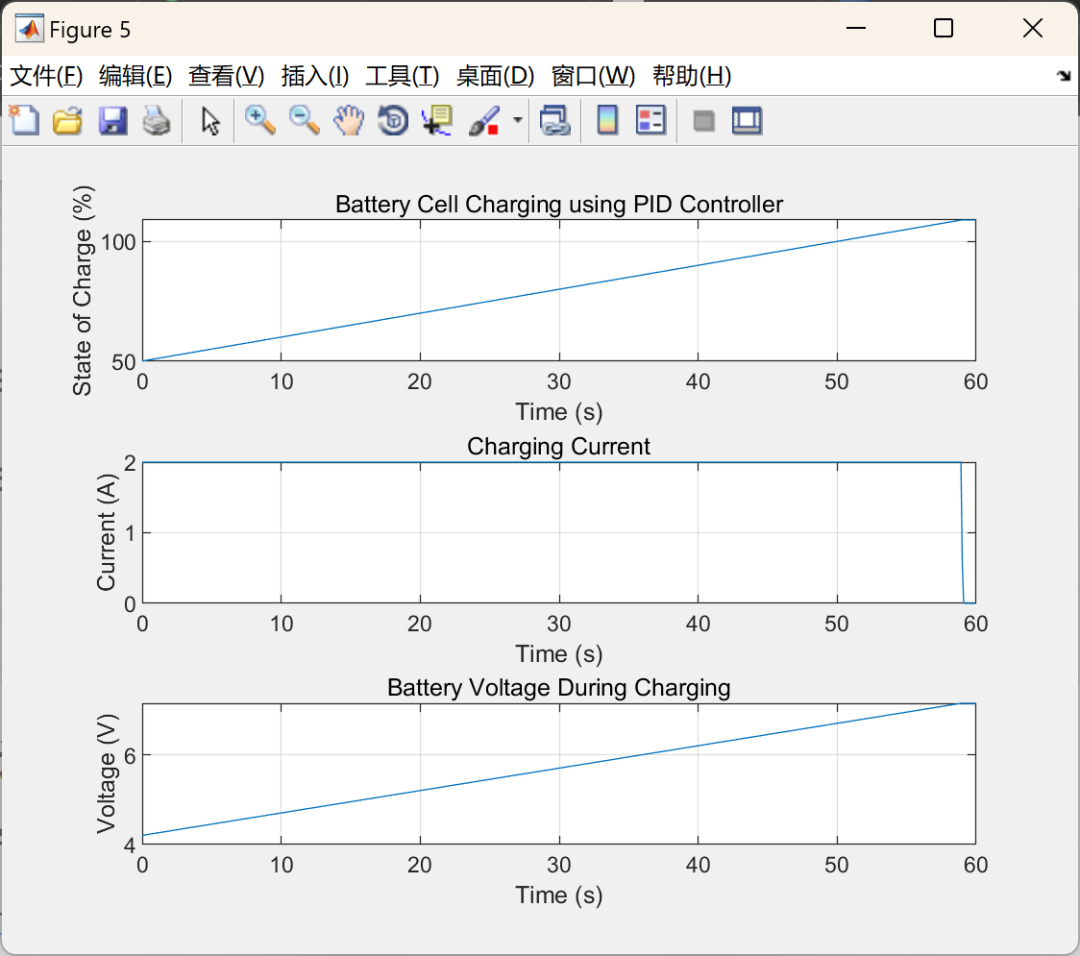
Partial Code:
% Battery parametersCapacity = 2000; % Battery capacity in mAhVoltage = 4.2; % Battery voltage in volts
% Initialize PID controller parametersKp = 1;Ki = 0.1;Kd = 0.01;
% Setpoint (desired SOC)setpoint = 80; % 80% state of charge
% Initialize variablesSOC = 50; % Initial state of charge in percentageerror = 0;integral = 0;
% Time vectortime = 0:0.1:60; % Time range for simulation in seconds
% Battery charging simulation
🎉3 References
Some content in this article is sourced from the internet, and references will be noted or cited as references. If there are any inaccuracies, please feel free to contact us for removal.
[1] He Huijie. Application research on PID controller parameter optimization design based on intelligent algorithms [J]. Science and Technology Innovation Herald, 2009(8):1.
[2] Li Yuan. Simulation research on intelligent PID controller optimization [J]. Computer Simulation, 2012, 29(12):4.