The router giant TP-Link’s journey in chip self-development ultimately could not withstand the winter of 2025. Following the rapid layoffs of the Shanghai team of its export entity, Lianzhou International, in June, news has recently emerged that its chip division has been completely disbanded, with even two router chips that had successfully taped out and were about to enter mass production being halted. This four-year self-development attempt has temporarily come to an end.
01
From “rapid layoffs” to “complete disbandment”: two major contractions in six monthsThe layoffs were more thorough than expected. According to market news, the chip division of Lianzhou International has been completely disbanded, with all chip-related positions closed, even affecting recent graduates who had only been on the job for two months. Just this June, the WiFi chip department of Lianzhou International in Zhangjiang, Shanghai, had experienced a “half-day completion of resignations” rapid layoff, focusing only on the research and development of WiFi front-end modules (FEM) while retaining some core members.Compared to the previous “partial contraction”, this adjustment can be described as a “complete exit”. However, it is worth noting that individuals close to TP-Link’s parent company, TP-Link Technologies, clarified that the disbandment of the chip business was by the independently operated Lianzhou International, and not by TP-Link Technologies, which focuses on the domestic market; the two are no longer directly related in operations.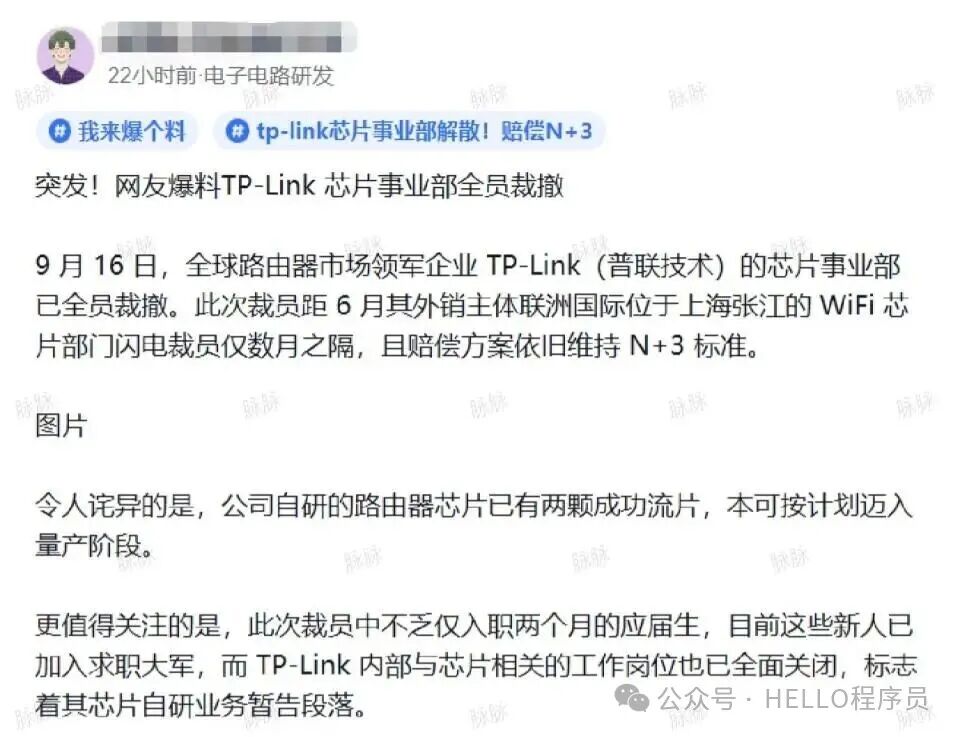 The layoff compensation continues to follow the previous N+3 standard, where N is calculated based on the average social wage, and additional compensation is based on years of service: 3 months’ salary for those with over a year, 2 months for those with 6 months but less than a year, and 1 month for those with less than 6 months. Although this plan is considered standard in the industry, it cannot hide the helplessness of the chip team—after four years of hard work producing two taped-out chips, they ultimately could not wait for the day of mass production.
02
Four years of investment down the drain? Self-developed chips stuck in a dead endTP-Link’s chip dream began in 2021, when it aimed at the smart home WiFi 6 chip market and formed a team to try to break free from reliance on suppliers like Qualcomm and MediaTek. As a giant that once held a 45% share of the global router market, its determination to develop its own chips was once viewed positively by the industry.However, reality has proven to be far more brutal than planned. Despite continuous investment in research and development over four years, and even successfully advancing two chips to tape-out, it has never achieved commercial viability, with core products still heavily reliant on external solutions. Industry insiders have calculated that the cost of just the tape-out phase of chip development can reach tens of millions, and with the manpower investment in algorithms, validation, design, etc., the scale of money burned over four years is unimaginable.Even more challenging is that the market is already crowded with players. Giants like Qualcomm, MediaTek, and Huawei not only occupy a large portion of the market share but have also built tight patent barriers. Meanwhile, competition for Wi-Fi 7 has intensified, and the Wi-Fi 8 standard is already in the research phase, leaving Lianzhou International’s chip team unable to catch up. Some netizens bluntly stated: “Realtek has driven the price of WiFi 7 chips extremely low; TP-Link’s self-developed costs can’t even be recouped, how can they compete?”
03
Market, cost, and geopolitical pressures: three mountains crushing the self-development dreamLianzhou International’s retreat is essentially a necessary choice under multiple pressures. From a cost perspective, chip development is a “money-eating beast”; Wi-Fi chips not only have a high technical threshold but also require continuous massive investment, and Lianzhou International has never been able to break through the profitability bottleneck. The long-term imbalance between investment and output ultimately exhausted their patience.Market competition is even more suffocating. Although the global network equipment market is expected to reach $127.139 billion by 2025 and grow to $173.367 billion by 2032, the market is crowded with competitors like Cisco, Huawei, and H3C. In such a highly competitive environment, companies are forced to cut unprofitable businesses and concentrate resources to maintain core advantages.Geopolitical variables have further pressured overseas operations. Earlier reports from Bloomberg indicated that the U.S. Department of Commerce is investigating Lianzhou International’s relationship with China, fearing it poses a national security threat—Lianzhou International’s market share of Wi-Fi devices in the U.S. retail market has reached 60%, six times that of 2019. Although the actual controller denies any relationship and has moved sensitive positions to the U.S., this pressure undoubtedly made the self-development of chips, a “sensitive business”, a priority for reduction.
04
Behind the giants’ exit: the deadlock of self-development for small and medium playersLianzhou International’s exit has shattered the fantasy of small and medium players in chip self-development. In the chip industry, it is already a consensus that “successful tape-out does not equal commercial landing”; even if the tape-out hurdle is crossed, subsequent challenges such as yield rates in mass production, market validation, and patent avoidance will follow. For non-chip-native companies like TP-Link, they must face not only the technological blockades of giants but also the pressure of continuous losses, making breakthroughs as difficult as climbing to the sky.Some industry analysts point out that this is not TP-Link’s main entity abandoning its chip layout, but rather a rational choice made by the independently operated Lianzhou International based on the overseas market environment. After all, for hardware manufacturers, “outsourcing is cheaper than self-development” is a realistic consideration, especially after companies like Realtek have initiated price wars, making the cost advantages of self-developed chips even harder to realize. Meanwhile, TP-Link Technologies focuses on the domestic market and may still be looking for a more suitable path for chip breakthroughs.This four-year self-development attempt has come to an end, leaving the industry with heavy reflections: when giants like Qualcomm and MediaTek build patent walls, when the speed of Wi-Fi standard iterations exceeds the research cycle, and when geopolitical factors intervene, is the chip self-development of hardware giants a necessary threshold to cross, or a risky venture that is not worth the cost?For ordinary consumers, there may not be noticeable changes in the short term—TP-Link routers will still be equipped with Qualcomm and MediaTek chips for normal sales. However, in the long run, with one less challenger in the chip market, will there be less innovation and cost-effectiveness? This is perhaps the more concerning question.Do you think TP-Link’s decision to cut its chip team is a wise stop-loss or a missed future opportunity? Feel free to discuss in the comments!