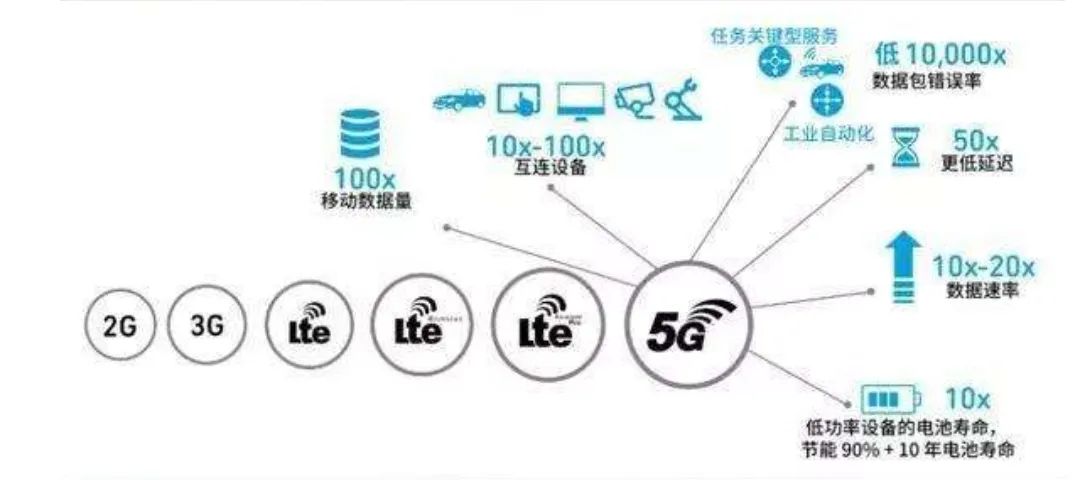
5G is the fifth generation mobile communication standard, formulated by International Telecommunication Union (ITU). The official name of 5G is IMT-2020. The vision of 5G is to achieve the Internet of Everything, rather than just improving the speed as done in previous generations of mobile communication standards.
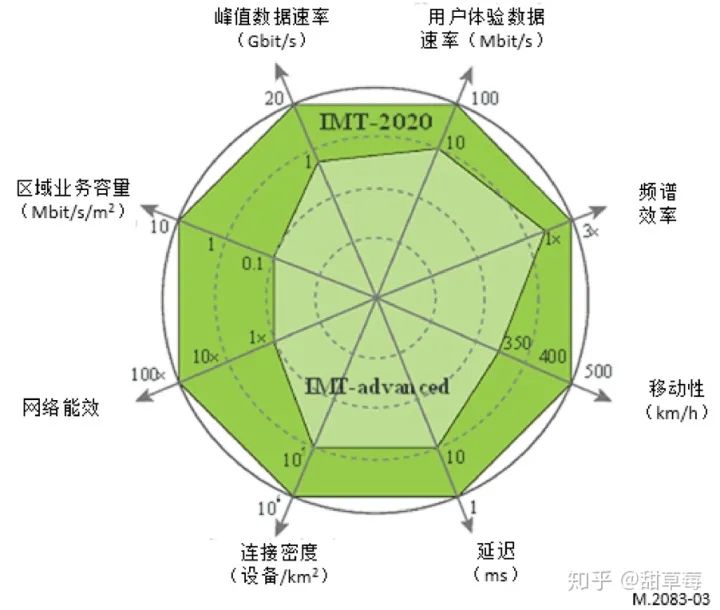
5G comprehensively considers peak rate, user experience rate, spectral efficiency, mobility, latency, connection density, network energy efficiency, traffic density and other technical indicators. From the radar chart below, it can be seen that 5G needs to support a peak data rate of 20 Gbit/s, with users experiencing a bandwidth of up to 100 Mbit/s, achieving an end-to-end connection latency of 1 ms, a cell throughput of 10 Gbps, a connection density of 1 million connections per square kilometer, and supporting high mobility services at 500 km/h.
Three Major Application Scenarios of 5G NR
5G takes into account so many performance indicators not just to meet the development of personal services, but also divides it into three major application scenarios:
- Enhanced Mobile Broadband (eMBB)
- Massive Machine Type Communications (mMTC)
- Ultra-Reliable Low Latency Communications (uRLLC)
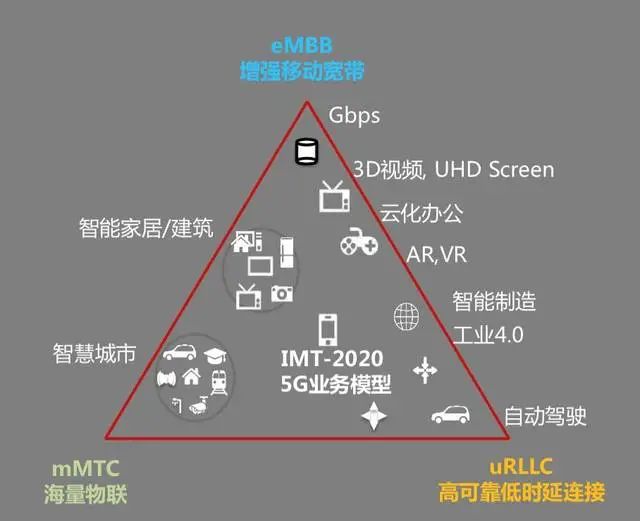
Enhanced Mobile Broadband: This application scenario has a high demand for data traffic, such as AR (Augmented Reality), VR (Virtual Reality), and 4K, 8K ultra-high-definition videos. These applications are currently limited by traffic, so the user experience is not optimal.
Massive Machine Type Communications: This application scenario has a demand for a large number of device connections, which are no longer just for mobile terminals but are aimed at connecting many other devices, achieving connectivity between people and things, and things to things, which is the Internet of Things. For example, smart cities, smart buildings, etc.
Ultra-Reliable Low Latency Communications: This application scenario is mainly reflected in special industries with low latency requirements, such as autonomous driving, industrial control, remote medical care, etc.
5G NR Frequency Distribution
Any wireless communication service transmission cannot do without the wireless spectrum, which is the carrier of information transmission, just like the roads around us. To achieve the three major application scenarios mentioned above, more spectrum resources are needed than ever before. However, spectrum resources are limited, and 5G allocates two frequency range resources FR1 and FR2. (FR: Frequency Range)
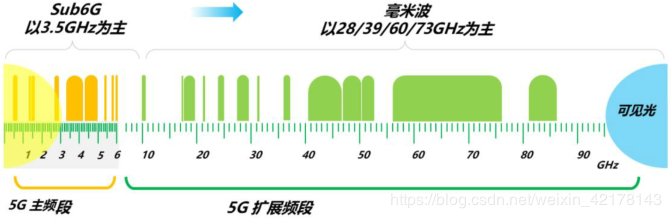
FR1: This is the main frequency band of 5G because this band is below 6 GHz, referred to as Sub6G. The frequency range is from 450 MHz to 6000 MHz. The lower frequency has a strong penetration capability and better coverage effect; this band is considered the golden frequency band for wireless communication.
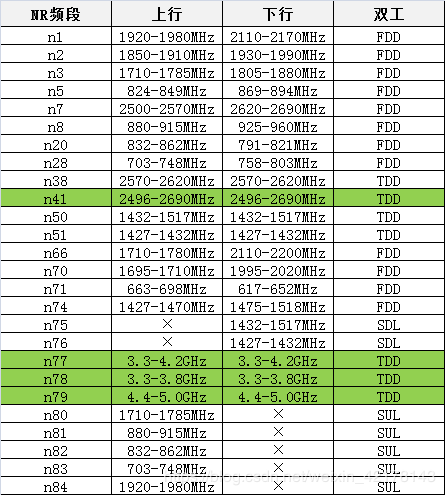
Currently, the 5G being built in China is also in this frequency band. The distribution of the main frequency bands of major operators can be referred to in the following figure. The broadcasting industry is also involved in 5G, possessing 700 MHz spectrum resources, which can be considered the golden spectrum among gold.
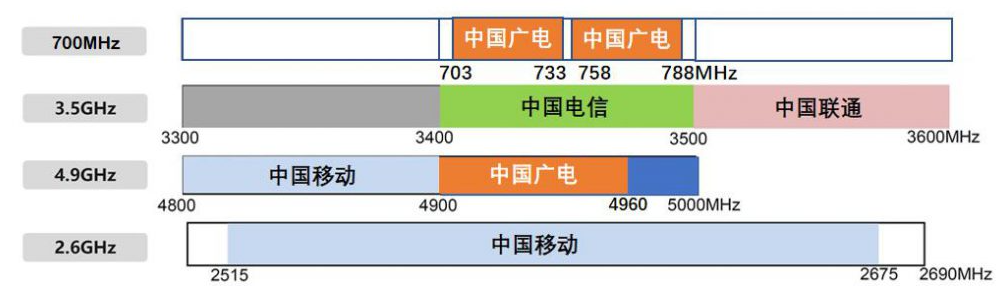
China Unicom and China Telecom use the n78 3.5 GHz frequency band, which is widely used in many countries globally for 5G, and its industrial chain is relatively mature. Therefore, they can deploy 5G networks at a relatively low cost. However, the n41 and n79 frequency bands used by China Mobile are not as mature as n78 in terms of chips or devices, requiring a lot of effort to promote the development of the industrial chain for these bands.
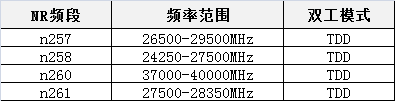
FR2: This is the extended frequency band of 5G, as this frequency band can reach up to 28 GHz, with wavelengths at the millimeter level, referred to as millimeter wave. Its frequency range is from 24250 MHz to 52600 MHz; this band has rich spectrum resources, which can achieve ultra-large bandwidth and less interference.