In May of this year, Xiaomi officially launched the self-developed Xuanjie O1, which is Xiaomi’s first self-developed 3nm flagship chip. Not only does it boast powerful performance, but its manufacturing process is on par with the latest flagship chips from Apple and Qualcomm, showing a significant advantage over Huawei’s Kirin chips.
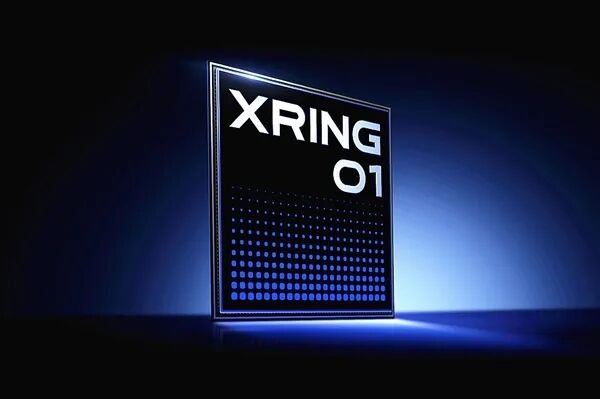
This makes Xiaomi the second company in China, after Huawei, to master high-end mobile core chips (SoC). This also means that future domestic flagship smartphones will no longer rely entirely on Qualcomm and MediaTek for core chip selection.
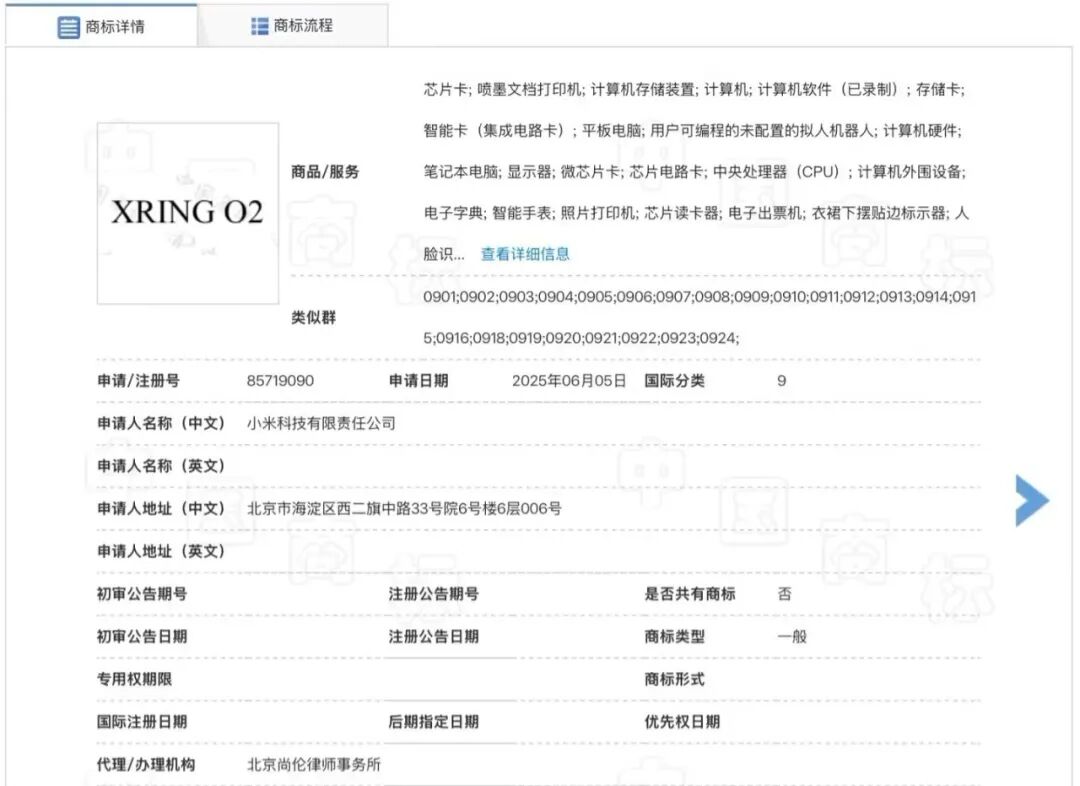
Additionally, reports indicate that Xiaomi is advancing the development of the Xuanjie O2 chip. Earlier this month, Xiaomi applied for the trademark registration of “XRING O2”, clearly preparing for the next generation of self-developed chips.
At the Xiaomi YU7 launch event on June 27, Lei Jun also discussed the Xuanjie chip. He stated that when developing the Xuanjie O1, Xiaomi did not expect it to perform this well. He also revealed that the second generation Xuanjie chip, the Xuanjie O2, will consider applications in automobiles, and Xiaomi has already developed a “four-in-one domain controller” to prepare for the chip’s successful integration into vehicles.
It is worth noting that recently, Digital Chat Station also brought new revelations: Xiaomi’s upcoming product lines in chips, automobiles, and smartphones are very aggressive, and there will be a technological explosion in the future, all progressing in an orderly manner.
However, the blogger also revealed that the subsequent iterations of the Xiaomi Xuanjie chip, due to the inability to break through the EDA ban, will be stuck at the 3nm process node, and it may take a long time to advance to a more advanced 2nm process.
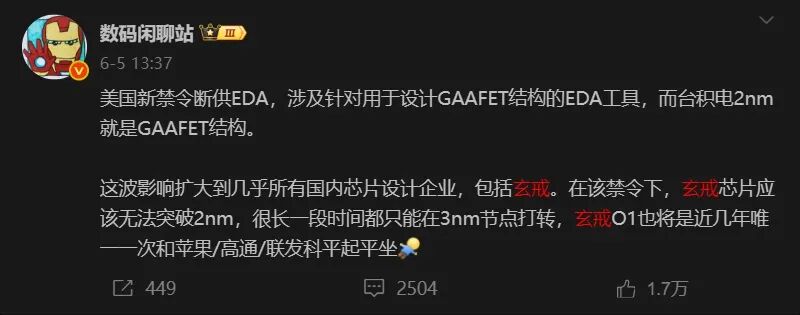
This means that the Xiaomi Xuanjie subsequent chips will still be at most 3nm, and this year’s Xuanjie O1 may be the only domestic chip in recent years that can compete with Apple, Qualcomm, and MediaTek in terms of process technology.
However, starting next year, these competitors will collectively shift to TSMC’s 2nm process, while Xiaomi will find it difficult to keep up.
It must be said that the Xiaomi Xuanjie O1 has indeed started strong, with a peak at the beginning, a 3nm process, and an internal integration of 19 billion transistors, utilizing a ten-core four-cluster design. Such a complex architecture cannot be handled manually; from layout to power optimization, it must rely on professional EDA tools to complete.
The inability of Xiaomi’s chips to break through 3nm is mainly related to the expansion of the ban by the U.S. Department of Commerce’s Bureau of Industry and Security (BIS) at the end of May, which comprehensively prohibits the export of EDA tools used for designing GAAFET (Gate-All-Around Field-Effect Transistor) structures to China. TSMC, Samsung, and other manufacturers’ 2nm processes use GAAFET structures, which means Xiaomi will not be able to obtain the necessary tools to design 2nm chips in the future.
However, this is not the first time the U.S. has restricted EDA tools; back in 2018 and 2019, ZTE and Huawei were already sanctioned due to EDA tools.
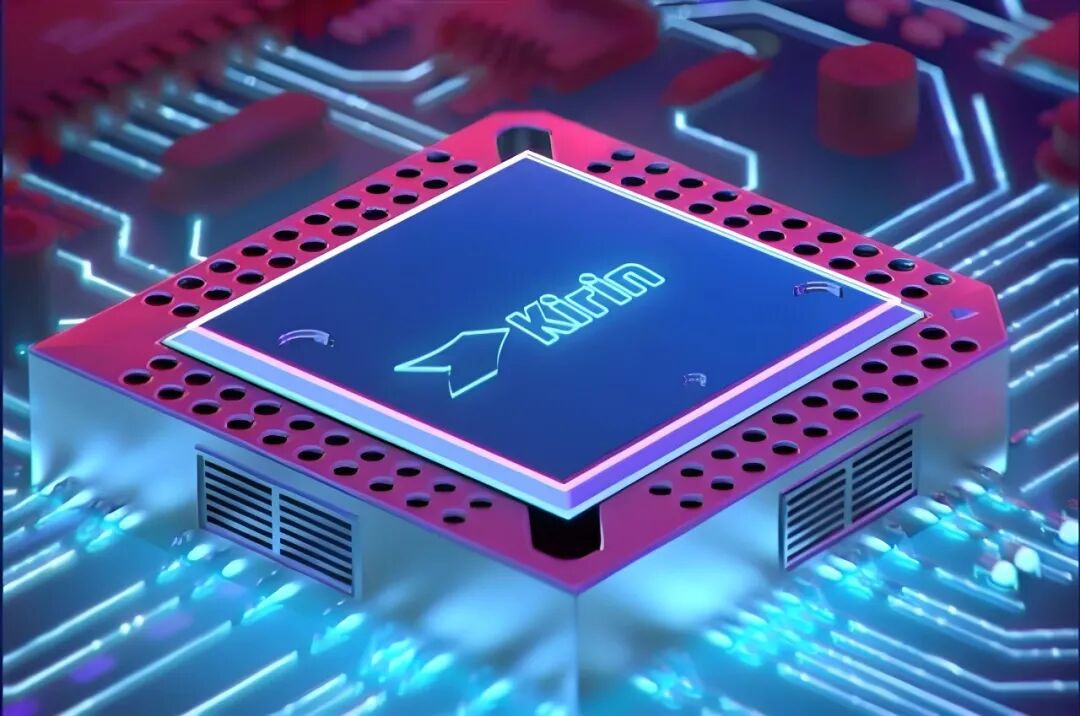
In comparison, Huawei is currently following a true self-research path. Although the process level of its Kirin flagship chips is still at 5 – 7 nm, it is completely unaffected by U.S. sanctions and is continuously making breakthroughs along its established path.
In summary, while the Xiaomi Xuanjie chip starts at a high point, its future improvement space is relatively small, especially as advanced process technology remains constrained. If nothing unexpected happens, starting next year, the process technology of competitors will completely widen the gap with Xuanjie.
This may be the reason why, despite the strength of the Xuanjie O1, Xiaomi continues to sign long-term supply contracts with Qualcomm.
Recommended Reading:
Not all power banks with 3C certification can board planes; new regulations have been implemented.
Xiaomi YU7 criticized by Dongfeng Nissan executives: fans are blindly loyal.
12 new products! Xiaomi’s launch event tonight was explosive.
WeChat has updated again; new features have finally arrived!
Just now, a major feature of WeChat has returned; I have waited for 6 years!