1. The “Impossible Triangle” of Industrial Data Transmission: Real-time? Reliable? Low Cost?
Industrial sites have three conflicting demands for data transmission:✅ Low Latency (alerts must be fast)✅ High Reliability (data cannot be lost)✅ Low Resource Usage (limited computing power/bandwidth on edge devices)
—— Traditional solutions struggle to balance these:
|
Modbus TCP |
Medium (polling jitter) |
Low (no retransmission) |
Low |
Only supports request-response, cannot actively report |
|
OPC UA PubSub |
High |
High |
Very High |
Requires TLS + certificates + XML modeling, which edge devices cannot handle |
|
HTTP/REST |
Low (long connection issues) |
Medium (retries possible) |
Medium |
High overhead in request headers, low efficiency for small packets |
|
Proprietary TCP Protocol |
High |
Customizable |
Low |
Closed ecosystem, difficult to integrate and expand |
In contrast, MQTT (Message Queuing Telemetry Transport) breaks the deadlock with its minimalist design:
💡 Core Philosophy: Achieve maximum flexibility with minimal overhead — it is not designed for “transmitting massive videos” but for “allowing 10,000 devices to communicate quietly”.
2. The Five Industrial Genes of MQTT that Make it the “Standard Answer”
✅ 1. Extremely Lightweight: A “Friendly Neighbor” for Edge Devices
- The minimum message is only 2 bytes (PUBLISH + 1 byte Topic + 0 byte Payload)
- The average protocol header is **<10 bytes**, far less than HTTP ( >100 bytes)
- Supports C Language SDK (e.g., Eclipse Paho), with RAM usage < 10KB
→ Even older ARM Cortex-M3 devices can run it, without needing hardware upgrades.
✅ 2. High Reliability: From “Best Effort” to “Guaranteed Delivery”
MQTT’s QoS (Quality of Service) Levels precisely match industrial scenarios:
|
0: At Most Once |
Send and forget |
Environmental temperature and humidity, non-critical states |
Data refresh on large screens |
|
1: At Least Once |
Publisher retransmits until ACK |
Device alarms, control commands |
WeChat alarms, PLC write points |
|
2: Exactly Once |
Two-way handshake (use with caution in industrial settings) |
Financial-grade transactions |
Rarely used (high latency) |
🔧 Eight-bit edge modules default to QoS=1 + automatic reconnection + local caching, and in tests: under weak networks (15% packet loss), data integrity reached 99.98%.
✅ 3. Publish/Subscribe Model: Decoupling Devices and Applications
- Devices only need to “publish”:
<span>/factory/line1/temp 32.5</span> - Applications only need to “listen”: subscribe to
<span>/factory/+/temp</span> - Need to add an AI analysis module? Just subscribe to the same Topic — zero modification, instant integration.
→ Completely breaks the silo architecture of “one system, one collection”.
✅ 4. Disconnect Awareness: Last Will, Letting Offline Devices “Speak”
When a device comes online, it declares its “will”:
Topic: /status/plc_line1
Payload: {“online”: false, “reason”: “power_lost”}
Retain: true
- Normal operation: sends
<span>{"online": true}</span>every 10 seconds to cover the will; - Abnormal power loss: Brokerimmediately publishes the will → platform triggers alarms/switches to backup in seconds.
🌰 Eight-bit customer (wind farm): achieved 0 seconds awareness of turbine power loss, speeding up fault location by 5 times.
✅ 5. Open Ecosystem: A “Universal Interface” from Edge to Cloud
- Supports TLS 1.2/1.3 encryption (Eight-bit platform centrally manages certificates)
- Compatible with OPC UA PubSub over MQTT (IEC 62541-14)
- Mainstream cloud platforms (AWS IoT Core / Azure IoT Hub / Alibaba Cloud IoT) natively support
→ Truly achieving “one-time access, usable everywhere”.
3. MQTT’s “Industrial Upgrade” in Eight-bit Cube: More than Just Transmission, Driving Intelligence
In Eight-bit Smart Connect, MQTT is not just a “data pipeline”, but the key to starting an intelligent closed loop:
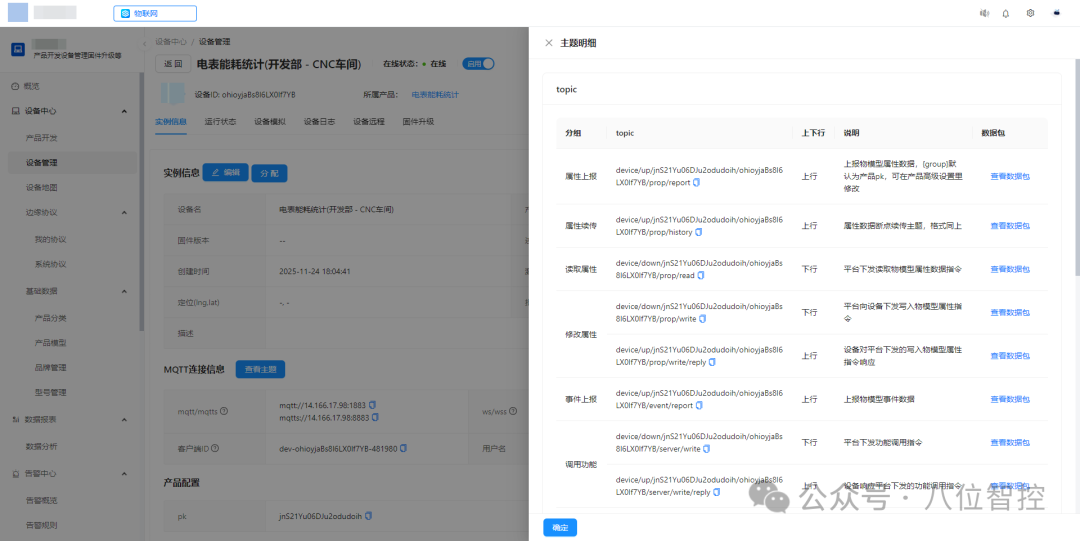
🔹 Scenario 1: Cross-Protocol Alarm Linkage (Modbus + S7 + MQTT)
- Modbus instrument: edge module detects temperature rise → publishes
<span>/alarm/temp_high</span> - Rule engine: subscribes to this Topic → automatically writes to S7’s DB block (shutdown signal) + pushes to WeChat → zero code, achieving “perception → decision → execution” closed loop.
🔹 Scenario 2: Edge-Cloud Collaborative Inference
- Cloud trains AI model → issues to edge via MQTT:
<span>/model/update/device001</span> - Edge inference results → publish to
<span>/ai/result/device001</span> - Platform aggregates → automatically generates maintenance work orders + feeds back model optimization
🔹 Scenario 3: Multi-Terminal Same-Source Distribution
The same MQTT message stream can simultaneously drive:
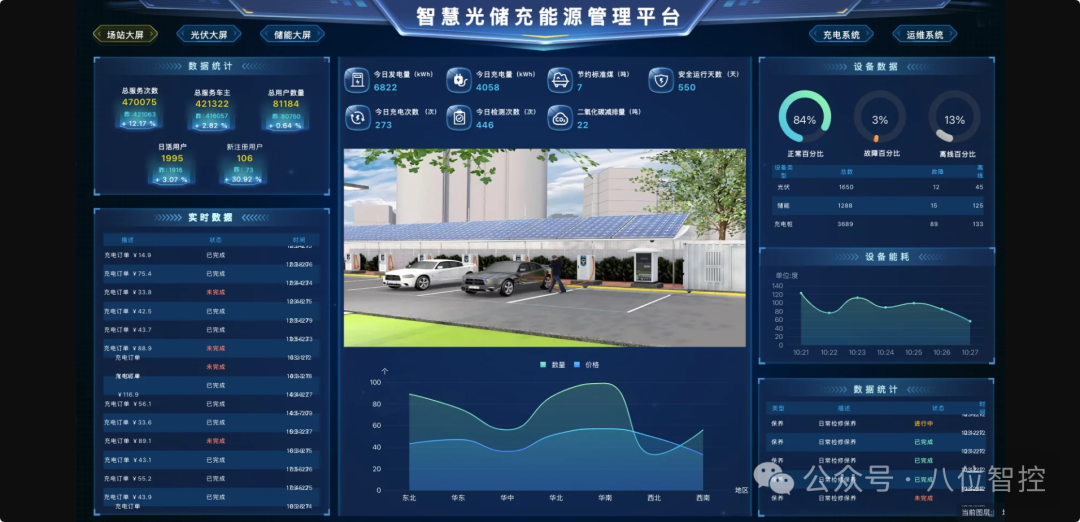
- Large screens (visual design tool subscribes)
- Mobile APP (application design module subscribes)
- Report systems (time-series database writes)
- Third-party MES (MQTT Bridge forwarding)
→ Data collected once, reused N times.
4. Customer Evidence: How Does MQTT Handle Industrial-Grade Loads?
🌰 Case Study: A Smart Energy Platform
- Scale: 12,000+ edge devices (RTU/gateway/PLC), average daily messages 120 million
- Architecture:
- Edge: Eight-bit edge module (MQTT Client + QoS=1 + AES encryption)
- Cloud: Eight-bit cube platform (self-developed high-concurrency Broker cluster)
- Metrics:
- End-to-end latency (P99):≤420ms
- Monthly message loss rate:0.0017%
- Single node throughput:150,000 messages/second
“We tried HTTP and proprietary protocols, ultimately choosing MQTT — not because it’s new, but because it’s stable, cost-effective, and scalable.” — Customer CTO
🔚 Conclusion: Standards Emerge from Consensus; Consensus Arises from Practicality
MQTT has become the data transmission standard for industrial IoT, not driven by any single giant, but by the choices of 100,000 engineers in workshops, wind farms, and substations —
When it allows an RS485 meter to communicate with an S7-1500, when it enables salespeople to build their own alarm APP, when it can stably transmit 100,000 messages/day over a 3G network…
— it has won..
At Eight-bit Smart Connect, we make MQTT:✅ Safer: Edge AES + Cloud TLS dual encryption✅ More Reliable: QoS + caching + reconnection triple guarantee✅ Smarter: Deep integration with rule engines/AI
🔗 Download Now: https://www.8iic.com/
#MQTT #IndustrialIoT #EdgeComputing #IIoT #IndustrialCommunication #EightBitSmartConnect #EightBitCube #OPCUA #PLC #SmartManufacturing