
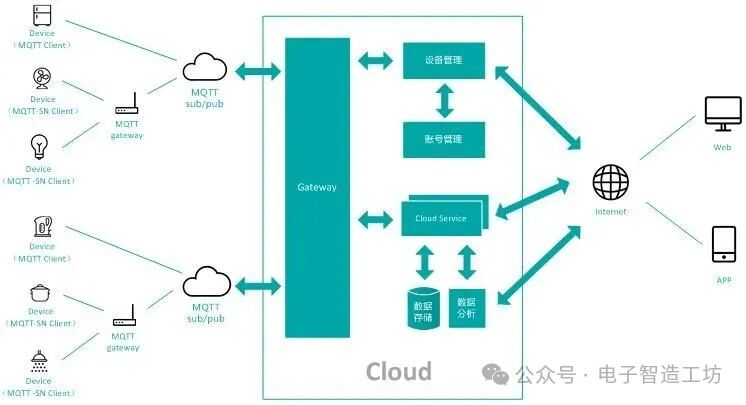
In today’s rapidly advancing technological era, the Internet of Things (IoT) has become the core link connecting the physical world with the digital world. The MQTT communication protocol, as the “invisible bridge” in the IoT field, is playing an irreplaceable role in automation, cutting-edge AI technologies, industrial intelligent manufacturing, and smart warehousing due to its unique advantages.
 // 1. MQTT: The “Nervous Center” of Automation
-
The core of automation lies in the efficient collaboration and precise control between devices. The MQTT protocol, with its lightweight and low bandwidth consumption characteristics, has become the ideal choice for device communication in automation systems.
-
In automated production lines, numerous sensors, actuators, and controllers need to exchange data in real-time. MQTT adopts a publish-subscribe model, allowing devices to focus only on the data topics they need without establishing complex point-to-point connections. For example, in an automotive assembly automated production line, a temperature sensor collects temperature data from the welding station in real-time and publishes it to the “Welding Temperature” topic. Once the controller subscribes to this topic and detects an abnormal temperature, it can immediately issue adjustment commands to the cooling system actuator, ensuring a rapid response and stability in production.
-
Moreover, the low power consumption feature of MQTT is also suitable for embedded systems in automation devices, ensuring stable data transmission even in resource-constrained environments, providing reliable support for the continuous operation of automation systems.
// 2. Deep Integration of MQTT and Cutting-edge AI Technologies
-
The development of AI technology relies on massive data support, and the MQTT protocol provides an efficient data collection and transmission channel for AI models, promoting the deep application of AI across various fields.
-
In industrial AI quality inspection scenarios, high-definition cameras, infrared sensors, and other devices scattered across the production line use the MQTT protocol to send collected product images, size data, and more to the AI server in real-time. The AI model trains and infers based on this continuous stream of data, quickly identifying product defects. With MQTT’s reliable message delivery mechanism, data integrity and timeliness are ensured, significantly improving the accuracy and efficiency of AI quality inspections.
-
Additionally, in intelligent decision-making systems, MQTT can aggregate device data scattered across various locations to the AI platform. AI analyzes this data to provide precise production scheduling, equipment maintenance, and other decision-making suggestions, achieving a deep integration of AI with the real economy.
// 3. The “Communication Cornerstone” of Industrial Intelligent Manufacturing
-
Industrial intelligent manufacturing pursues the intelligent, flexible, and efficient production process, with the MQTT protocol playing a key communication role, assisting industrial enterprises in achieving transformation and upgrading.
-
In smart factories, the entire production process from raw material storage to finished product delivery relies on the interconnection of various devices. Through the MQTT protocol, CNC machine tools, robots, AGVs (Automated Guided Vehicles), and other devices can share production data in real-time, enabling real-time monitoring and dynamic adjustment of production progress. When a device malfunctions, it immediately sends an alarm message to the operation and maintenance platform via MQTT. Upon receiving the information, the platform can quickly dispatch maintenance personnel to address the issue, reducing downtime and improving production efficiency.
-
Furthermore, the MQTT protocol supports collaborative communication between edge computing and the cloud. In industrial sites, edge devices can perform preliminary processing on the collected data and then upload critical data to the cloud via MQTT, reducing the computational pressure on the cloud and network bandwidth consumption, making industrial intelligent manufacturing systems more efficient and stable.
 // 4. The “Efficient Connector” of Smart Warehousing
-
Smart warehousing requires precise management of goods, rapid turnover, and efficient scheduling. The MQTT protocol provides strong support for seamless collaboration between various devices and systems in smart warehousing.
-
In smart warehousing, RFID (Radio Frequency Identification) tags, cameras, shelf sensors, and other devices use the MQTT protocol to transmit real-time information about the location, quantity, and status of goods to the warehousing management system. Based on this information, the system can intelligently plan the storage location of goods and schedule AGVs for material handling, achieving automation and intelligence in warehousing operations.
-
When an order is received, the warehousing management system publishes picking instructions to relevant devices via MQTT. The picking robots accurately pick according to the instructions and feedback the completion information to the system, making the entire process fast and accurate, significantly improving the order processing efficiency of the warehouse. At the same time, through the MQTT protocol, the smart warehousing system can also interact with upstream and downstream systems in the supply chain, achieving collaborative operations and reducing inventory costs.
Conclusion
The MQTT IoT communication protocol, with its unique advantages, demonstrates powerful enabling capabilities in automation, cutting-edge AI technologies, industrial intelligent manufacturing, and smart warehousing. As technology continues to advance, the MQTT protocol will continue to improve and optimize, providing solid communication support for the intelligent development of more fields, driving society towards a more efficient and intelligent direction.
If you would like to learn more about the application cases of the MQTT protocol in specific industries, feel free to leave a comment for discussion!

Recommended Previous Articles: