📝 Basic Concepts PLC stands for Programmable Logic Controller, which is a rugged computer used for automating processes.DCS, or Distributed Control System, is similar to PLC; it is also a rugged computer controller, but DCS includes multiple autonomous controllers distributed throughout the system, also used for automating processes. 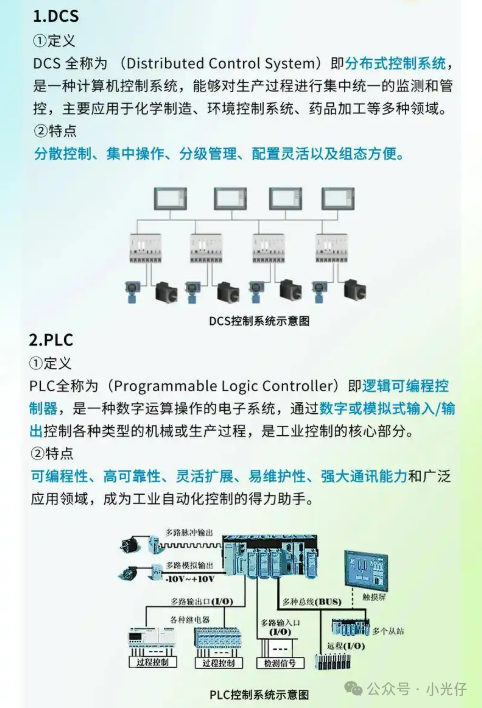 🔍 Traditional Differences Initially, PLCs were mainly used for discrete control, heavily purchased by automotive factories to replace relay systems, with programming primarily using ladder logic, a format very similar to schematics. PLCs receive information from field devices, solve logical problems, and then trigger outputs to produce the desired effects. Their invention was aimed at performing repetitive tasks reliably and durably. Around 1975, some companies launched DCS versions. The creation of DCS systems was driven by the increasing use of microcomputers. Since the late 1950s, there have been other computer-based systems in the industry, but their scalability, robustness, and security were limited. ✨ Features of DCS The main advantage of DCS is that the entire plant can be controlled by proprietary communication connections and distributed systems. For example, in an ice cream sandwich factory, the ice cream production line, freezing, cookie batching, baking processes, etc., can be handled by different autonomous controllers. A failure in one controller will only affect that process, nearly eliminating the risk of a total plant failure. DCS excels at autonomously controlling single or multiple processes, with an integrated monitoring system similar to today’s SCADA systems. A complete library of tags has been created for process control, which can be used on monitoring and control screens. It also features function block programming, where a segment or multiple lines of code behind a single interface can perform manual and automatic operations of valves, saving significant time and redundant programming.
 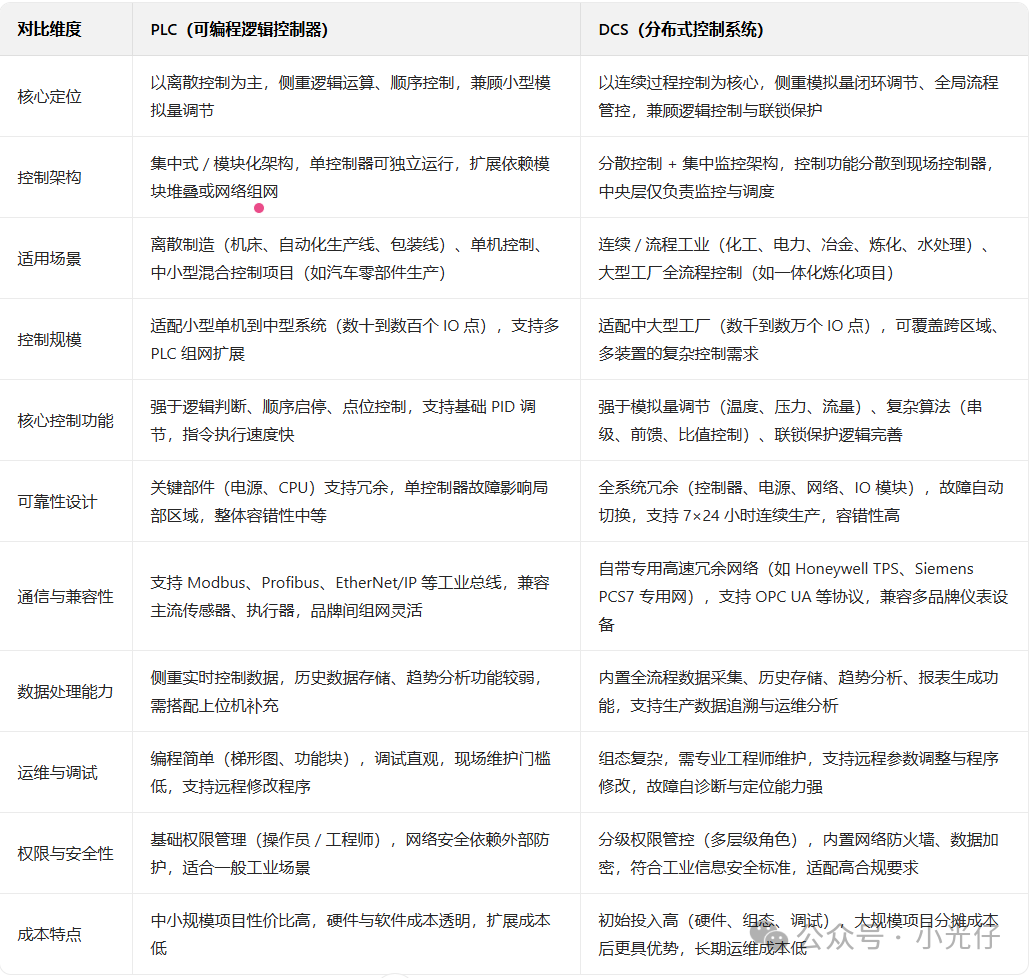 🔄 Modern Developments and Convergence Forty years ago, the differences between the two were quite significant, with large plants having continuous processes likely to choose DCS. In today’s industry, besides integrated monitoring, DCS and PLC are very similar. With open-source communication, fiber optics, Ethernet, etc., many PLCs can now communicate with each other and become autonomous PLCs, communicating with other autonomous controllers over the network. Powerful PLC systems can perform nearly the same tasks as DCS. ⚖️ Comparison of Advantages and Disadvantages Advantages of DCS: Installation costs are lower as autonomous controllers are close to process locations, which is advantageous compared to pulling long-distance I/O lines in the plant; it has onboard monitoring and control systems.Disadvantages: There is a lack of programmers with DCS experience; DCS programmers and technicians typically require more specialized database functionality experience and IT-related networking knowledge, making them harder to find. Advantages of PLC: The pool of available programmers is growing, and with the emergence of new programming languages like function blocks and sequential functions, the advantages of function block programming are no longer exclusive to DCS, saving development time.Disadvantages: For multiple PLCs in a factory structure, a monitoring system still needs to be created, and a separate PLC database must be created in SCADA system software, excluding monitoring and data acquisition SCADA.
 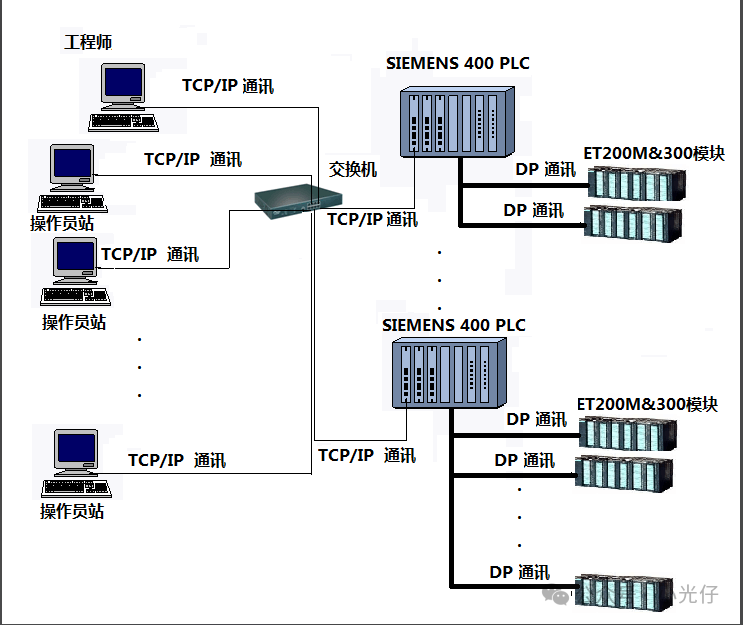 🎯 Conclusion With today’s technology, either system can control an entire plant. The choice of which system to use may consider the advantages and disadvantages as well as the system costs. DCS has autonomous controllers distributed throughout the plant, and a controller failure does not necessarily affect the entire plant, with onboard monitoring and control functions that save development time. A single PLC is a single point of failure, but a connected PLC system can achieve nearly the same safety and robustness as DCS.