In rehabilitation training, have you encountered these “small troubles”? Want to practice movements at home but worry about incorrect posture without anyone to correct you; dislike wearing sensors because they are uncomfortable, and often forget to charge wearable devices… Now, a motion analysis technology called MoveAI™ from the Israeli company Wizecare has lowered the “threshold” for home rehabilitation training to the minimum! Small companies can also have big ideas01WizeCare, originally established in 2011 as a physiotherapy clinic in the Tel Aviv area, began transforming in early 2016 to develop a service that connects physical therapists and patients globally.Today, WizeCare provides a mobile application for healthcare providers that allows therapists and clinicians to guide patients in home rehabilitation training. WizeCare creates personalized instructional videos based on the specifications of therapists or the care standards of the entire organization. Healthcare providers can also select from an existing video library. Patients receive invitations for customized plans created by their healthcare providers, who can track their compliance and training outcomes and adjust the plans accordingly.In March 2019, WizeCare launched the innovative MoveAI™ technology, which analyzes patients’ movements using mobile device cameras and deep learning algorithms. This technology allows patients to receive real-time performance scores and personalized guidance without using any wearable devices, simply by using their mobile devices, thereby improving their movements.
 No sensors needed, the phone camera can “understand” your movements02
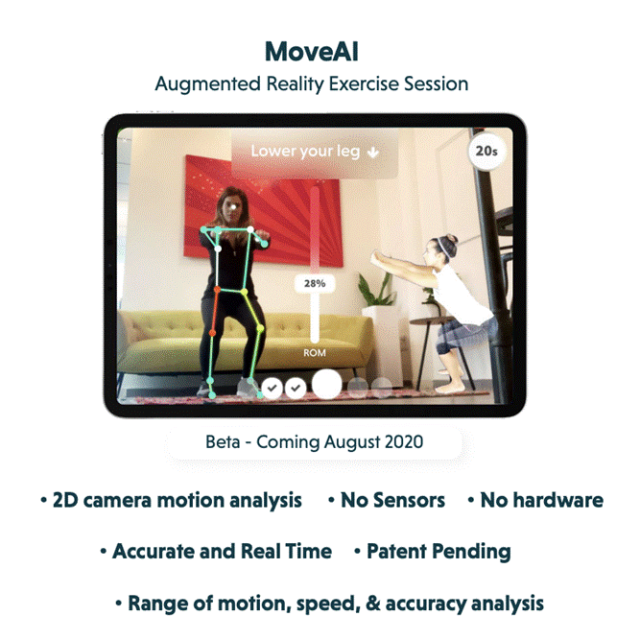 The core logic of MoveAI™ is very “light” yet very “accurate”—it does not require any sensors, wearable devices, or depth cameras; it can accomplish three tasks using just a regular 2D camera on a mobile phone:✅ Identification: Accurately capturing the entire process of patients performing rehabilitation movements (e.g., raising hands, bending knees, turning);✅ Tracking: Real-time locking of the movement trajectory of limbs/joints (e.g., “the left hand was raised from 90 degrees to 120 degrees in 2 seconds”);✅ Analysis: Translating “movements” into “data”—providing patients with immediate feedback (“not enough range, raise it higher~”), and generating clinical reports for therapists (“the speed of the patient’s left limb is 30% slower than the right limb”).
 It not only observes “whether the action was performed” but also “whether the action was performed correctly”03
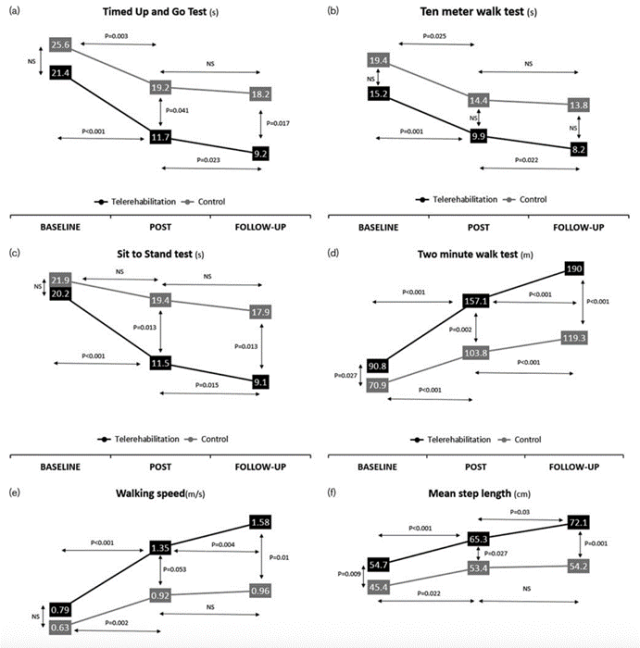 Many people think that rehabilitation training is “enough to do it”, but the quality of the movements is the key to effectiveness—what’s impressive about MoveAI™ is its ability to turn “vague feelings” into “quantifiable metrics”, covering the full-dimensional needs of rehabilitation.In simple terms, it helps you distinguish between “raising a hand” and “raising the correct hand”, transforming rehabilitation training from “based on experience” to “based on data”.
 Zhi Yuan Yi Kang: Bringing “Sensorless Rehabilitation” to a Product That Understands You Better04The idea behind MoveAI™ is essentially to use “lightweight technology” to solve the “pain points of rehabilitation scenarios”—and what Zhi Yuan Yi Kang can do is to make this “lightweight” more aligned with the needs of Chinese patients:1. Localization scene adaptation: Allowing the phone camera to “adapt” to your homeFor common scenarios in Chinese households (e.g., warm light in the living room, curtain light in the bedroom, natural light on the balcony), we can optimize the 2D camera algorithms so that no matter which room you practice in, movements can be accurately recognized; even for “high-frequency scenarios” such as post-orthopedic surgery and stroke rehabilitation, we can customize “exclusive recognition models” (e.g., “after hip replacement surgery, focus on tracking the knee bending angle”).2. Disease customization: Different patients measure different “key points”For example, for Parkinson’s patients, we will enhance the monitoring of “tremors” and “movement smoothness”—the system can provide real-time reminders like “your hand tremor exceeds the threshold”; for post-orthopedic surgery patients, we focus on “range of motion (ROM)” and “left-right symmetry”, making the metrics more “useful” rather than just “data accumulation”.3. More intuitive interaction for Chinese users: Feedback should be “intuitive”, not “brain-burning”Changing the prompts for “movement errors” to dialect voice + animated guidance (e.g., “Auntie, raise your left arm a bit higher~” “Look at this arrow, your knee should bend to here”) is easier to understand than rigid text; even integrating AI facial expression recognition to determine if the patient is “tired from practice”, timely popping up reminders like “rest for 1 minute before continuing”.4. Clinical + Home: Allowing therapists to “manage remotely”We have developed a data integration platform that can directly connect to the electronic medical record systems of domestic hospitals, allowing therapists in clinics to see all data from patients’ home training (e.g., “practiced 3 sets yesterday, ROM compliance rate 80%”), generating “customized rehabilitation plans” with one click; the patient-side app can generate “progress curves”, allowing them to see their progress like “leveling up in a game”, providing more motivation to persist.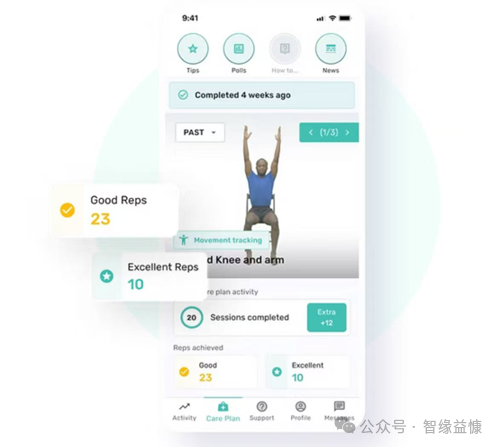
 The Future of Rehabilitation: Integrating “Professionalism” into “Daily Life”05The value of MoveAI™ lies in transforming rehabilitation training from “a hassle in hospitals” to “a reassuring task that can be done at home”, and what Zhi Yuan Yi Kang aims to do is to push this “reassurance” one step further: making technology more aligned with the lives of Chinese people, and making data more attuned to the rehabilitation needs of Chinese individuals.In the future, when “sensorless motion analysis” combines with “localized design”, it will enable more people to love “using data for rehabilitation”. After all, good rehabilitation technology is never about “making you adapt to the equipment”, but rather “making the equipment adapt to you”.