
In the field of intelligent connected vehicles, it has become commonplace to establish different alliances and ecosystems centered around chips and operating systems. The most common examples are the INTEL-MOBILEYE alliance, NVIDIA ecosystem, Baidu Apollo ecosystem, and Alibaba-Zebra Smart Mobility ecosystem. Today, we introduce Renesas, which has been actively pursuing various collaborations and alliances over the past two years to build the Renesas Autonomy ecosystem.
Renesas is the world’s largest automotive MCU/SoC semiconductor provider
In 2003, Renesas Technology was established with investment from Mitsubishi Semiconductor, ranked 10th globally, and Hitachi Semiconductor, ranked 11th. The merged revenue of Renesas Technology in 2003 reached $7.971 billion, ranking third globally. In 2010, Renesas Technology announced a merger with NEC Electronics, becoming the new Renesas Electronics Corporation.
Renesas’s main products in the automotive sector focus on MCU and SoC fields. In 2015, Renesas held a 32.7% market share in the automotive MCU/SoC semiconductor market, ranking first globally, with NXP in second place.
Renesas’s R-CAR products mainly supply Japanese customers, including not only Japanese automakers but also Japanese infotainment manufacturers such as Aisin, Alpine, Panasonic, Clarion, Pioneer, and JK.
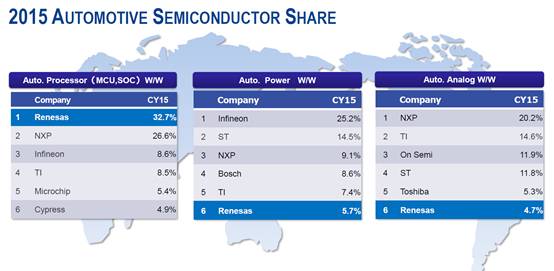
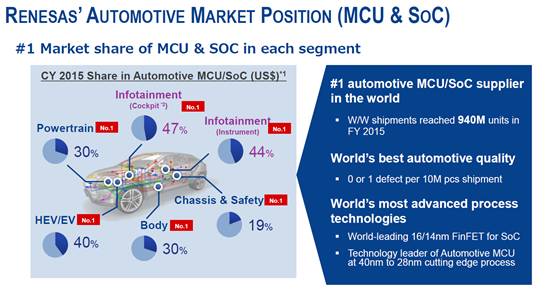
In specialized fields such as automotive cockpit, instrumentation, and HEV/EV, Renesas’s MCU and SoC hold over 40% market share, ranking first globally, while body, power systems, chassis, and safety sectors lead the market with shares of 30%, 30%, and 19%, respectively. Renesas shipped 940 million MCU/SoC products in 2015.
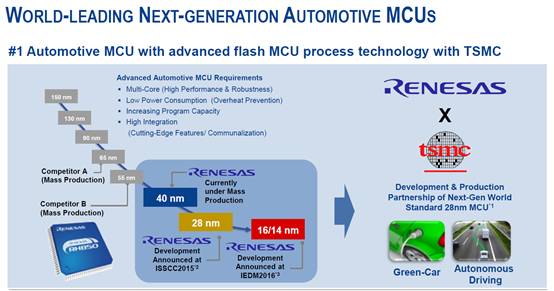
In September 2016, Renesas expanded its collaboration with TSMC after four years of partnership on a 40nm MCU platform to include 28nm embedded flash eFlash process technology. The automotive MCU produced using this new 28nm process technology was sampled in 2017 and began mass production in 2020.
In December 2016, Renesas developed the world’s first SG-MONOS flash memory cell, which uses FinFET technology for MCUs with on-chip flash memory featuring a line width of 16 to 14nm or finer. SG-MONOS technology can be reliably applied in automotive applications, and Renesas Electronics is currently mass-producing 40nm MCUs using this technology, while 28nm MCUs are also under development.
Renesas’s IoT Layout
In October 2015, Renesas Electronics launched the R-Car W1R, which complies with Japanese wireless communication standards and can be used in V2V and V2I communication systems. The R-Car W1R has been applied in the in-car ITS devices developed by Denso. These devices are also used in Toyota’s Crown, Prius, and Lexus RX models, utilizing vehicle and infrastructure communication to display traffic signal violations, crossing traffic, and pedestrian warnings, assisting in cruise control and other functions.
At the same time, to support different communication frequencies, standards, and safety standards in the US, Europe, and other regions, in October 2016, Renesas Electronics launched a series of widely applicable V2X solutions globally, offering V2X kit solutions that combine R-Car W1R or R-Car W2R with R-Car W2H. R-Car W2H began mass production in October 2017, with an expected monthly production capacity of 300,000 units by 2019.
Renesas Electronics Wireless Communication SoC Kit Solutions:
•R-Car W1R: Wireless communication SoC supporting Japanese communication standards (760MHz band).
•R-Car W2R: Wireless communication SoC supporting European and US communication standards (5.9GHz band).
•R-Car W2H: V2X communication processor SoC supporting safety standards in Japan, the US, and Europe.
•R-Car W1R + R-Car W2H Kit: Implementing V2V and V2I communication systems for the Japanese market.
•R-Car W2R + R-Car W2H Kit: Implementing V2V and V2I communication systems for the European and US markets.
Entry-level V2X kits supporting the Japanese, US, and European markets,providing a basic software package (BSP: products include operating systems, drivers, firmware, and middleware) for V2X communication processors, simplifying application software development for users. Wireless communication evaluation tools are also provided to support various evaluations and tests of complex wireless communication characteristics for system developers, from the system prototype development phase to mass production phase wireless communication testing, and vehicle testing conducted at OEM manufacturers’ locations.
• For the European market: RTK00V2XRC7746SBS
• For the North American market: RTK00V2XRC7746SCS
• For the Japanese market: RTK00V2XRC7746SDS
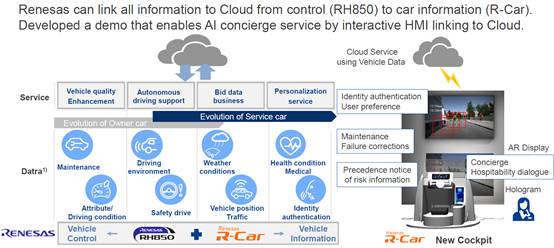
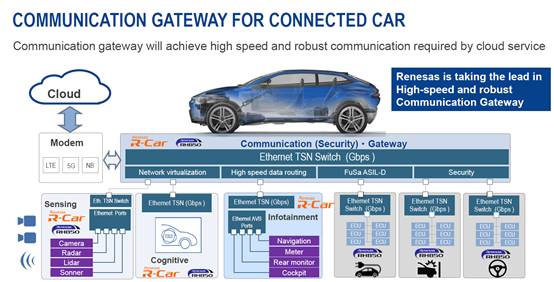
Currently, the V2X solutions provided by Renesas allow for connectivity from vehicle information collected by R-Car for perception systems to on-board information collected by RH850 for vehicle control, all through cloud services such as big data, while also providing high-speed and highly robust communication gateways, enhancing system security.
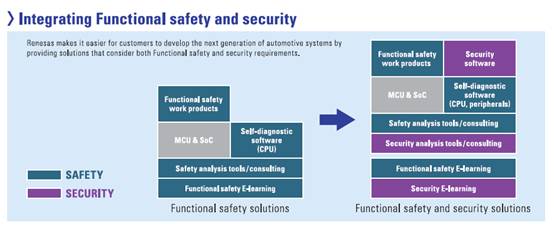
In March 2017, Renesas launched the “Automotive Functional Safety and Cybersecurity Support Program” to simplify the design complexity of automotive systems. This program aims to alleviate the burden on Tier 1 suppliers by integrating a complete set of solutions including Renesas automotive semiconductor products, software, and analytical tools certified by ISO26262, simplifying the implementation of functional safety features. The program supports several RH850 series MCU products and plans to expand to R-Car series SoC products.
Layout of ADAS Chips, Building the Renesas Autonomy Ecosystem
In August 2014, Renesas Electronics announced the launch of R-Car V2H, which supports high-resolution surround view functions.
In July 2015, Renesas introduced the R-Car development kit – ADAS entry-level kit, which utilizes Renesas’s high-end R-Car H2, helping to simplify and accelerate the development of ADAS applications.
In October 2015, Renesas launched the ADAS panoramic surround view kit, which expanded upon the original ADAS entry-level kit.
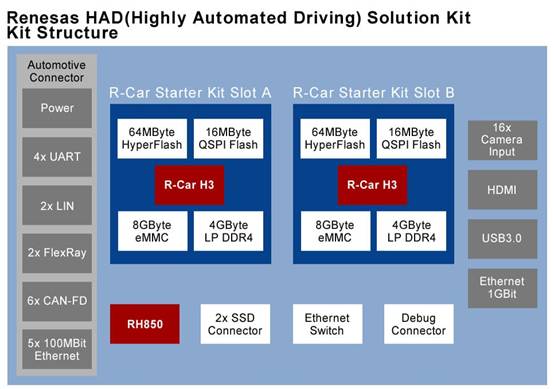
In October 2016, Renesas launched a highly automated driving (HAD) solution kit that provides high computing performance for automotive functional safety to shorten ECU development time.
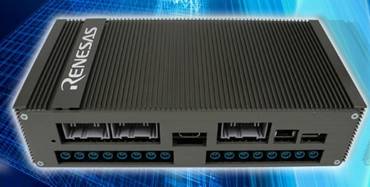
The HAD solution kit includes two Renesas entry-level kits, Premier and the automotive control RH850/P1H-C microcontroller. The R-Car entry-level kit Premier is based on the R-Car H3 SoC, which complies with ISO 26262 ASIL-B standards, while the RH850/P1H-C complies with ISO 26262 ASIL-D standards.
The new solution kit enables system developers to immediately evaluate functionalities and software in an environment similar to actual ECU development, thereby reducing the time and effort required for developers to port software to actual ECUs.
In November 2016, Renesas launched an integrated ADAS panoramic surround view solution kit that can support up to eight cameras, enabling electronic rearview mirrors, driver monitoring, and panoramic surround view systems simultaneously.
In January 2017, Renesas Electronics launched the first RH850-based 32-bit automotive radar MCU series, RH850/V1R. The first product in this series, RH850/V1R-M, includes a digital signal processor (DSP) and high-speed serial interfaces, integrating 2MB of high-speed flash memory and 2MB of internal RAM, designed specifically for medium- to long-range radar.
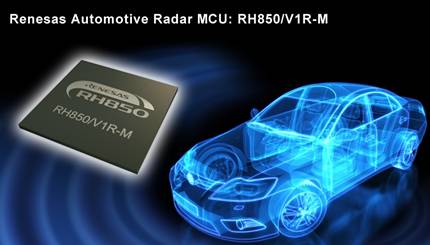
Samples of RH850/V1R-M and the DSP math library were released in the second half of 2017, with a sample price of $30 each, and mass production planned to begin in November 2018. A complete programmable toolchain featuring a C/C++ compiler, debugger, simulation model, and detailed performance analysis tools will also be launched.
In April 2017, ADI and Renesas Electronics collaborated to develop 77/79-GHz automotive RADAR technology to improve ADAS applications.
In April 2017, Renesas first announced an important layout in the autonomous driving field: a newly designed ADAS and Autonomous Driving Open Platform Renesas Autonomy. By establishing a “development architecture” for the platform, it facilitates users to port algorithms, function libraries, and real-time operating systems (RTOS) onto the platform. The new Renesas Autonomy platform is supported by Renesas Electronics’ sustainable and scalable SoC and MCU roadmap.
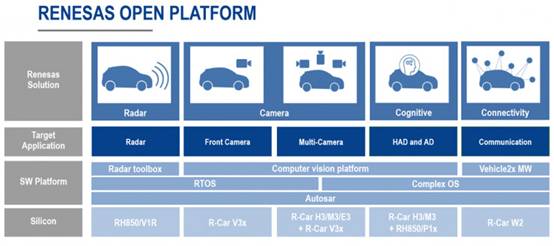
The first product launched on the Renesas Autonomy platform is an image recognition SoC called R-Car V3M, primarily used for smart camera sensors but can also be applied in surround vision systems and even LiDAR data processing. R-Car V3M supports the Euro-NACP Level 2 standard.
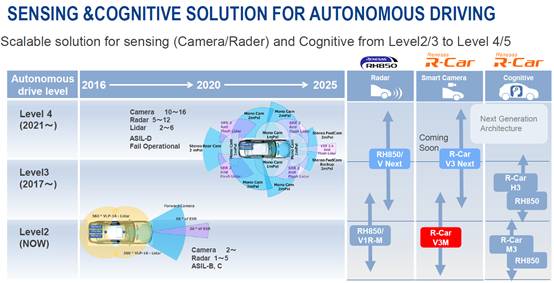
Renesas has formed a system solution for automotive perception (cameras/radars) to decision-making and execution from L2/3 to L4/5, although the layout is not complete, and the roadmap is not very clear.
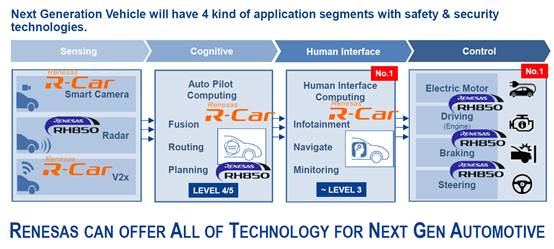
Japanese automotive manufacturers have their own systems, and Renesas’s autonomous driving chips are first applied to domestic companies like Toyota and Denso.
In November 2017, Toyota selected Renesas’s autonomous driving vehicle solutions, including R-Car SoCs for in-car infotainment systems and ADAS, as well as the RH850 MCU for vehicle control, with commercialization expected in 2020. Renesas Electronics will provide Toyota with a comprehensive semiconductor solution from environmental perception, driving judgment, to body control.
For the autonomous driving ECU developed by Denso, Renesas’s R-Car was selected as the core component of autonomous driving. Additionally, the RH850 was chosen as the microcontroller to receive commands from the R-Car and perform control functions such as driving, turning, and stopping.
Building a Software Ecosystem to Simplify Developer Applications of Renesas Chips
Renesas is a platinum member of the Automotive Grade Linux (AGL) alliance. There are mainly four automotive electronic operating systems: QNX, Android, Linux (including AGL, Tizen, Genivi), and WinCE. Since QNX, WinCE, and others are relatively closed, and the automotive industry requires open operating systems, platforms based on Linux such as AGL and GENIVI have emerged.
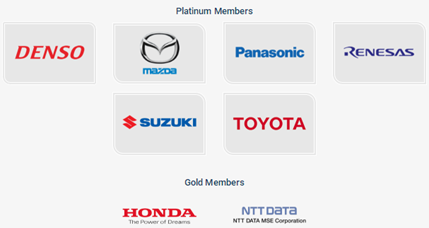
AGL stands for Automotive Grade Linux. Currently, ten major automakers support AGL, and all Japanese manufacturers are said to support AGL, with core experts in AGL primarily being Japanese. AGL is developing rapidly, with 109 members, including domestic companies such as Youzhong Technology, Desay SV, China Mobile, and Zhongke Chuangda joining successively.
In August 2017, Renesas began mass production of its first R-Car SoC based on AGL. Renesas Electronics’ first R-Car series SoC integrated with AGL platform software has been mass-produced for Toyota’s all-new Camry system in 2018. This model is Toyota’s first vehicle to adopt AGL in its infotainment system.
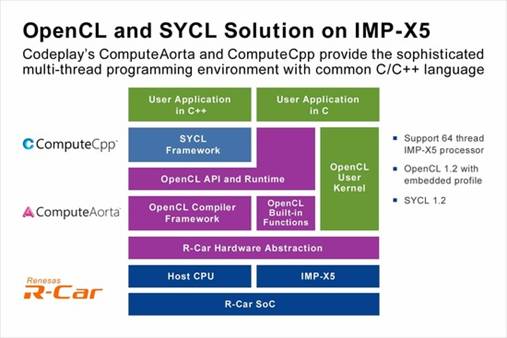
In September 2017, Codeplay will provide the OpenCL open standard software framework ComputeAorta for Renesas R-Car SoC. The new framework aims to support the software development of R-Car’s latest image recognition IP IMP-X5. Codeplay will also provide ComputeCpp™, which supports single-source C++ software. This collaboration can provide developers with standard software development tools and support various open-source computer vision or open-source deep learning software, such as TensorFlow™ Library.
In October 2017, Renesas Electronics announced the launch of an Android R-Car development package for R-Car, which supports the latest operating system Android 8.0 released by Google in August 2017. Android 8.0 is the first operating system to support the functions required for automotive systems.
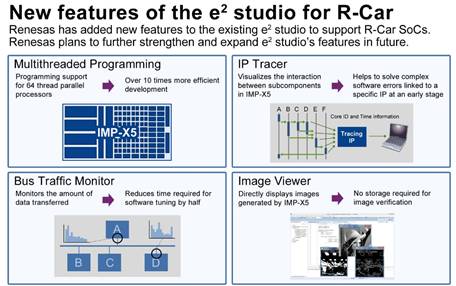
In October 2017, Renesas Electronics’ integrated software development environment e2studio began supporting R-Car V3M. The R-Car V3M solution based on e2 studio is part of the Renesas autonomy™ platform. e2 studio is an integrated development environment (IDE) based on the open-source Eclipse C/C++ development tool software. The toolchain, libraries, and simulators in e2 studio simplify software development based on R-Car and accelerate time to market.
Renesas Partners
|
Partner |
Start Date |
Cooperation Project |
Cooperation Goal |
|
国能NEVS |
November 2015 |
国能 acquired Swedish NEVS, and NEVS cooperated strategically with Renesas |
R&D covers various intelligent control areas of new energy vehicles, including main drive motors and control systems, in-car infotainment systems, ADAS, and body control and safety systems |
|
Lincoln |
2017 CES |
L3 autonomous vehicles |
Renesas and six other companies collaborated to develop L3 autonomous vehicles. After completing the design, tests were first conducted in Canada, followed by a drive from Canada to Las Vegas. |
|
ADI Company |
April 2017 |
Collaborative development of system-level 77/79-GHz RADAR demonstration solutions |
Combining Renesas Autonomy’s RH850/V1R-M microcontroller with ADI Drive360’s 28nm CMOS RF-to-bits technology, enabling early detection of rapidly moving small objects at greater distances |
|
Great Wall Motors |
May 2017 |
Established an automotive electronics joint laboratory |
Focusing on four areas: (1) Key components of new energy vehicles; (2) On-board network systems with high-speed reliable communication; (3) Next-generation automotive infotainment systems; (4) ADAS |
|
Codeplay Software |
September 2017 |
Will provide Renesas Electronics R-Car SoC with Codeplay’s OpenCL open standard software framework ComputeAorta |
The new framework aims to support software development for R-Car’s latest image recognition IP IMP-X5, which is optimized for computer vision and cognitive processing. |
|
eSoftThings |
November 2017 |
eSoftThings announced joining Renesas Electronics R-Car Alliance |
eSoftThings focuses on developing computer vision technology for ADAS and autonomous driving |
|
HELLA |
December 2017 |
Launched an open and scalable front camera solution for autonomous driving |
Combining Renesas’s R-Car V3M, which supports NCAP, with HELLA Aglaia’s camera software that meets the requirements for Level 2 and Level 3 in SAE J3016. |

Organizer

Co-organizer
Supporting Media

Schedule
8:20-9:00 Participant Sign-in
9:00-9:10 Welcome Speech
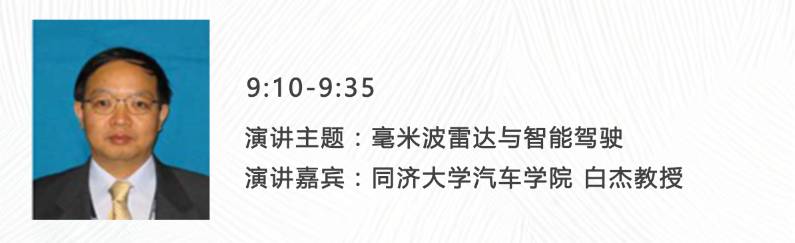
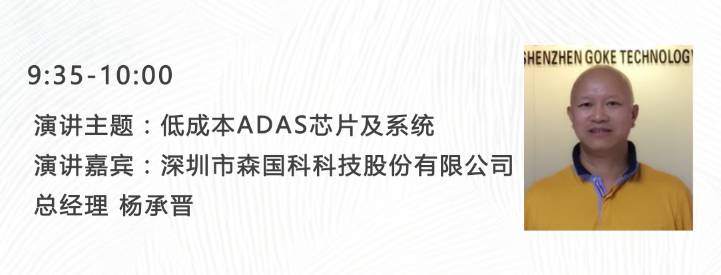
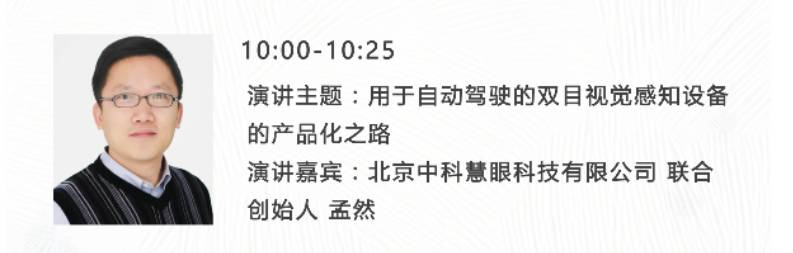
10:25-10:45 Tea Break


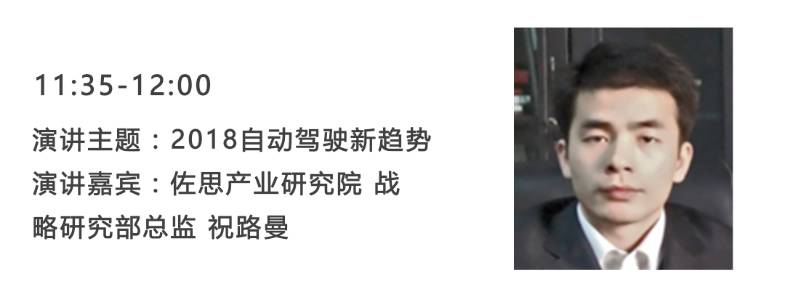
12:00-13:30 Lunch, Break
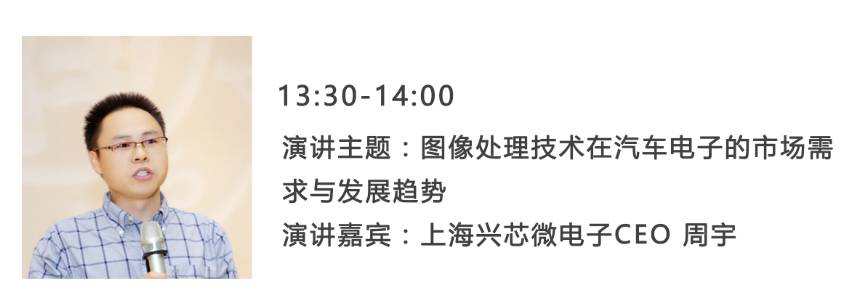
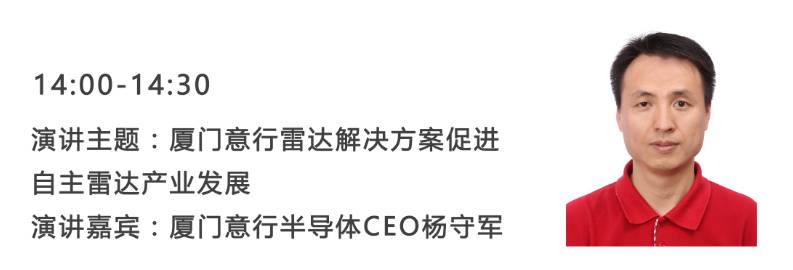

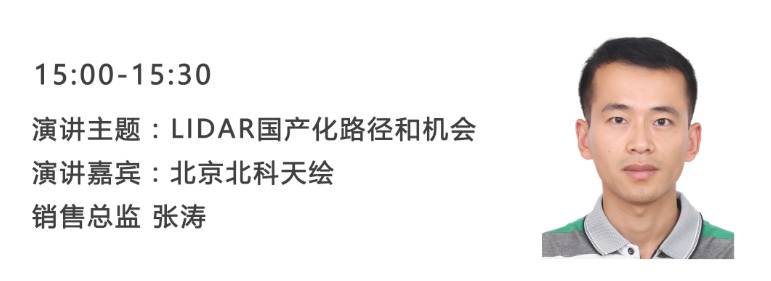
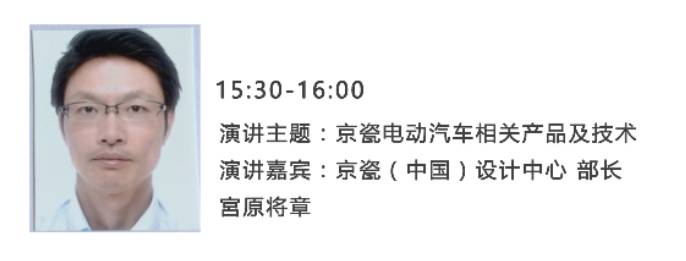

Recent Articles and Events
AlixPartners: Global Automotive Industry Trend Outlook
This Week’s PDF and Video Material Recommendation Summary (12-1)
This Week’s PDF + Video Material Recommendation Summary (11.20-11.24)
ZhuoZhi Data Center: This Week’s PDF Material Recommendation Summary (11-20)
ZhuoZhi Data Center: This Week’s PDF Material Recommendation Summary (11-10)
Registration for the CES 2018 Tour Begins
LeddarTech Solid-State LiDAR Disassembly