NXP and Renesas, in 2021, it seems that NXP is the leader in MCUs, while currently, Renesas appears to lead in automotive MCUs; without specific data, it’s hard to tell…
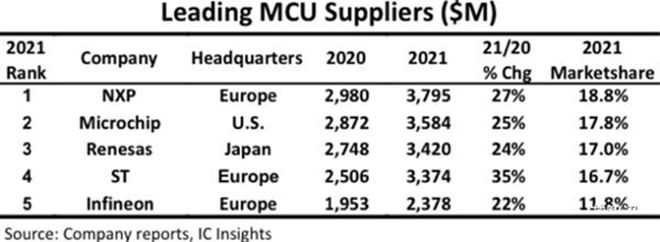
Today, I will share the high-end automotive MCU layouts of both companies: NXP’s S32 Z/E series and Renesas’s RH850 U2 series.
Table of Contents:
-
Overview of NXP S32 and RH850
-
On-chip Resources and Features
-
Virtualization Support
-
Appendix: Feature Summary
1
Overview of NXP S32 and RH850
Most are more familiar with NXP’s S32K series, based on Cortex-M0/M4 and M7, targeting the general automotive market; today, we focus on NXP’s S32Z and S32E, based on the advanced 16nm process, aimed at future domain control architectures.
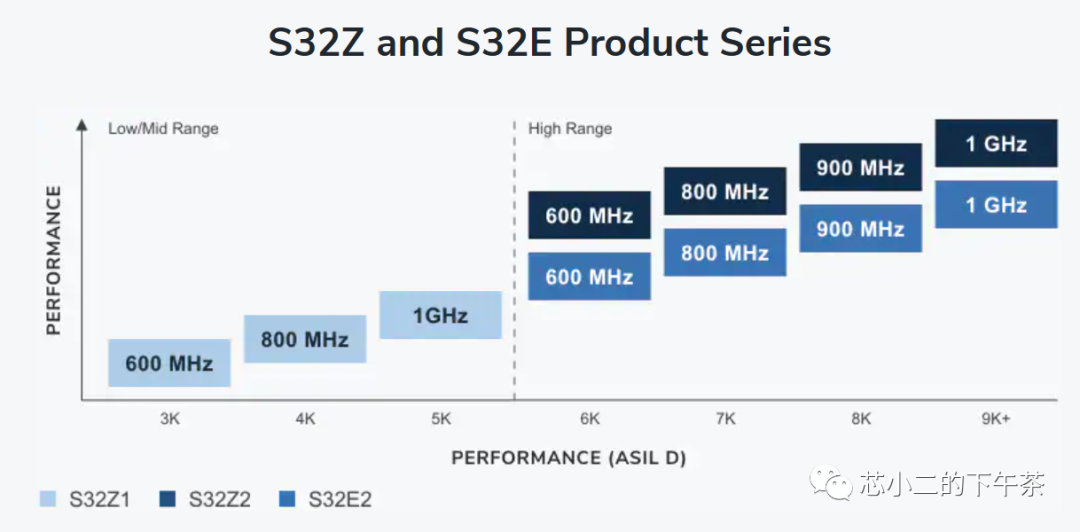
The S32Z series targets safety computing and domain control, with up to 8 Cortex-R52 cores, and a maximum single-core frequency of 1GHz…
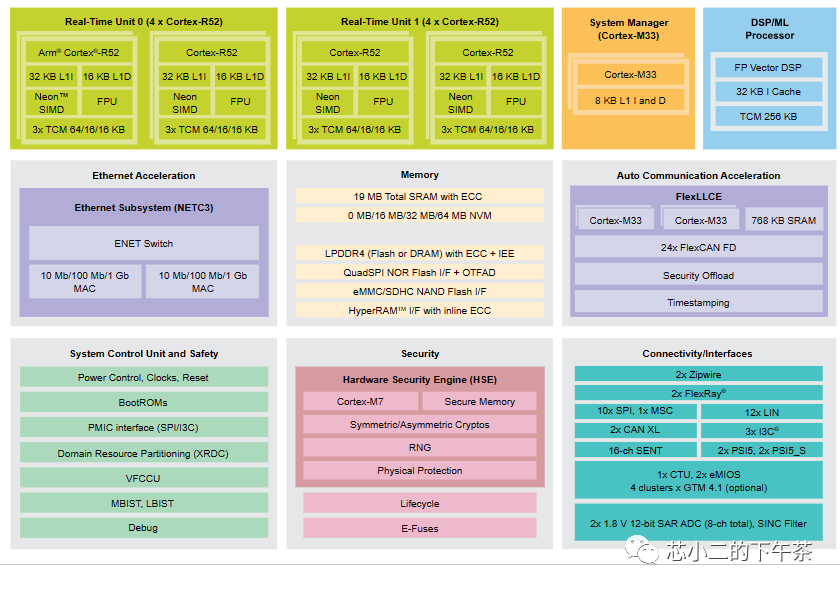
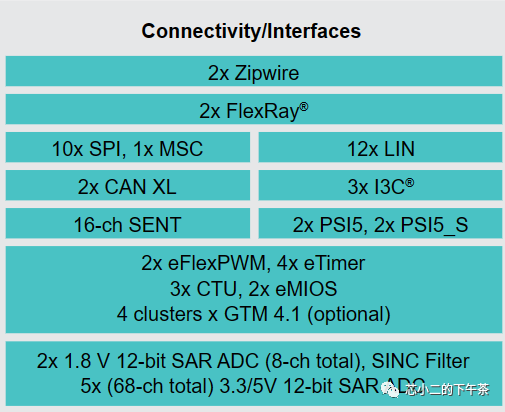
The S32E series enhances control peripherals, with a similar block diagram; the main differences are as follows, where timer resources and ADC resources are enhanced.
Renesas RH850 is a high-performance automotive series.
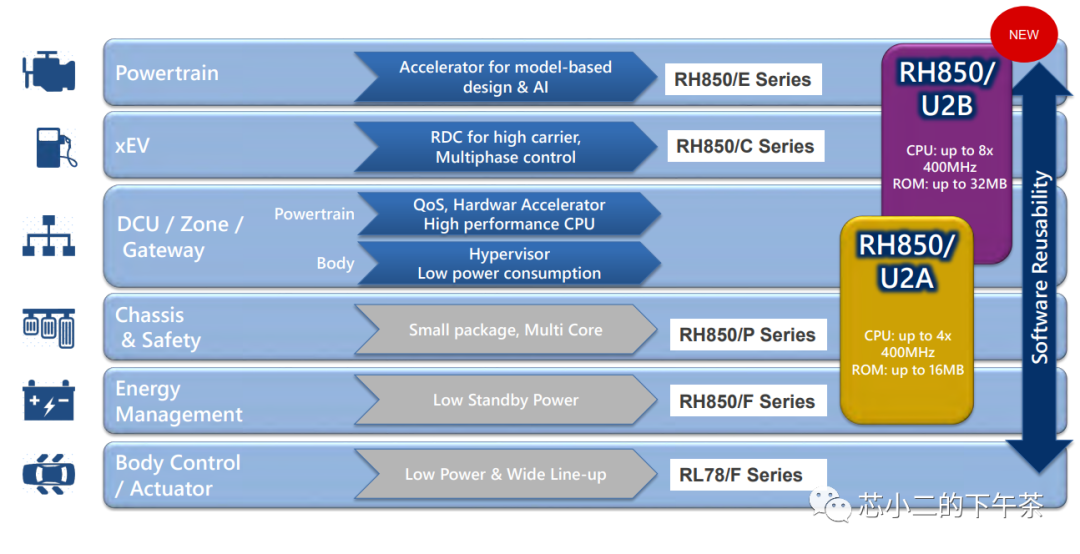
Among them, U2A/B is the highest performance MCU based on TSMC 28nm automotive process released by Renesas in 2021, targeting up to 8 RH850 G4MH cores, with a maximum single-core frequency of 400MHz (aligned with ST’s Stella).
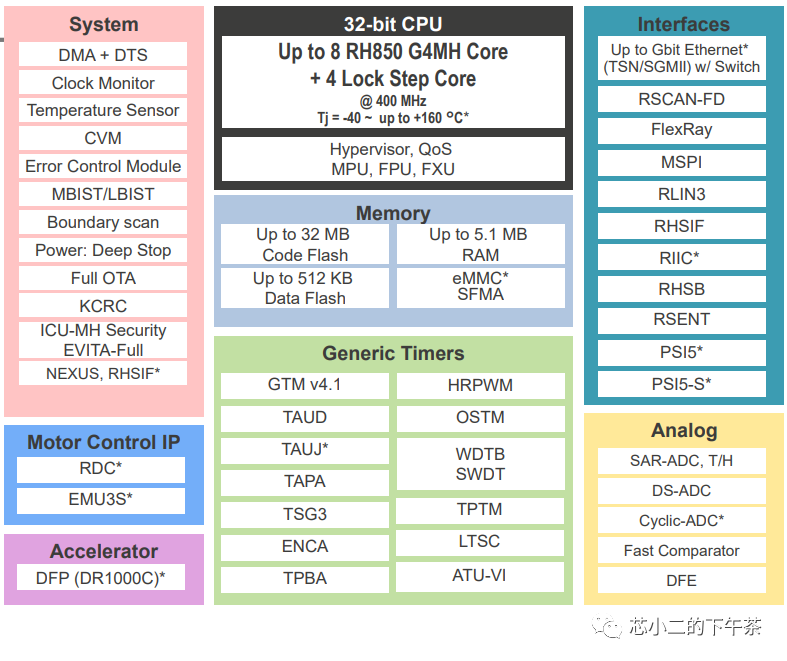
It can be seen that including ST/Infineon/NXP/Renesas, the core of high-performance MCUs aimed at future domain control architectures is consistent: higher computing power (including Edge AI/ML), higher safety, richer resources, and faster communication peripherals.
2
On-chip Resources and Features
In terms of resources, the block diagrams above show a few points observed by me, and I welcome further discussion:
- NXP, due to its advanced process, seems that the 16nm eFlash automotive process is not yet mature, thus it uses Logic technology, with no embedded Flash internally, and has 19MB of SRAM; Flash needs to be expanded externally.
- In terms of operating temperature, the S32Z has a maximum Junction temperature of 150°C, while the RH850 U2 has a maximum of 160°C.
- Gbit Ethernet is standard and supported by all.
- AI acceleration units are standard: Renesas’s DFP (Data Flow Processor) and NXP’s DSP/ML Processor (combined with many control strategies in the VCU domain controller from the past few days, the future of AI on Vehicle seems to be the direction).
- The power supply voltage is not specified in public materials.
- In terms of safety, both are ASIL-D, Evita-Full configuration.
3
Virtualization Support
Under the future SOA (Service Oriented Architecture), Hypervisor/Virtualization is standard; the first article on ST & Infineon introduced this, and both Renesas and NXP support it.
 S32Z/E’s Virtualization
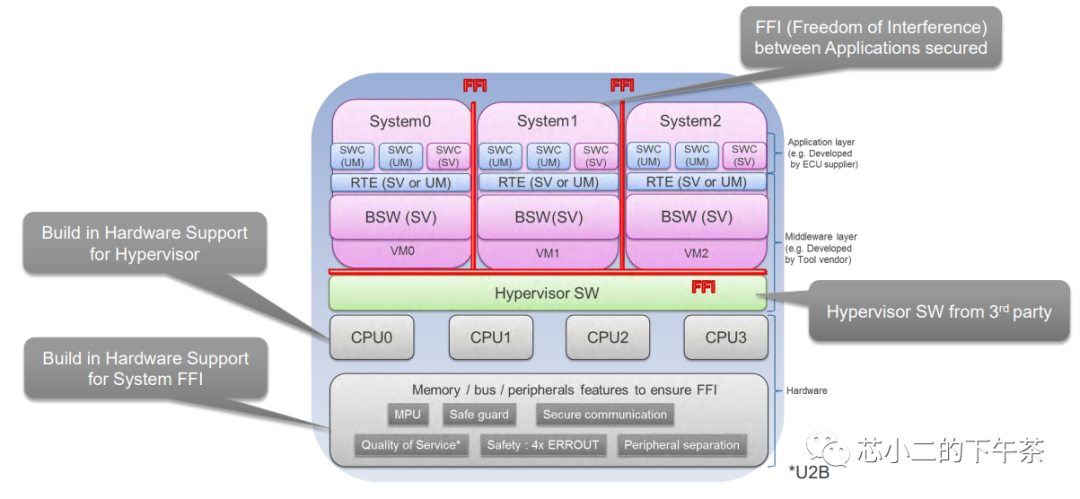 RH850/U2’s Hypervisor
4
Appendix: Feature Summary
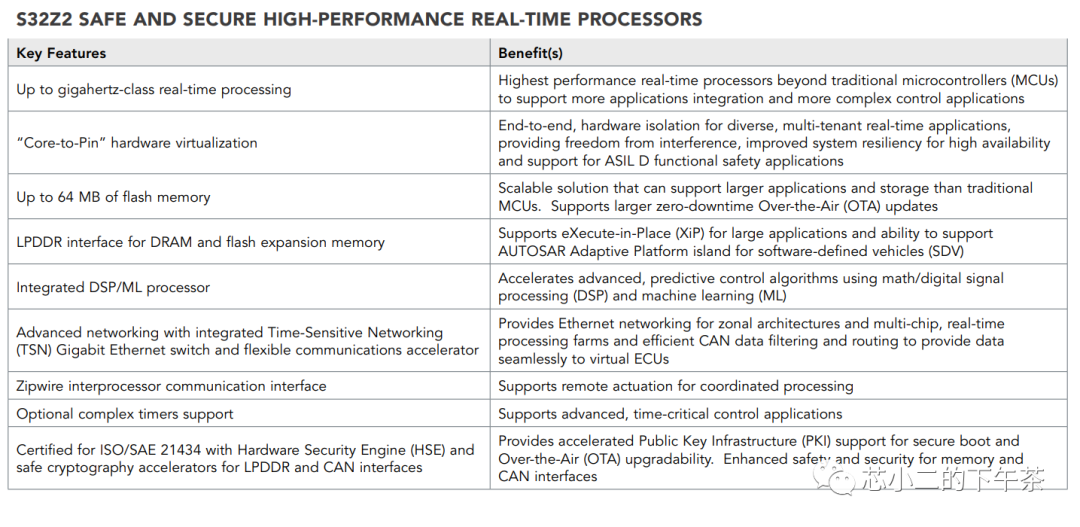 S32Z Highlights
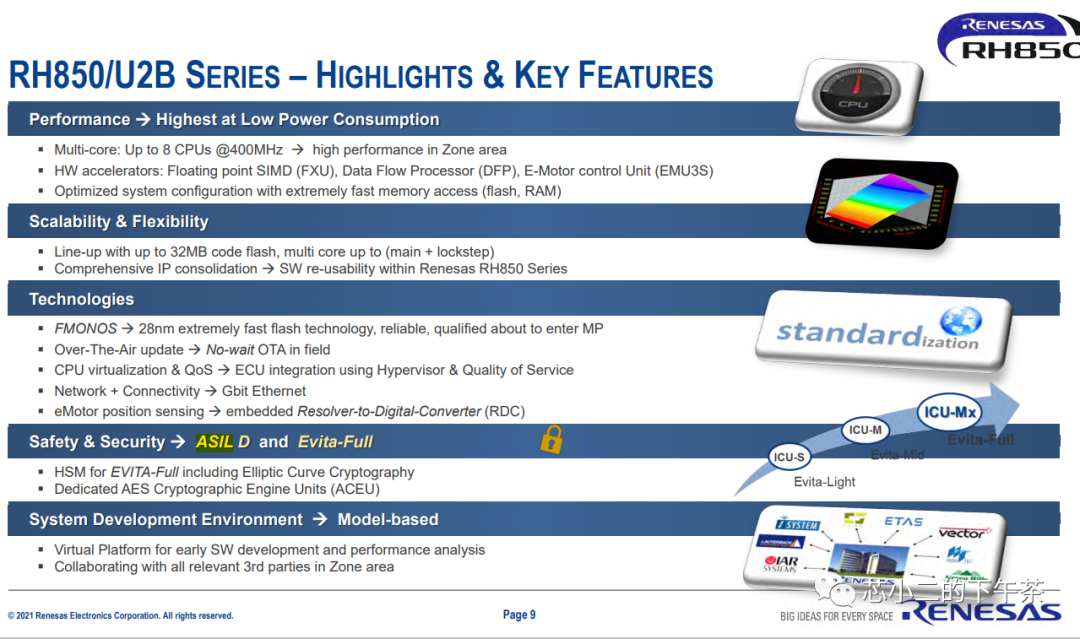 RH850/U2B Highlights
My knowledge is limited, and I welcome comments and discussions.
Extend your kind thumb in the lower right corner, give a like👍, give me some encouragement!
As each article may involve quoted content, some sources are unknown. If any infringement is found, please notify the backend, thank you.