Hello everyone, this week I would like to share an article published in J. Am. Chem. Soc. titled “Ultrafast Tyrosinase-Mediated Biotinylation of Living Cell Surface Analysis Reveals Novel Cell Surface Proteins Responsible for Influenza A Virus Entry.” The corresponding authors are Professor Lu Haojie and Researcher Zhang Ying from Fudan University, whose research focuses on the development of proteomics technologies.
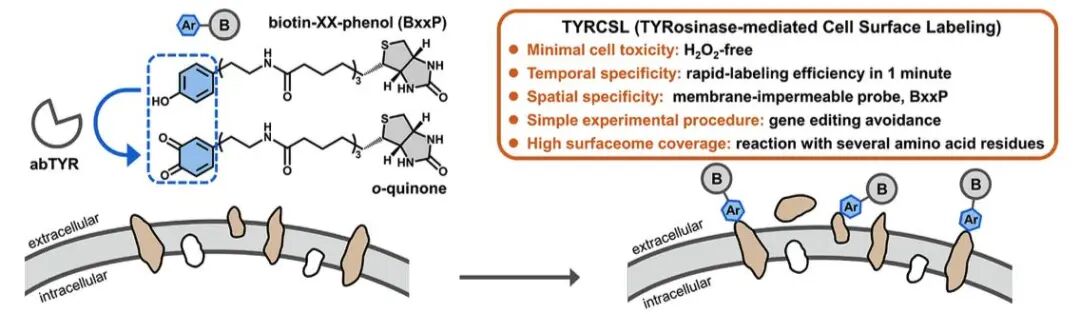
Cell surface proteins play a core role in cellular recognition, signal transduction, and pathogen invasion, but they are difficult to study systematically due to their high hydrophobicity and low abundance. Previous methods developed for membrane proteins, such as chemical labeling and enzyme-catalyzed labeling, have issues such as slow labeling speed and high cytotoxicity. Therefore, the authors aimed to develop a new generation of cell surface protein labeling and enrichment methods.
Tyrosinase (TYR) can oxidize phenols or catechols to their corresponding quinones under mild conditions, which can then rapidly react with nucleophilic groups in proteins. The authors designed and synthesized the probe BxxP, where the phenolic group is oxidized to a quinone group under the catalysis of TYR, allowing it to covalently bond with Lys, Cys, and His on the cell surface, thereby labeling the proteins; the biotin group at the other end is used for subsequent separation and enrichment. BxxP cannot cross the cell membrane, thus avoiding non-specific labeling. Subsequent experiments demonstrated that this process can be completed within 1 minute, has low cytotoxicity, and the labeling signal specifically appears in the cell membrane region.
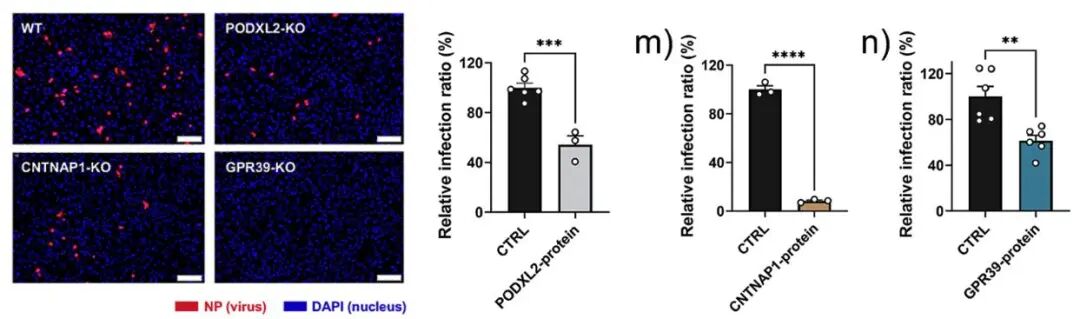
During the process of influenza virus infecting host cells, the virus first binds to the cell surface through “adhesion factors,” and then the viral particles interact with the receptors on the host cell, promoting viral invasion. Therefore, studying the early stages of viral infection can help develop new therapies. The authors applied the labeling strategy developed in this paper to investigate the dynamic changes of cell surface proteins during the infection of H1N1 influenza virus (IAV), particularly in the early stages of infection. The results showed that 25 cell surface proteins were downregulated during IAV infection. After knocking out PODXL2, CNTNAP1, and GPR39, the infection efficiency of IAV on cells significantly decreased. After IAV infection, the levels of these three proteins on the cell surface also significantly decreased. These data suggest that these three proteins may be receptors for IAV, mediating the virus’s entry into cells.
In summary, the authors developed a tyrosinase-mediated cell surface protein labeling technique and successfully applied it to the study of the mechanism of influenza virus invasion.
Article Author: YAQ
Editor: LYC
DOI: 10.1021/jacs.5c12360
Original link: https://doi.org/10.1021/jacs.5c12360