Introduction
Duplex stainless steels (such as Fe-Cr alloys) are key candidate materials for nuclear reactor structural applications. However, under high-energy particle irradiation, defects such as dislocations and vacancies form within the material, leading to irradiation hardening, fatigue, and other issues that significantly impact material lifespan. The formation and evolution of Cr-enriched nanoprecipitates (α′ phase) are closely related to the interactions between dislocations and point defects. However, the mechanism by which dislocation stress fields dynamically drag solute atoms (e.g., Cr) and point defects (vacancies and interstitials), thereby influencing nanoprecipitate morphology, remains unclear. Understanding this mechanism is crucial for optimizing the performance of nuclear materials.
Methods
This study employs a multi-phase-field simulation that couples dislocation stress fields, solute atom diffusion, and point defect evolution to model the formation of α′ phase in Fe-35 at.% Cr alloys. By introducing multiple dislocation loops and incorporating anisotropic elasticity theory, the study quantifies the dragging effect of dislocation stress fields on Cr atoms and the role of Cr migration in driving the formation of vacancy loops. The model also considers the generation and recombination kinetics of irradiation-induced defects (vacancies and interstitials) to analyze the complex interactions between stress, atoms, and defects.
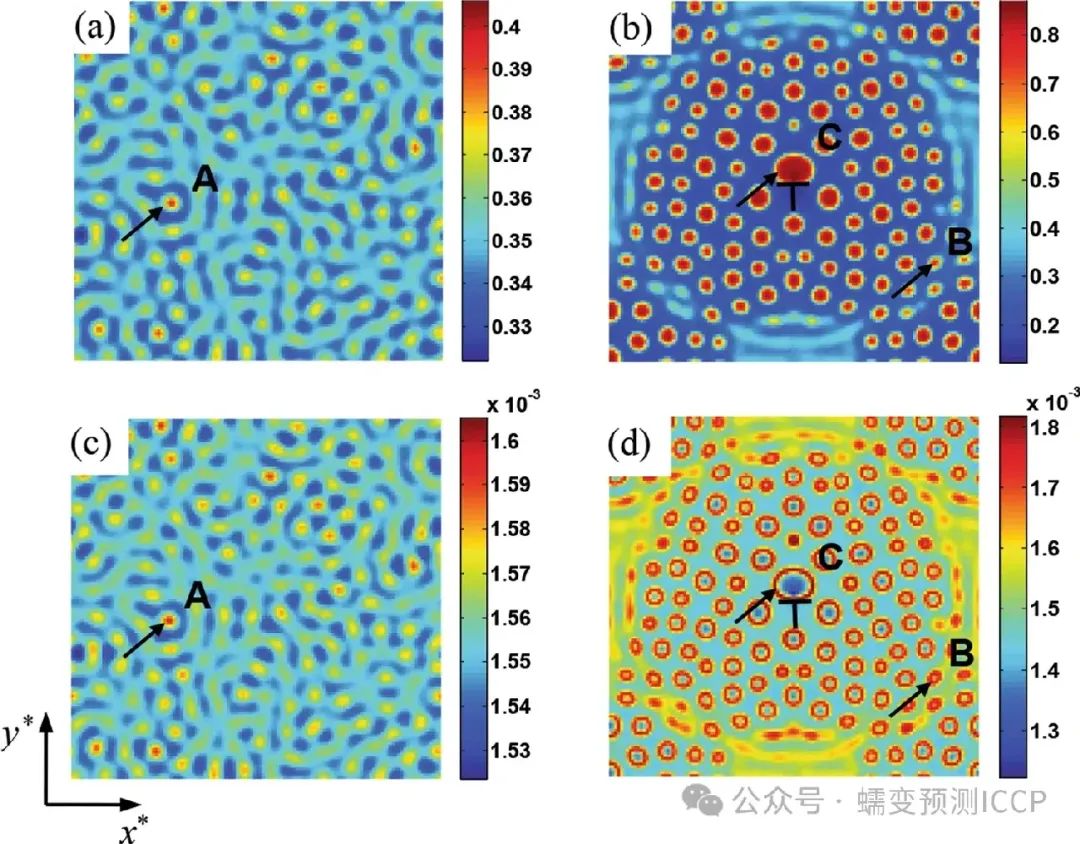
Fig. 1. Morphology of the Cr-enriched α′ phase (a)–(b) and vacancy (c)–(d) at 750 K. (b) and (d) correspond to the case with an edge dislocation and Burgers vector, while (a) and (c) represent the case without dislocations.
Findings
-
Dislocation stress fields significantly influence the morphological evolution of Cr-enriched phases and the concentration distribution of Cr atoms. Tensile stress from dislocations accelerates Cr atom aggregation, promoting the growth of Cr-rich phases.
-
The tensile stress of dislocations drives Cr atoms to accumulate in phase transformation regions, facilitating local phase separation.
-
Cr atom migration also induces vacancy clustering, forming a two-dimensional vacancy loop.
-
The study reveals the dynamic effects of multiple dislocation loops on Cr atoms and point defects.
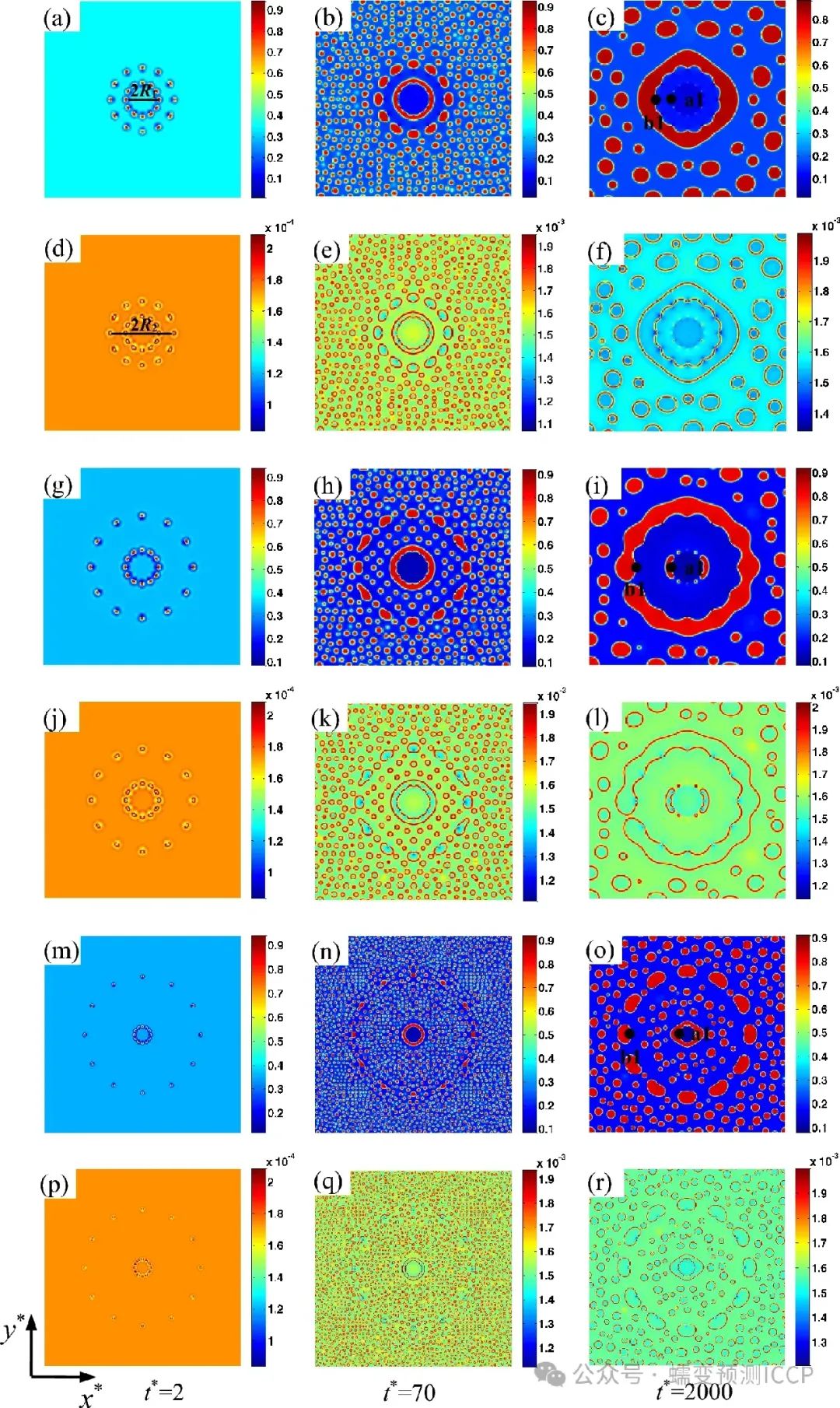 Fig. 2. Morphological evolution of the Cr-enriched α′ phase and vacancies with multiple dislocation loops.Significance
This research provides new insights into the microstructural evolution of Fe-Cr-based alloys under irradiation, particularly in the context of irradiation hardening and phase transformation. By employing multi-phase-field simulations, the study enhances the understanding of solute-dislocation-point defect interactions, offering a theoretical foundation for optimizing the irradiation resistance of Fe-Cr alloys.
Authors
 Author list: Zhengwei Yan, Shujing Shi, Peng Sang, Zan Zhang, Kaiyue Li, Weijin Zhao, and Yongsheng Li.
This paper is from Prof. Yong-Sheng Li’s team at Nanjing University of Science and Technology.
CitationZ. Yan, S. Shi, P. Sang, Z. Zhang, K. Li, W. Zhao, Y. Li, Multi-Phase-Field Simulation of the Dynamic Dragging of Dislocation on the Solute Atoms and Point Defects, Journal of Materials Engineering and Performance 33(14) (2024) 6857-6869. https://doi.org/10.1007/s11665-023-08484-2Recommendations
- Acta Materialia | Solute-vacancy binding energy database of Al
- MMI | In-situ TEM Study of Irradiation Induced Creep
- ATAT Alloy Theoretic Automated Toolkit: ab-inito to CALPHAD
- Acta Materialia | Grain Boundary Database: 327 GBs 58 Elements
- Acta Materialia | Predicting Grain Boundary Sliding of Metals
- Four Open Source Materials Gene Databases
Welcome to the International Center for Creep Prediction ICCP! We share the latest research and insights on high-temperature materials, strength, Creep, and Fundamental Theory and experiments of Materials. We welcome you to share your research for free! Join us in advancing the field! Submission email: [email protected]