Recently, Xu Lida, an undergraduate alumnus of Nanjing University and a PhD student at the University of Maryland, along with his team, designed a fast-slow dual clock system based on topological photonics and microcavity frequency combs, allowing light to rapidly circulate within micro-rings while slowly flowing along the edges of a super-ring.
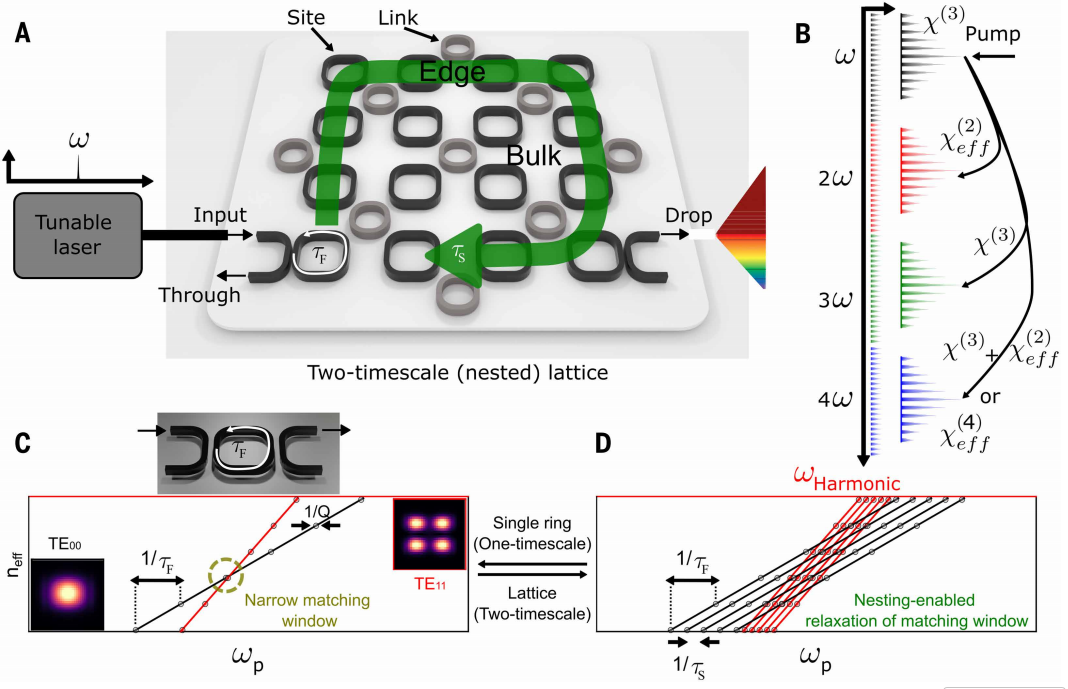
This ingenious structure forms a dense network of optical modes, enabling infrared light to be efficiently converted into second, third, and even fourth harmonics, passively generating a brilliant spectrum from infrared to blue-violet on the chip.
This nested phase-matching technology breaks through the limitations of manufacturing precision, achieving a 100% yield in nonlinear optical processes on chips, opening new doors for next-generation quantum light sources, atomic clocks, and spectral detection technologies. The related paper was published in Science.
Co-author Xu Lida told DeepTech: “Previous methods were like trying to hit a flying disc with a bullet from a handgun, which is extremely difficult; whereas this new method is akin to using a shotgun, firing multiple pellets at once, significantly increasing the probability of hitting the disc.”
Image | Xu Lida (Source: Xu Lida)
In the study, the team observed fourth-order nonlinear optical effects for the first time on a commercial silicon nitride photonic chip platform, successfully generating blue light from the 1550 nm communication wavelength.
This is quite symbolic, as the inventors of blue light-emitting diodes have previously won the Nobel Prize, and this team achieved blue light generation on a mainstream integrated optical platform that was considered difficult to produce strong nonlinear effects, demonstrating the powerful capabilities of this approach.
When Light Sings in Harmony on the Chip
To understand this technology, one must first know a little secret about light: they like to collaborate to create new light. One can imagine a beam of light as a well-trained choir. Each photon, the smallest unit of light, is like a singer. When these singers sing together at specific pitches and rhythms (i.e., frequencies and phases), they can produce wonderful harmonies, which is new light.
For example, two red singers collaborating might produce a blue singer; this process is called nonlinear optical processes. The colorful colors seen in the laser performances are generated through similar principles.
However, organizing such a choir on a tiny chip is very challenging. The structures used to confine light on the chip, such as tiny ring resonators, have extremely stringent size requirements. Even a few nanometers of error during manufacturing, like a singer hitting a wrong note, can completely ruin the harmony.
This leads to the situation where, among thousands of chips produced on the production line, only a very few lucky ones can work perfectly. The others will fail due to slight manufacturing differences, which has become a stumbling block for the technology in this field to achieve broader applications.
(Source: https://www.science.org/doi/10.1126/science.adu6368)
Building a Fast-Slow Clock Tower Photonic Maze
This challenge has made the pursuit of 100% yield for nonlinear optical chips seem like a fantasy. To address this, the team changed their approach: instead of requiring a perfectly controlled environment, they designed a system that can tolerate more imperfections. Their system resembles a clock tower, which typically has multiple hands: a second hand, a minute hand, and an hour hand. The second hand is the fast clock, formed by a single micro-ring.
Light runs in this small ring at an extremely fast speed, completing a loop in 1 picosecond, determining its basic rhythm. Hundreds of small rings are then coupled together in a topological array, forming a massive super-ring at the edge of the entire array, which constitutes the hour hand. The time it takes for light to propagate around the edge channel of this super-ring is much slower, taking only 250 picoseconds.
This two-dimensional array composed of 10×10 small rings is a carefully designed photonic maze. Unlike previous single-ring structures that had only one fixed scale, it possesses a very dense frequency network composed of both fast and slow clocks.
Just as a piano has not only white keys but also black keys, allowing for a richer and more flexible scale, in this maze, light has more notes to choose from. It no longer has to sing at a precise pitch but can find partners within a small range of pitches.
The team named this new method nested frequency-phase matching, where “nested” refers to the fast and slow clocks being layered together.
(Source: https://www.science.org/doi/10.1126/science.adu6368)
Crossing Two Octaves of Spectral Symphony
After constructing the aforementioned maze, they injected an invisible infrared laser (wavelength in the communication band, approximately 1550 nm) as a “magic wand” into the photonic maze. Next, an astonishing phenomenon occurred:
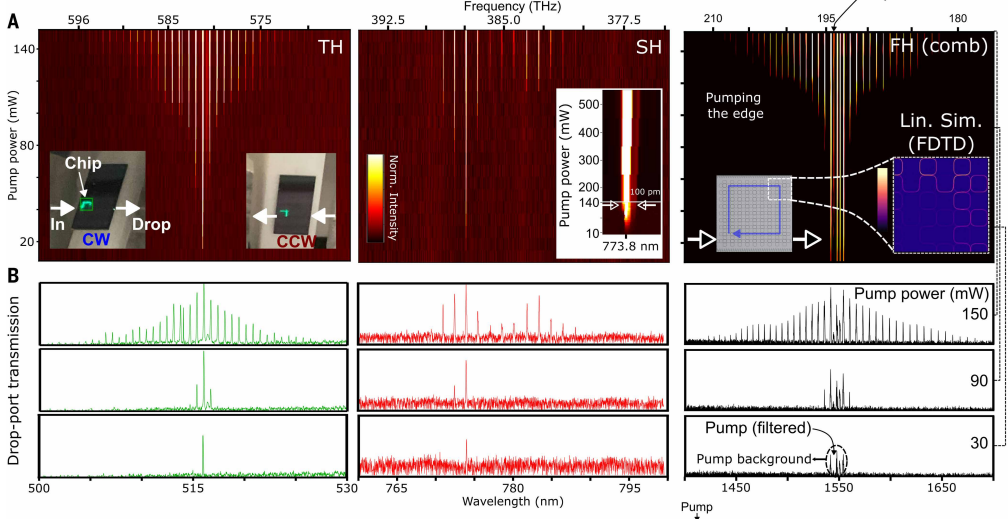
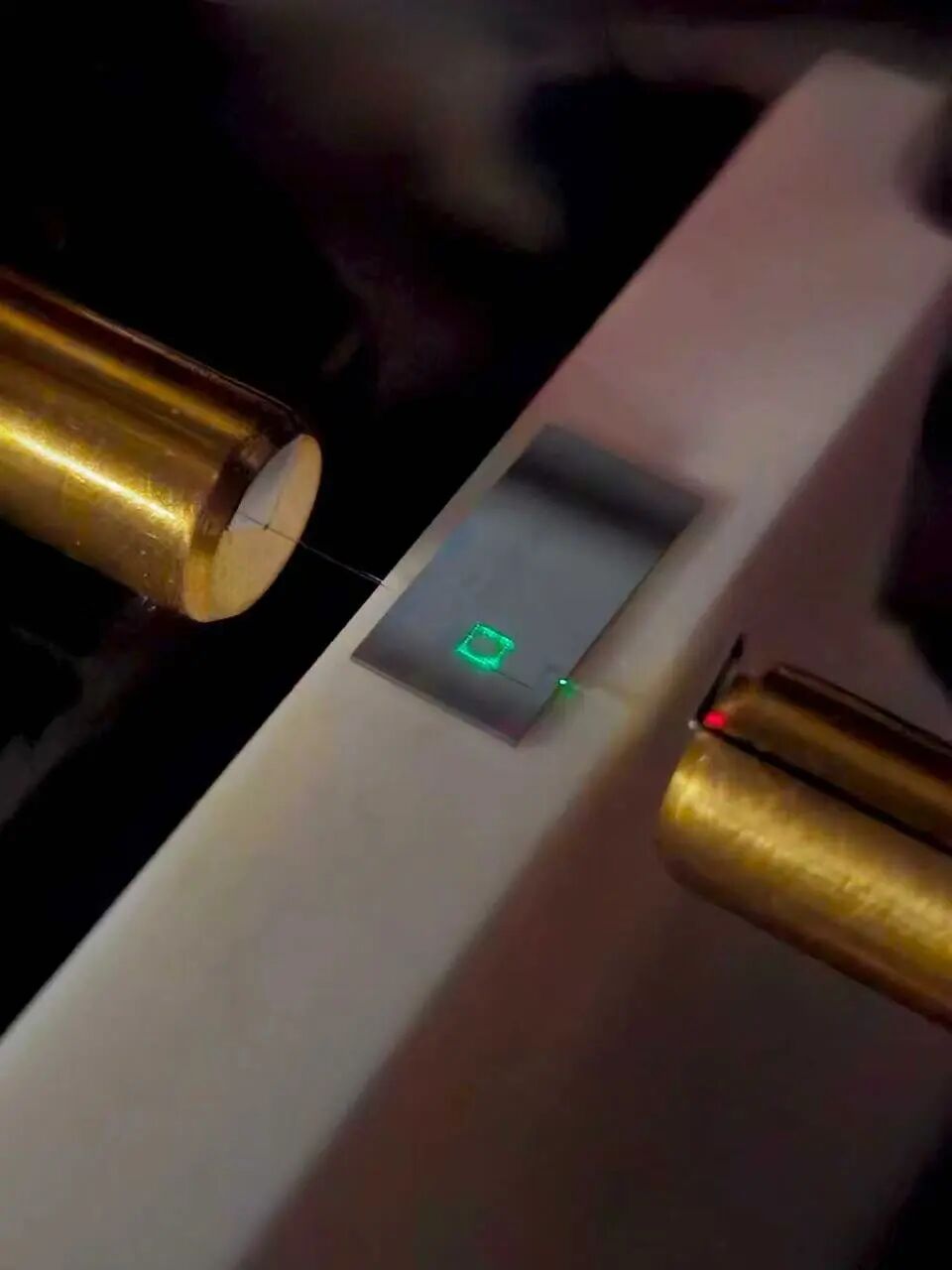
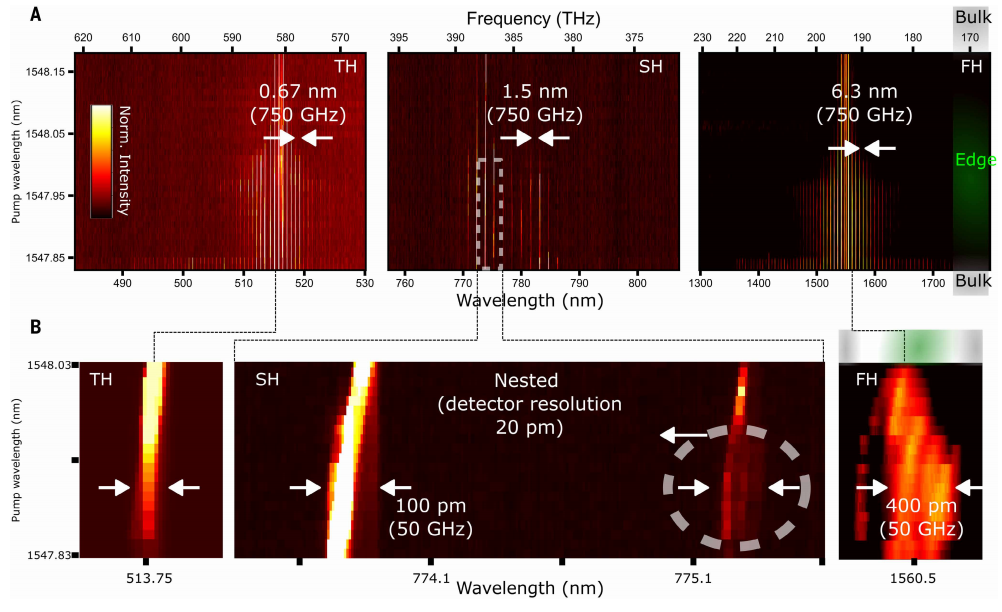
First was the magical color change; from the chip’s exit, they detected various newly generated lights. Among them, the second harmonic is like two infrared singers holding hands, merging into a singer with doubled energy and halved wavelength, emitting approximately 775 nm red light; the third harmonic is like three infrared singers collaborating, producing approximately 517 nm green light; the fourth harmonic is akin to four infrared singers working together to generate approximately 388 nm blue-violet light.
This means that from a beam of invisible infrared light, this small chip passively generated a symphony spanning two octaves without any external assistance.
(Source: Xu Lida)
Next was the movement of light; these created colorful lights did not fill the entire chip but were merely confined to flow along the edge channel of the super-ring.
Even with a 90-degree sharp turn in the channel, light could smoothly glide past without leaking into the middle space, proving that light was indeed moving along the edge defined by the slow clock in that maze.
Finally, spectral features were generated; when they carefully analyzed the colors of these lights, i.e., the spectra, they saw direct evidence of the nested structure. Within each coarse spectral line determined by the fast clock, there were clearer spectral structures defined by the slow clock.
This is like drawing a line with a thick pen, only to find upon closer inspection that this line is actually composed of countless fine fibers, which is characteristic of the harmonious operation of the dual clocks.
(Source: https://www.science.org/doi/10.1126/science.adu6368)
100% Success Rate, Simple Yet Powerful
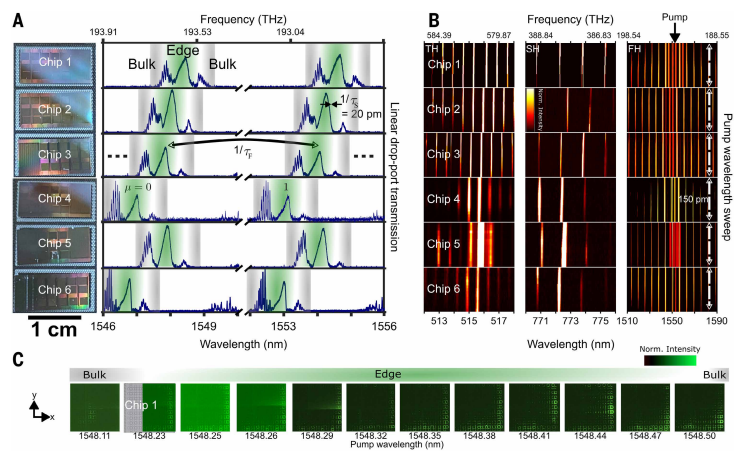
So, how impressive is this? The team tested the photonic maze built on the same design scheme across multiple different chips. Despite slight pitch deviations due to manufacturing errors (some reaching 1.6 nm), every chip successfully and stably generated all harmonics.
This is akin to a craftsman producing a batch of violins; although each one has slightly different wood and strings, each can be picked up and played to produce a pleasant tune without needing a tuner, achieving a 100% success rate.
The traditional single-ring structure is like walking on a tightrope; any slight instability can lead to a fall. In contrast, the nested maze is like walking on a wide bridge; even if you sway slightly left and right, you can still safely reach the other side. This passive fault tolerance is the core breakthrough of this technology.
It does not require complex post-processing, such as installing micro-heaters to tune frequencies, nor does it need complicated electronic controls, making it more energy-efficient, stable, and easier to integrate into various future devices.
(Source: https://www.science.org/doi/10.1126/science.adu6368)
What Else Can Be Done Besides Generating Light in the Lab?
This achievement, while belonging to basic research, has very clear application prospects.
First, the most direct application is to utilize the design principles proposed this time to enhance the yield of various integrated nonlinear optical devices. This means that in the future, nonlinear photonic chips used for optical communication, spectral detection, or quantum information processing can achieve more stable and lower-cost mass production.
Secondly, this scheme has strong universality. Although it was validated on a silicon nitride platform, the core idea of “relaxing phase-matching conditions through topological array structures” does not depend on specific materials. This design principle can be extended to other popular photonic platforms like lithium niobate.
Thirdly, this technology opens the door to generating higher-order nonlinear light, such as ultraviolet light, on chips. As mentioned earlier, the team generated blue light (fourth-order nonlinearity) for the first time on a silicon nitride platform, proving that this architecture has the capability to reach previously difficult-to-achieve high-order nonlinear processes.
If research continues in this direction, it is entirely possible to efficiently generate shorter wavelength light, such as ultraviolet light, on integrated optical chips, paving new paths for chip-level biochemical sensing, medical disinfection, and high-precision photolithography technologies.
(Source: Xu Lida)
In summary, this achievement is not only an experimental success but also a shift in design thinking. They no longer struggle against manufacturing errors that cannot be completely eliminated but choose to embrace imperfections by designing a system that utilizes more complex structures to resolve the fragility of simple structures.
In the future, they plan to extend the topological array design principles from silicon nitride to other more promising optical materials, such as the currently popular lithium niobate. Lithium niobate itself has strong second-order nonlinear effects, and its optical properties can be controlled by electric fields.
At the same time, the research team is not only satisfied with generating various colors of light but also hopes to actively and dynamically control the production ratios of different harmonics (second, third, and fourth harmonics), like distributing candies. If they can create an integrated light source based on this in the future, it would be like pressing a button on a multi-colored ballpoint pen to output the desired color.
Currently, they have only detected blue light (fourth-order nonlinearity), but this is likely not the limit. “Due to the sensitivity limitations of the experimental equipment, we may have missed higher-order nonlinear effects. The next step is to enhance detection capabilities to explore whether we can generate deeper ultraviolet light on the chip,” Xu Lida stated.
References:
https://www.science.org/doi/10.1126/science.adu6368
Operation/Layout: He Chenlong