
In the previous article, we discussed the penetration of RISC-V in the automotive and industrial sectors, where it is beginning to emerge in ARM’s traditional stronghold—this undoubtedly dropped a “bombshell” in the industry. The giants are restless: Intel is concerned about its market share in IoT and other sectors, ARM is wary of its dominant position being challenged, while companies like Huawei view RISC-V as a historical opportunity to break technological shackles. Even players like NVIDIA and Alibaba are ramping up their investments.
The past chip landscape was characterized by a “duel” between x86 (Intel/AMD) and ARM (Qualcomm/Apple), but the rise of RISC-V is pushing the situation towards a “three-way standoff”—the giants are either acquiring, becoming compatible, or forming alliances, with strategies emerging one after another. Today, we will take stock of how these “big players” are responding to the RISC-V wave and where this competition is headed.
PART.01 International Giants: From Observation to Engagement, Competing for Future Discourse Power
In the early stages of RISC-V development, international giants mostly held an observational or even skeptical attitude. However, with the rapid development of its ecosystem, these companies have shifted their strategies, quickly positioning themselves to ensure they do not fall behind in the new round of competition.
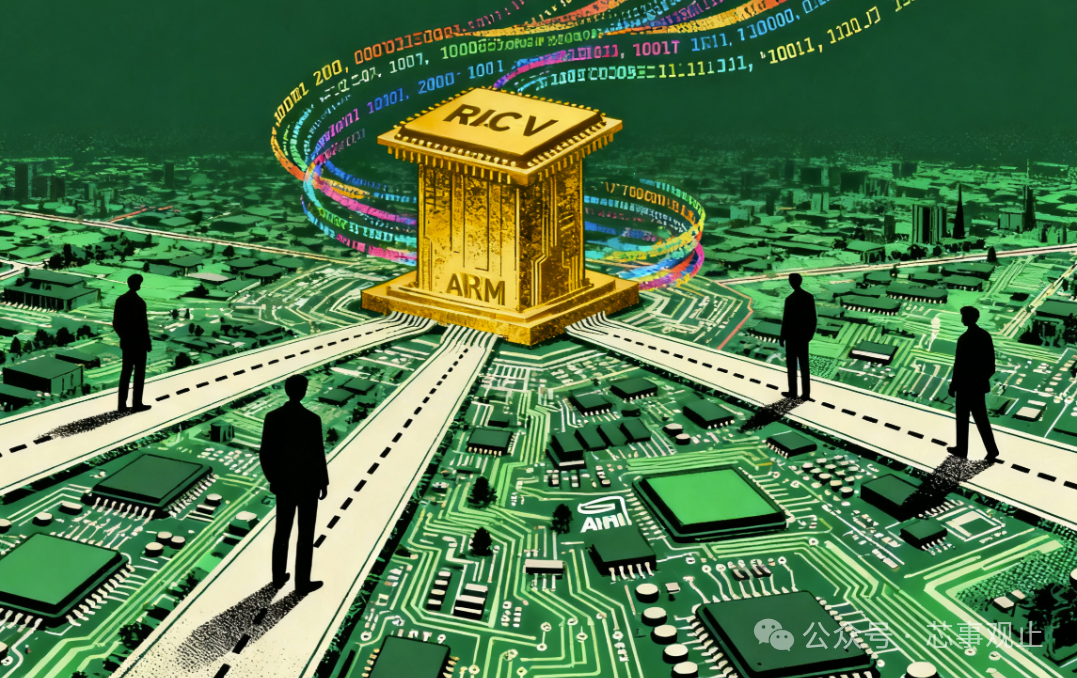 Intel: Acquisitions to Fill Gaps, Strategically “Embracing” RISC-V
Intel has a solid position in the PC and server markets with x86, but has long faced strong competition from ARM in the IoT and embedded sectors, where power consumption and cost are more sensitive. To respond to RISC-V’s expansion in these areas, Intel has adopted a strategy of acquisition and integration. For example, its acquisition of RISC-V leader SiFive is seen as a key step to acquire critical technology and talent, and to quickly enter the market.
Strategic Intent: By launching its own RISC-V core, Intel aims to fill its gaps in low-power, high-efficiency chip areas. Additionally, its “bundled sales” strategy (such as pairing RISC-V coprocessors with Xeon server CPUs) also helps consolidate its competitive edge in “end-to-cloud” integrated solutions, enhancing customer loyalty.
Underlying Logic: This is a defensive offensive. By solidifying its position in the edge and embedded markets with RISC-V, the fundamental goal remains to protect x86’s high-value market in data centers and guard against potential bottom-up disruptions from RISC-V.
NVIDIA: Supporting Software Ecosystem, Positioning for Future Markets
NVIDIA’s approach to RISC-V demonstrates far-sighted strategic vision. Although its Grace CPU superchip is based on the Arm Neoverse architecture, NVIDIA has opened the door for RISC-V at the software ecosystem level.
CUDA Ecosystem Expansion: NVIDIA is promoting its CUDA software platform to strengthen support for RISC-V. This initiative allows RISC-V to serve as the main processor in CUDA systems, paving the way for RISC-V applications in AI edge devices (such as NVIDIA Jetson modules).
Strategic Consideration: By laying out its software ecosystem in advance, NVIDIA maintains deep cooperation with the existing Arm architecture while preparing for the potential emergence of high-performance RISC-V processors. This “hardware-software separation” strategy ensures it remains at the forefront of any architectural changes.
ARM: Actively Responding, Balancing Competition and Compatibility
The direct competitive field of RISC-V is ARM’s “base” (microcontrollers and some automotive chips), and its growth undoubtedly puts pressure on ARM. ARM’s response strategy shows duality:
Strengthening Its Advantages: By emphasizing its mature ecosystem, proven reliability, and comprehensive technical support, ARM aims to consolidate its existing customer base. At the same time, it does not rule out leveraging its strong patent portfolio for legal battles to protect its intellectual property.
Enhancing Toolchain Compatibility: A noteworthy trend is that ARM is making its development tools better support debugging for RISC-V devices. This may seem contradictory, but it is actually shrewd: by lowering the transition costs for developers, it retains tool users and prevents a complete loss of its ecosystem.
PART.02 Chinese Power: Seizing Opportunities, Building an Independent Ecosystem
Unlike the “defensive” strategies of international giants, Chinese manufacturers view RISC-V as a strategic opportunity for achieving technological independence and industrial upgrading, actively participating in and attempting to lead ecosystem construction.
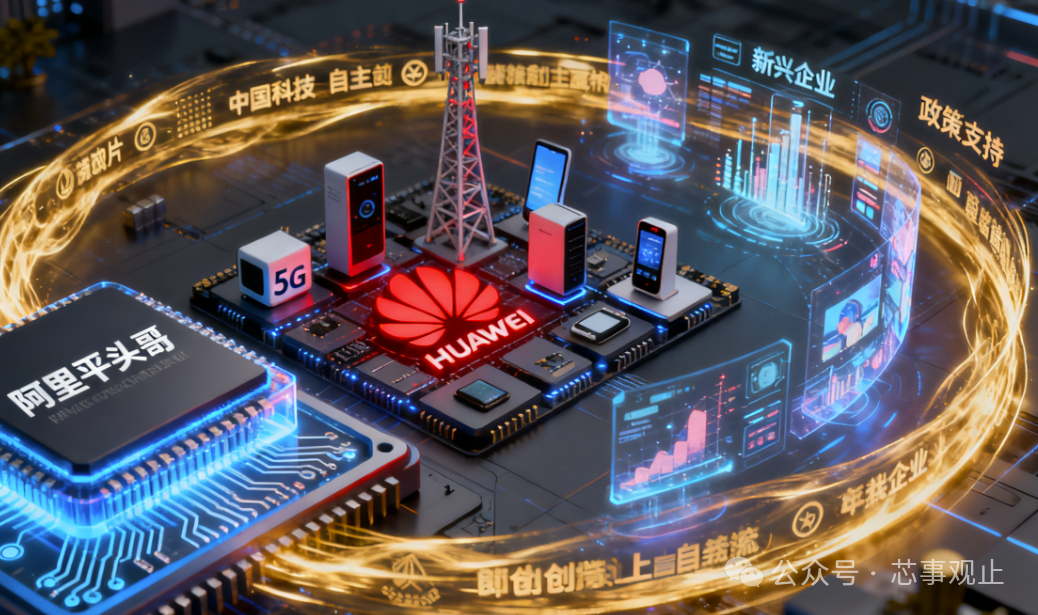 Alibaba Pingtouge: Building the “Xuantie” Core
As a cornerstone of the ecosystem, Alibaba Pingtouge is one of the core builders of the Chinese RISC-V ecosystem, and its “Xuantie” series of RISC-V processors has become one of the most widely used RISC-V cores in the country.
✅Full-Stack Layout: The “Xuantie” series covers all scenarios from low-power embedded to high-performance computing, with its high-performance processors already applied in edge computing, network communication, and other fields, providing a reliable RISC-V computing foundation for many enterprises.
✅Open Source and Ecosystem Construction: Pingtouge was the first to open-source its high-performance RISC-V core, greatly promoting the development of domestic RISC-V research and applications. At the same time, its “Wujian” platform provides developers with the key IP and tools needed for chip design, significantly lowering the design threshold for RISC-V chips.
✅Developer Cultivation: Pingtouge actively promotes the construction of the RISC-V developer ecosystem by organizing competitions and launching certifications, supplying a large number of talents to the Chinese RISC-V industry.
Huawei: Focusing on Ecosystem Construction, Participating in Standard Setting
Huawei is an active participant and promoter of the RISC-V ecosystem, while maintaining cooperation with the ARM architecture, it is also actively laying out in the RISC-V field.
✅HarmonyOS Ecosystem Integration: Huawei regards RISC-V as one of the various chip architectures supported by the HarmonyOS ecosystem, providing an important market for RISC-V’s widespread application in IoT devices. In smart wearables, smart home, and other fields, HarmonyOS devices based on RISC-V have already taken shape.
✅Participation in Standard Setting: Huawei actively participates in key standard-setting work within the RISC-V International Foundation, especially in advantageous areas such as 5G and network processing, striving to gain discourse power in the future technological landscape.
✅R&D Investment: Huawei’s HiSilicon Semiconductor continues to invest in RISC-V R&D, laying the foundation for the diversification of its future product layout.
Emerging Enterprises and Policy Support: Perfecting the Industrial Ecosystem
In addition to the giants, a number of domestic emerging enterprises focused on RISC-V are rising, driving RISC-V innovation in AI acceleration, high-performance computing, and other niche areas.
✅Policy Support: The Chinese government supports RISC-V development through the establishment of industrial alliances and R&D funds. Organizations like the “Yangtze River Delta RISC-V Industry Alliance” promote cooperation between industry, academia, and research.
✅Talent Cultivation: Many top universities in China have opened RISC-V related courses, continuously supplying professional talents to the Chinese RISC-V industry.
PART.03 Core of the Game: Patent Wars and Standard Struggles
Behind the giants’ competition lies a deeper struggle over patents and standards, which determines the future industry dominance and profit distribution.

✨1. Patents: Potential Risks in an Open Ecosystem Although the RISC-V base instruction set is open-source, specific implementation technologies and extended instructions may still touch on others’ patents. International giants possess vast patent libraries, which serve as both their moat and a potential tool to restrict latecomers. Response Strategy: Domestic manufacturers are uniting to collectively address potential patent risks through the construction of “patent pools” and cross-licensing.
✨2. Standards: Defining Future Game Rules Whoever controls the standards controls the direction of the ecosystem. Within the RISC-V Foundation, various stakeholders are engaged in fierce competition over expansion standards in key areas such as servers, automotive, and industrial applications.
Regional and Interest Struggles: The US, Europe, and China are all striving to push their technology solutions that align with their industrial interests as global standards.
Strategic Significance: Leading a key standard means that a country’s industry can occupy a more advantageous position in future competition, reduce adaptation costs, and even gain a technological lead.
✨3. Software Ecosystem: Upstream Priority and Fragmentation Challenges
The software ecosystem is a decisive factor for chip success. RISC-V is making a strong push for the “Linux upstream” strategy, which is seen as a key indicator of ecosystem maturity.
Upstream Priority Strategy: Integrating RISC-V drivers, security modules, and other code into the Linux kernel mainline ensures that it automatically becomes part of all future Linux distributions, significantly reducing long-term maintenance costs.
Fragmentation Challenges and Unified Efforts: The scalability of the RISC-V instruction set is a double-edged sword, leading to fragmentation issues with ISA extensions. To address this, the industry is promoting a profile mechanism aimed at defining a minimal compatibility subset to reduce maintenance complexity for operating systems and compiler vendors, providing a consistent certification path for hardware products.
PART.04 Future Battlefield: The Evolution Path of RISC-V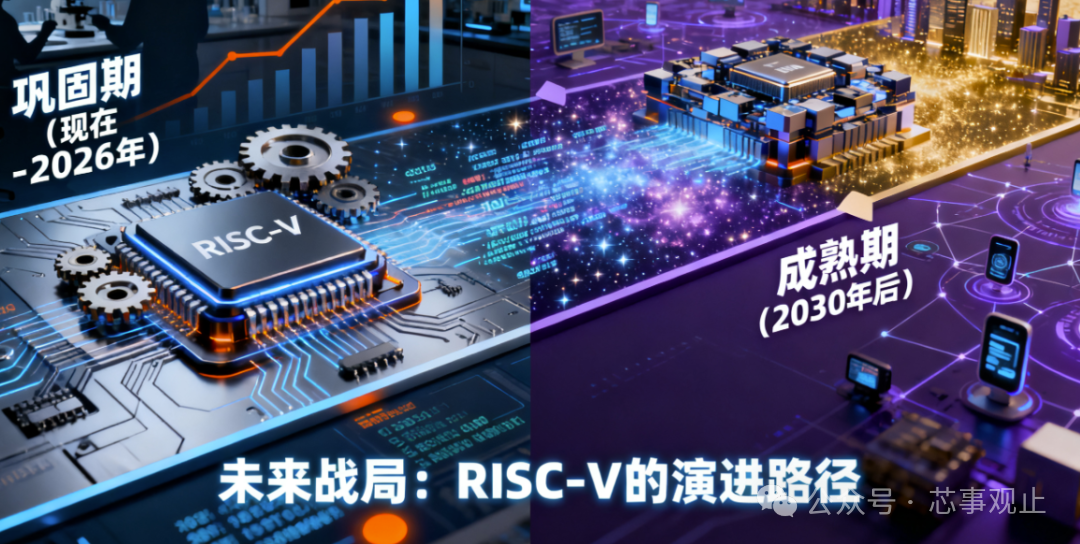
From the current industry dynamics, the future development of RISC-V may go through several stages:
Consolidation Period (Now-2026): Fully consolidating its position in the embedded and IoT markets while forming large-scale applications in emerging fields such as edge computing and AIoT.
Expansion Period (2027-2030): Penetrating higher-value markets such as high-performance computing, data centers, and automotive electronics, forming effective competition with x86 and ARM.
Maturity Period (Post-2030): Establishing a complete software and hardware ecosystem, achieving a leading advantage in specific fields, and realizing a three-way standoff with x86 and ARM.
Conclusion:The Landscape is Uncertain, but China Has Secured a Valuable Position
 The current RISC-V landscape resembles an exciting game with multiple participants: Intel: seemingly a dominant ruler, strategically investing to layout the future, defending while attacking. Alibaba Pingtouge: As a cornerstone of the domestic ecosystem, it builds the foundation of the Chinese RISC-V industry through core technology breakthroughs and ecosystem construction.Huawei: As an important participant in the ecosystem, it promotes the broader application of RISC-V through standard setting and all-scenario applications.ARM, NVIDIA, and others are important variables, seeking their optimal positioning amid competition and cooperation.This chaotic battle is far from over, but one clear signal is that Chinese power has grown from a past follower to a significant influencer. We are not only using RISC-V but are also deeply involved in and even leading parts of the rule-making process. This presents an unprecedented historical opportunity for the Chinese chip industry to break through the traditional architecture monopoly.
In the next article, we will confront RISC-V’s “soft spots”—issues such as ecosystem fragmentation, the maturity of high-level IP cores, and ongoing innovation pressures. How to fill these “pits” will be key to determining whether it can achieve stable and long-term development.