Yesterday, Arm announced its latest Cortex-M series product, the new Cortex-M55. In addition to the new CPU microarchitecture bringing several improvements, we also saw the introduction of the new Ethos-U55 NPU IP, which is designed to integrate with the new M55 core.Arm’s new IP aims to enhance the machine learning and inference capabilities of billions of low-power embedded devices in the coming years and expand its product portfolio to accommodate new use cases.
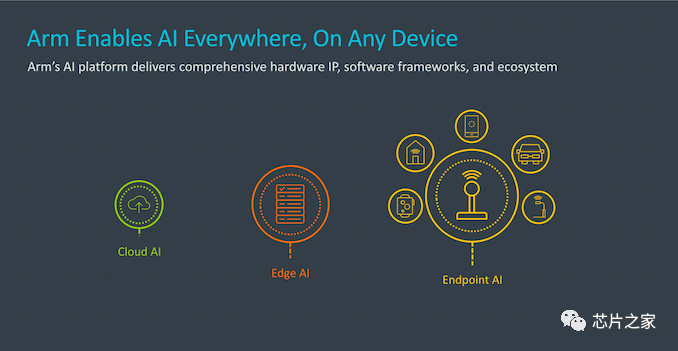 Edge AI is one of the biggest trends in chip technology. This means that many AI functionalities can run locally without a connection to cloud servers,which directly improves speed and privacy.NXP’s Senior Vice President of Edge Processing, Geoff Lees, stated, “Driven by new AI requirements and challenges of cloud-based processing regarding cost, latency, reliability, and privacy, ‘Empowered Edge’ has become a new major trend. Arm’s new endpoint ML technology will help many microcontroller developers at NXP accelerate edge processing for devices constrained by size and power.”Here are a few examples:
One application of IoT AI is something that already exists, but using Cortex-M55 and Ethos-U55 can elevate it to a new level. This device is not something everyone must have,but for those who need it, it can be life-changing.Here are some statistics: In the United States, there are 10 million registered blind or visually impaired individuals. Globally, this number approaches 300 million. The device I want to mention is a connected cane. Early versions already exist, and we found the following version: WeWalk, which uses sensing and navigation capabilities to intelligently guide people away from indoor and outdoor hazards.The new AI includes new human-assisted, voice, and gesture-guided machine interactions, as well as predictive fault sensor systems that will greatly change lives.
We spoke with Arm’s healthcare innovation team about how our new Cortex and Eth operating system processors could undergo significant upgrades.They told me that the biggest challenge facing today’s connected developers is the reliance on ultrasonic positioning.However, the range and fidelity of ultrasound are limited, and the required sensing, processing, and power components often bloat designs.
The new processors will allow developers to replace ultrasound with AI-supported visual sensing using 360-degree cameras.In addition to wireless communication and navigation, they will also be powered by ultra-thin batteries that can last all day.The device looks like a traditional device but is the ultimate visual aid. Moreover, since AI computation is performed locally, losing unit connectivity is not an issue.
Next, let’s take a look at the new features of the newly released Cortex-M55 and Ethos-U55.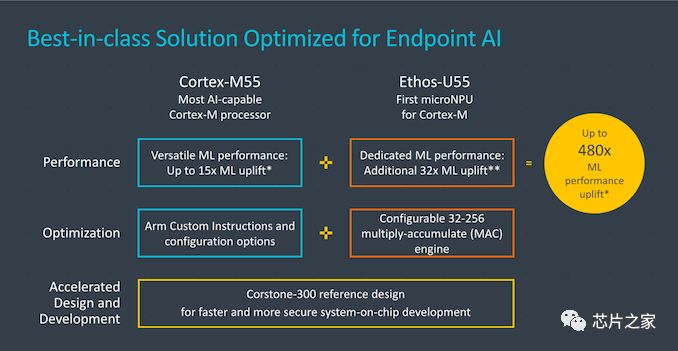
The new Cortex-M55 is a next-generation IP closely related to the M33, but it brings several new architectural improvements, promising significant performance and flexibility enhancements in machine learning and vector instructions.
Ethos-U55 is a dedicated “microNPU” inference accelerator that can be used in conjunction with Cortex-M class CPUsand provides the performance and energy efficiency of a dedicated NPU, or typically brought to the desktop by MAC engines – similar M-class IP occupies a small footprint.
Cortex-M55:The First CPU Core withHeliumand Custom Instruction Capabilities
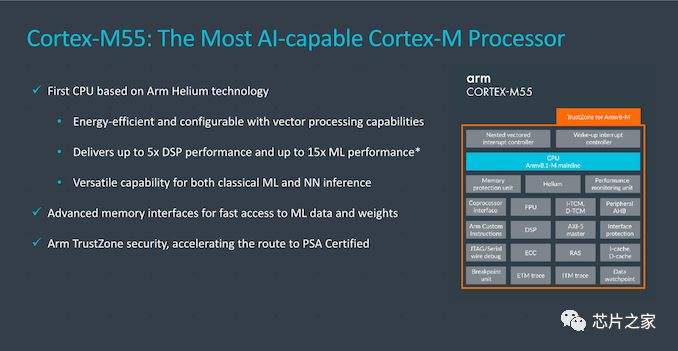
The new Cortex-M55 is significant because it is the first Arm CPU core to feature both Helium (I apologize for not knowing the Chinese name) and custom instruction capabilities. The technical name for Helium is actually MVE (for M-Profile Vector Extension), which is a new vector extension and dedicated vector execution unit in the M-series processor product line, making it the first CPU in this range to have SIMD capabilities.The new features increase the DSP performance of the new core by 5 times, and when optimized instructions for ML workloads are combined with MVE, performance improves by 15 times.
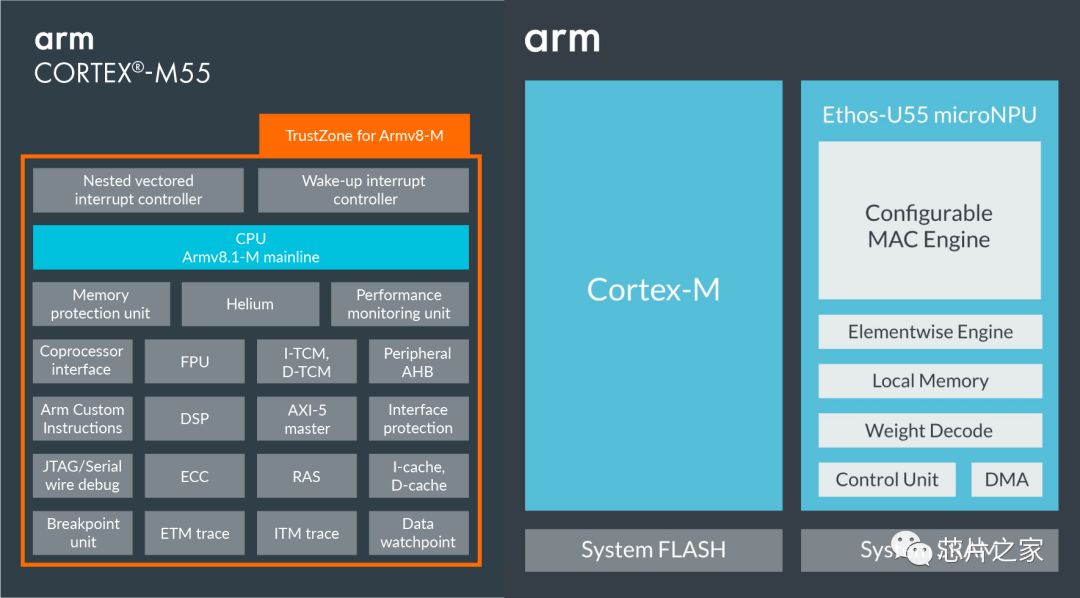
In terms of overall microarchitecture, it is the successor to the M33 and µarch combination, and the frequency increase will improve scalar workload performance by about 20%, depending on the vendor’s configuration.The design focus of this core is bandwidth, enabling new MVE and new ML workloads that require bandwidth, thus improving the memory subsystem, such as having four 32-bit interfaces to TCM (Tightly Coupled Memory).
Ethos-U55:Arm’s First microNPU
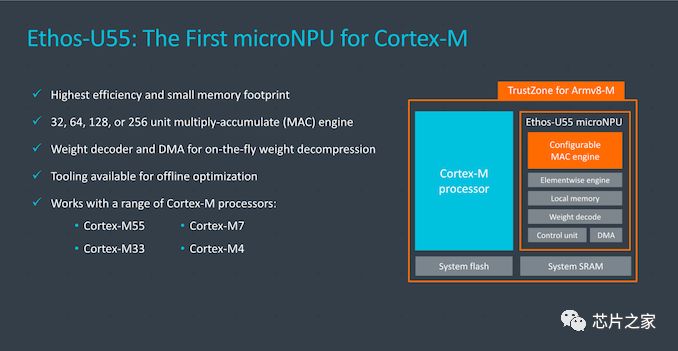
Arm is relatively late to the NPU field, as most vendors have adopted their own first-party IP architectures in their products, and now most vendors are using such implementations. However, the embedded market is somewhat different, and thus a product is needed that is much smaller in area and power consumption than those typically used in “larger” implementations (for example, in Arm’s Ethos-N covering mobile SoCs), NPU IP.This is the first product in the company’s new “microNPU” neural network accelerator coprocessor for microcontrollers.Arm claims that combined with the newly released Cortex-M55, Ethos-U55 can increase machine learning performance by 480 times on the company’s existing Cortex-M series products.
The new U55 is a small NPU that can scale from 32 MACs to 256 MACs and needs to be coupled with Cortex-M class NPUs.Arm did not delve into the main details of the microarchitecture, but it is a very streamlined design focused on area and power efficiency, with a smaller memory footprint, including some features we saw in the N series products, such as weight reduction.We are talking about the U55 needing to be coupled with M-class CPUs to serve as a controller, but in reality, this is not much different from the functionality of the N series, as this IP already includes M-class CPUs,specifically designed for low-power use cases.
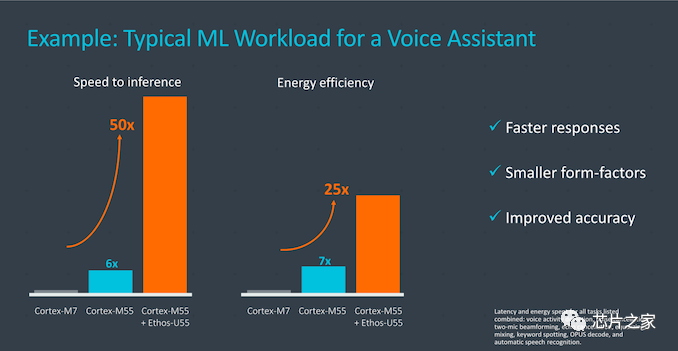
The performance improvements of such systems using M55 and U55 compared to previous generation solutions represent a very significant step function enhancement. Compared to Cortex-M7 based systems,Arm provides data that can increase performance by up to 50 times while improving energy efficiency by 25 times.
As for where the new IP will be used, there are a variety of embedded systems.Here we need to understand that the main part of such systems will actually be subsystems of currently existing chips.For example, in mobile devices, you will see subsystems using IP in the phone’s fingerprint sensor, in voice assistant functions that are always listening with audio chips, and even in RF systems using subsystems to optimize workloads, such as antenna tuning.Hundreds of M-class processors in today’s mobile devices will benefit from ML capabilities, most of which are completely transparent to users.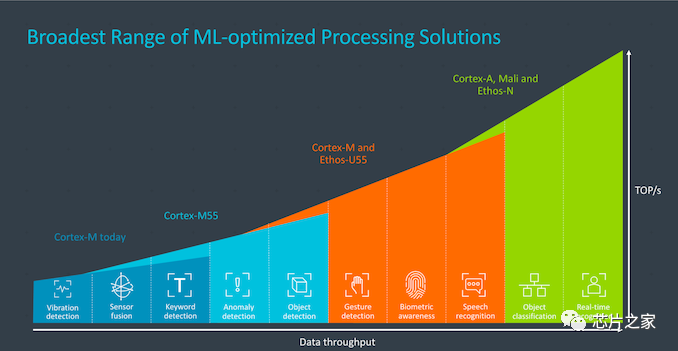
Arm has currently licensed the M55 and U55 to its major partners and will open broader licensing to other customers in the coming months.As with IP, if vendors have ever publicly confirmed whether they are using these designs in their products,the earliest chips are expected to debut as early as early 2021.
Previous Highlights 1. Open Source Project | RT-Thread Software Package Application Works: Ink Screen Desktop Calendar
2. One-stop Development Tool: RT-Thread Studio Officially Released
3.Bear: A Letter to Community Partners
4. Using USB Host to Read and Write U Disks on STM32
5. Smart Home DIY Tutorial Series 4 – Step-by-Step Guide to Connecting to the Cloud
6. Community Interview | Wang Junjie: Sharing Experience and Usage of Package Creation
7. How to Safely Return to Work Under COVID-19? How to Safely Work from Home?
You can add WeChat 17775982065 as a friend, indicating: Company + Name, to join the RT-Thread official WeChat group!

RT-Thread
Making the development of IoT terminals simple and fast, maximizing the value of chips. Apache2.0 license, free to use in commercial products without the need to disclose source code, with no potential commercial risks.
Long press the QR code to follow us
 Click to read the original text, enter the RT-Thread GitHub homepage
 Every “look” you click is taken seriously as a like