 This article is for knowledge and academic sharing only, copyright belongs to the original author. If there is any infringement, please contact for removal.
Source: Quantum Bit
Robots no longer need to have disjointed brains!
ByteDance’s Seed model can handle robot reasoning, task planning, and natural language interaction all in one.
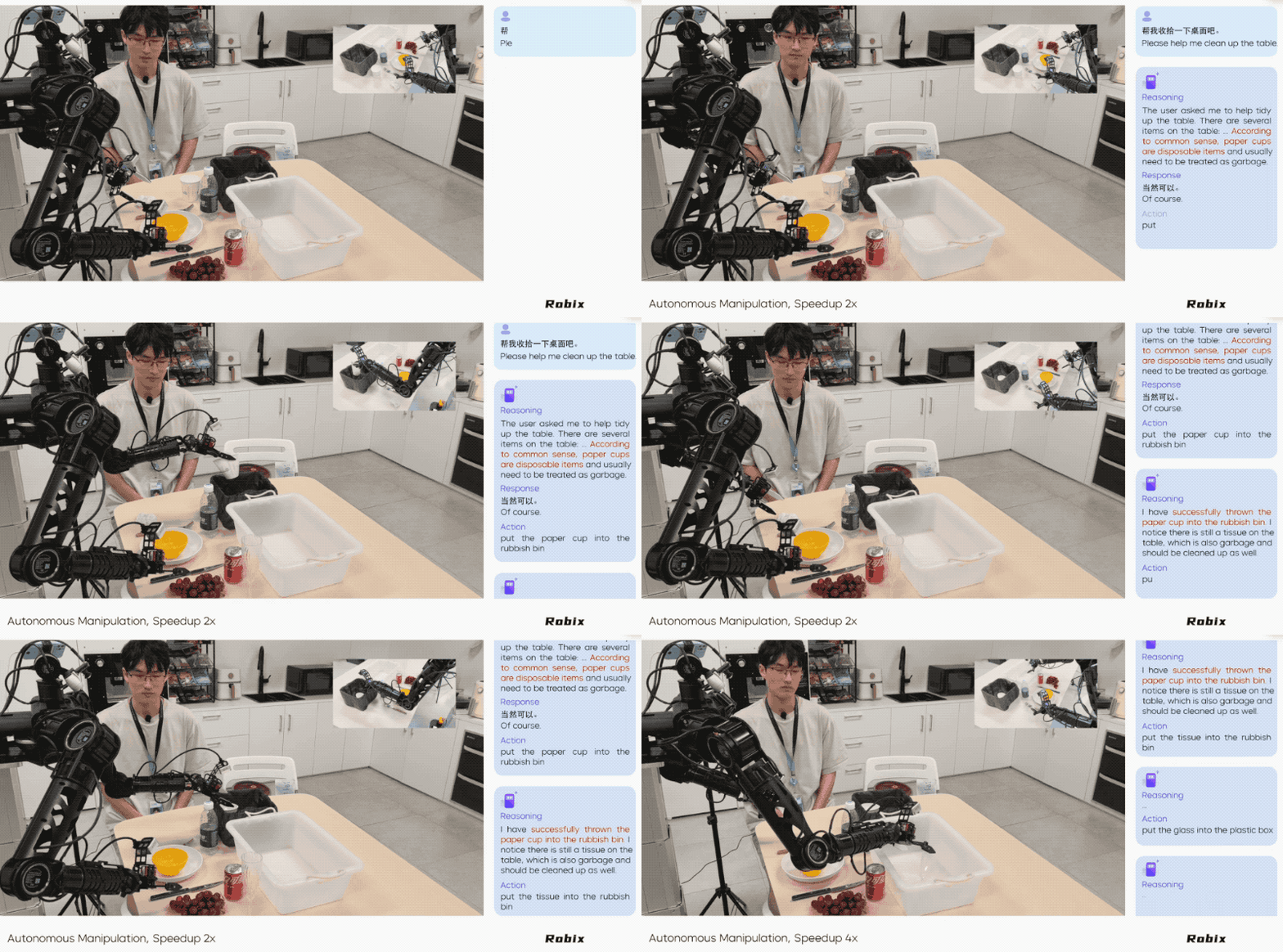
Friends who often work with robots know that previously, to make a robot work, one had to solve a frustrating problem —
the information gap between modules.
Understanding commands and executing them are completely different things. In the past, to make a robot understand human language, a dedicated language interaction module had to be installed; to enable it to avoid obstacles from the living room to the balcony, a task planning module was also needed; and to achieve… one had to…
Thus, developers have long struggled with piecing together different modules on robots.
But now, ByteDance has launched Robix Vision — a single model for language, which encompasses all three functions without the need for multiple module integrations.
So, how is this achieved?
The core employs chain reasoning and a three-stage training strategy
Robix is a model specifically designed for robots. The core idea is to enable a single model to accomplish three tasks simultaneously:
- Figuring out how to work (reasoning)
- Arranging the steps to work (task planning)
- Communicating with humans (natural language interaction)
First, the team’s approach is to divide the robot system into two layers: high-level cognition and low-level execution, with Robix managing the high-level cognition.
The low-level (VLA) executes the commands issued by Robix.
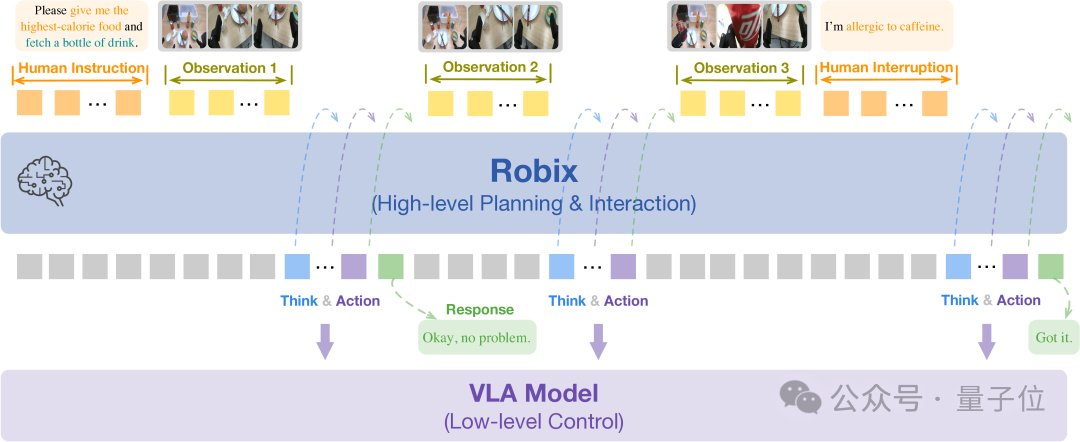
Moreover, Robix itself is not a disjointed brain made up of multiple modules, but rather a single model that integrates vision and language, capable of processing images and language simultaneously, while also integrating the thought process, action commands, and human responses into a single logical loop, avoiding communication delays between modules.
The core of Robix employs chain reasoning and a three-stage training strategy.
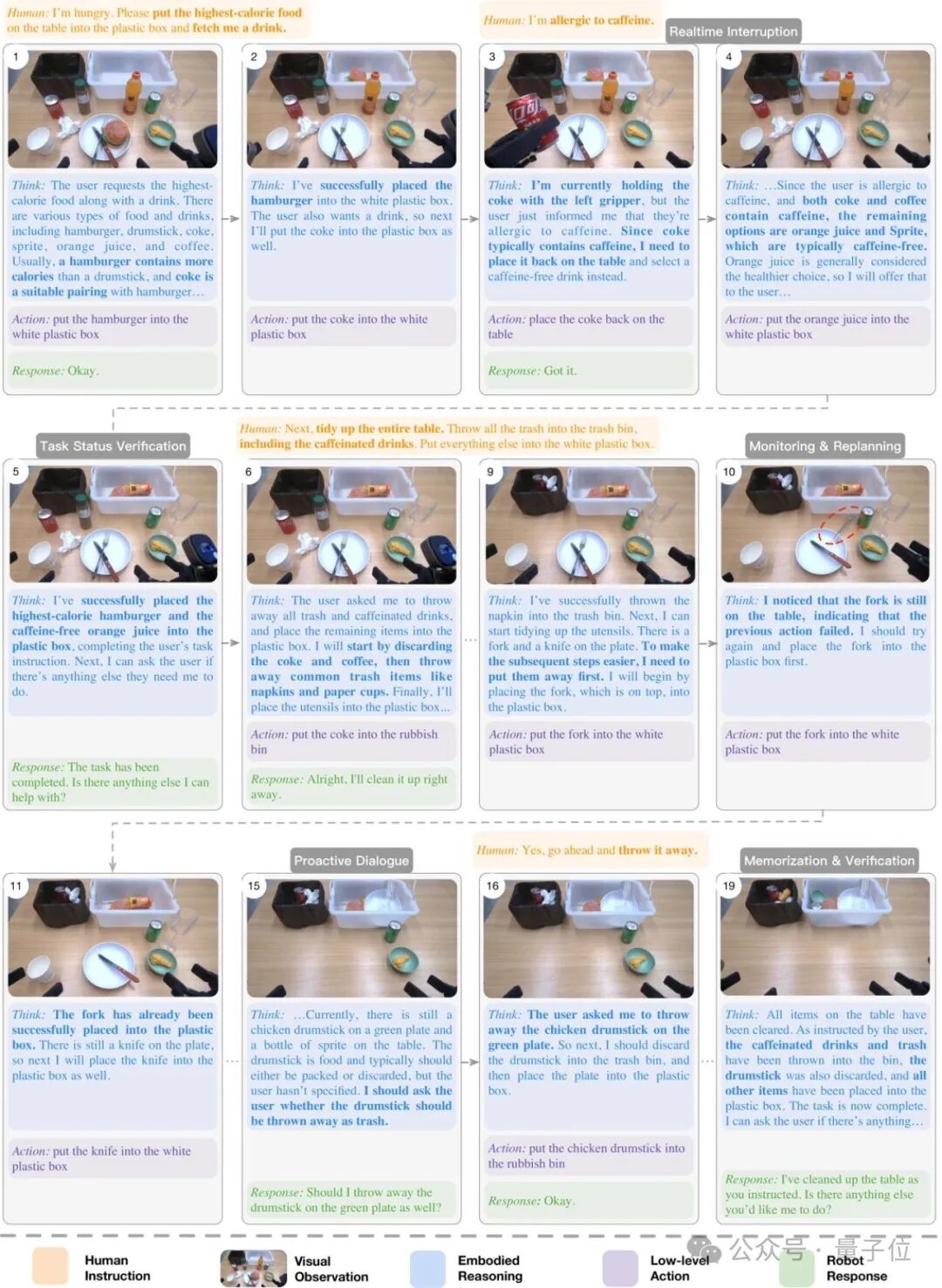
In terms of reasoning and decision-making, it uses chain reasoning to conduct thoughtful reasoning based on input information.
During the reasoning process, it considers factors such as objects in the current scene, spatial relationships, and task requirements, predicting the next direction of thought, action plans, and possible language responses.
This process is an iterative decision-making process, where each decision is based on current observations and previous interaction history.
Next, let’s talk about how Robix is trained.
The three stages consist of continuous pre-training, supervised fine-tuning, and reinforcement learning.
In the continuous pre-training stage, a large amount of robot-related data is used to teach it to understand 3D space, correlate language with images, and learn to judge task progress.
In the supervised fine-tuning stage, real-world scenarios such as clearing a dining table and grocery shopping are simulated to teach it to handle various commands, think logically step by step, and learn to engage in simple conversations with humans, achieving understanding, planning, and chatting capabilities.
In the reinforcement learning stage, specialized algorithms correct the issue of “thinking and doing differently” by rewarding correct actions and providing reminders for mistakes, enabling it to make more stable decisions and precise actions over long-duration tasks.
As for the results, the team provided some test data.
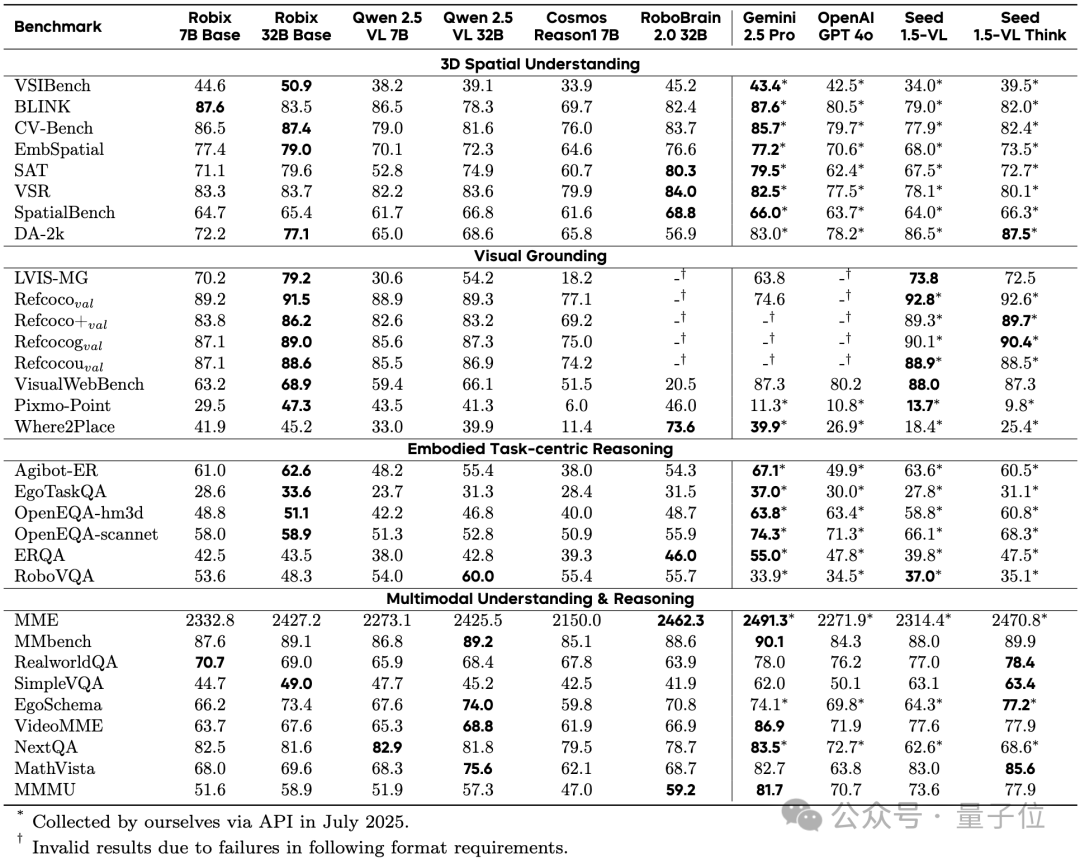
In basic capability tests, the two versions of Robix (7B and 32B) outperformed Qwen2.5-VL in 7 out of 8 spatial understanding tasks, with higher average accuracy;
and it surpassed closed-source models like GPT-4o and Gemini 2.5 Pro in most benchmark tests.
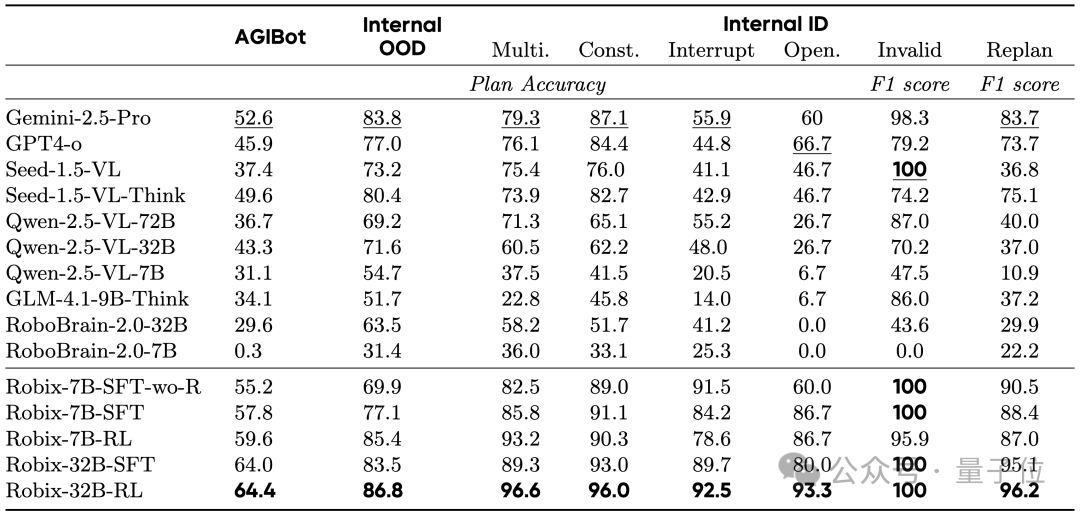
In offline evaluations, Robix-32B-RL ranked first across all evaluation sets.
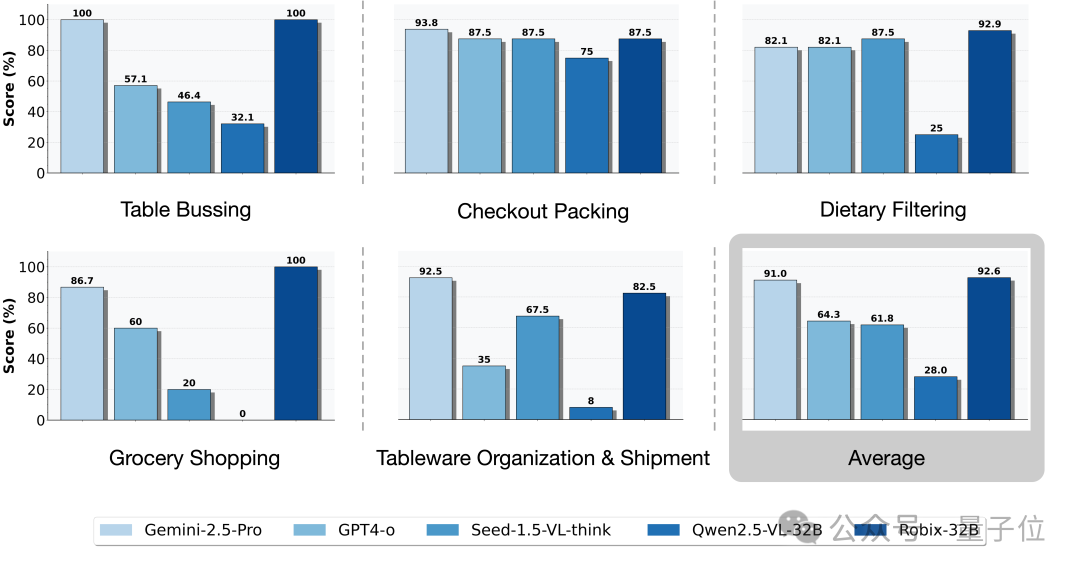
In interactive tests simulating real environments, using UMI devices for online evaluation, Robix-32B surpassed Gemini 2.5 Pro in 3 out of 5 tasks, with slightly higher average task progress, and significantly outperformed Qwen2.5-VL-32B.
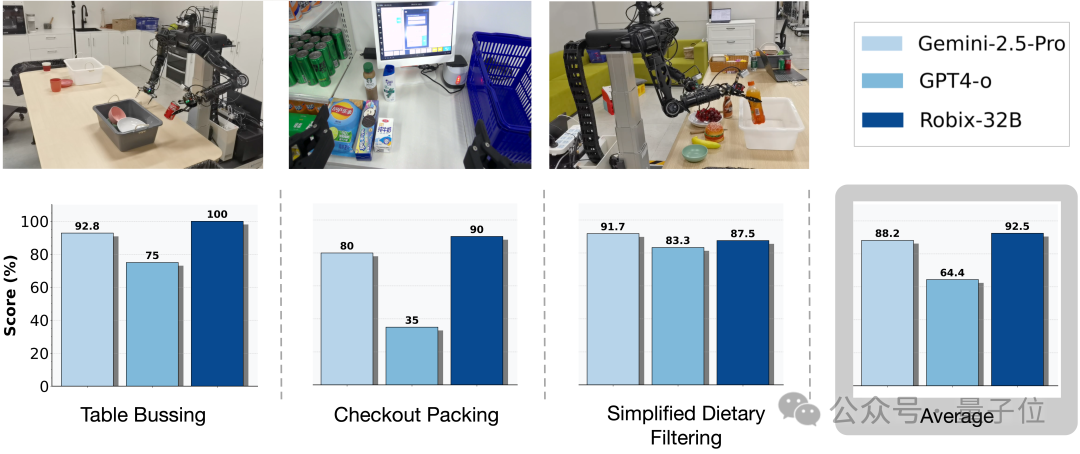
When using GR-3 for online evaluation, in automated real robot assessments, Robix-32B achieved an average task progress of 92.5%, surpassing Gemini 2.5 Pro and GPT-4o by 4.3 and 28.1 percentage points, respectively.
It seems that in the future, the capabilities of robot models will be measured not by the number of modules but by the comprehensive ability of a single model.
One More Thing
It is worth noting that the head of the Robix project is Dr. Li Hang, who is also the head of ByteDance’s AI Lab. Previously, he served as the director and chief scientist of Huawei’s Noah’s Ark Lab.

△Image source: Li Hang’s Weibo
He joined ByteDance in 2017 and has since led the team in developing ByteDance’s robot projects.
In June of this year, sources revealed that Li Hang had retired, but ByteDance officials quickly stated that he would continue to work as a consultant with unchanged responsibilities.
Additionally, Dr. Li Hang’s book “Machine Learning Methods,” published in 2022, has reportedly been in the works since 2018…

△Image source: Li Hang’s Weibo
The new edition has added content on deep learning and is now available. If you want to delve deeper into machine learning, you can follow the book!
Technical report: https://robix-seed.github.io/robix/Paper link: http://arxiv.org/abs/2509.01106
Click the "Global Robot News" above to follow for more interesting knowledge!

Feel free to recommend this public account to your peers!
(Please ask readers to add a star, as articles may not be visible without it.)