In previous articles, we introduced the principles and structures of gas sensors. This time, we will discuss the development history of electrochemical gas sensors. The development of electrochemical gas sensors is a history that transitions from theory to practice, from the laboratory to industrial and civilian use, and from single oxygen monitoring to precise detection of multiple toxic gases.
1. Overview of Development Timeline
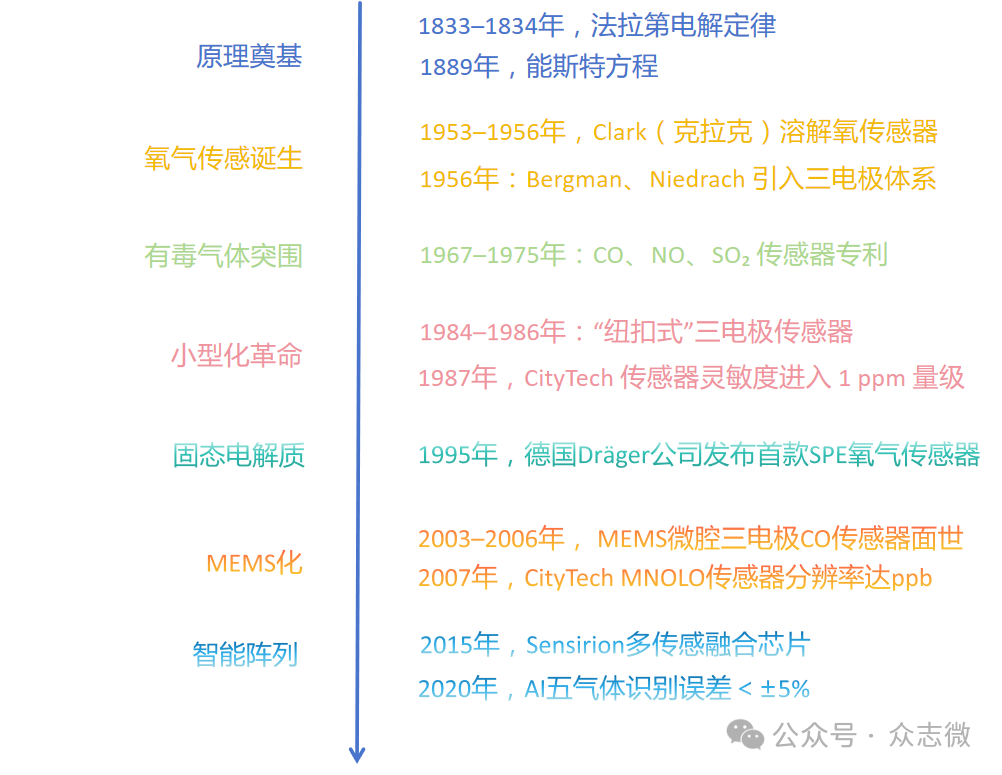
Overall, the development of electrochemical gas sensors shows a trend from theoretical foundation and single application to miniaturization, intelligence, and multifunctionality. From the establishment of electrochemical principles in the 19th century, to the birth of oxygen sensors in the 1950s, the rise of toxic gas detection in the 1960s and 1970s, the realization of miniaturization and multi-component detection in the 1980s, the exploration of solid-state electrolytes in the 1990s, breakthroughs in MEMS and low power consumption in the early 21st century, and the recent developments in intelligence and array technology, electrochemical gas sensors have undergone a journey from laboratory prototypes to widespread industrial and civilian applications, continuously evolving towards smaller, smarter, and more functional designs.
2. Evolution of Key Technical Parameters
| Year | Volume | Detection Limit | Power Consumption | Representative Products |
|---|---|---|---|---|
| 1950s | >100 cm³ | O₂: 1% vol | >500 mW | Clark Electrode |
| 1980s | 3 cm³ | CO: 10 ppm | 50 mW | CityTech Series 4 |
| 1990s | 2 cm³ | O₂: 0.1% vol | 10 mW | Dräger SPE Oxygen Sensor |
| 2006 | 0.2 cm³ | CO: 1 ppm | 100 μW | GE MEMS Microcavity |
| 2020s | <0.1 cm³ | SO₂: 1 ppb | <50 μW | Alphasense Array Sensor |
The table shows the leap in the development of electrochemical gas sensors from the 1950s to the 2020s: the volume has significantly reduced from >100 cm³ to <0.1 cm³, the detection limit has jumped from percentage levels (O₂ 1% vol) to ppb levels (SO₂ 1 ppb), and the power consumption has decreased from >500 mW to <50 μW. At the same time, the technology has evolved from single gas detection to multi-gas array sensors, with breakthroughs in high integration, ultra-low power consumption, and ultra-high sensitivity.
3. Five Milestone Technologies
1. In 1956, Bergman and Niedrach developed an amperometric oxygen sensor for NASA’s spacecraft, introducing the three-electrode system into gas detection for the first time. The addition of a reference electrode allowed for better control and monitoring of the working electrode potential, improving the performance and stability of the sensor, laying the foundation for the basic architecture of modern electrochemical sensors.
2. In 1987, CityTech (now acquired by Honeywell) developed a multi-gas platform, which first achieved the integration of multiple gas sensing units (such as CO, H₂S, O₂, etc.) on a single substrate, breaking the limitations of traditional single gas detection and reducing the sensor size by 60%.
3. In 1995, Germany’s Dräger introduced the solid polymer electrolyte (SPE) technology, which removed the liquid chamber, reducing its volume by 60%. Its structure changed from a “long battery type” to a “button type”, solving the problem of traditional electrolytes leaking and corroding circuits, extending the sensor’s lifespan from 1-2 years to over 5 years.
4. In 2006, General Electric collaborated with Alphasense to launch the MEMS microcavity three-electrode CO sensor, integrating the traditional three-electrode structure (working/reference/counter electrode) into a silicon microcavity, reducing the volume to 0.2 cm³, with an average power consumption of <100 μW, capable of being powered directly by a button battery for over 5 years.
5. After 2020, gas recognition algorithms based on deep learning combined with EGS arrays can simultaneously output the concentrations of five gases (CO, NO₂, SO₂, O₃, NH₃) within a volume of 1 cm³, with an error of <±5% FS. The involvement of AI represents a paradigm shift for traditional electrochemical gas sensors, transitioning the cost focus from hardware to algorithms.