 Click the blue text above to subscribe with one click.

In this work, the Dave J. Adams group at Glasgow University constructed a self-stabilizing hydrogel biomimetic system. This system is based on a pH-responsive peptide self-assembled hydrogel system, which can drive the dynamic changes of the hydrogel system by introducing a chemical reaction cycle that can change the pH in situ. Notably, these hydrogel systems exhibit self-regulating functions, where the intrinsic molecular cross-linking network types of the hydrogel can undergo corresponding transformations during the pH changes driven by the chemical reaction cycle, allowing real-time changes in the mechanical properties of the gel while maintaining the system’s stable gel form.
Living systems are open systems that are constantly undergoing dynamic changes. Through continuous exchanges of materials, energy, and information with the external environment, living systems maintain internal environmental stability through a series of complex feedback and regulatory mechanisms, such as temperature control, heart rate maintenance, and blood pressure regulation. In contrast, most artificially synthesized material systems are static systems in equilibrium and lack the ability to make corresponding adjustments when subjected to external stimuli. Constructing material systems that have self-monitoring and self-regulating functions, like living systems, is a hot direction in the current research of self-assembled biomimetic materials.
Most reported chemically driven gel dynamic systems undergo transitions between solution and gel states. In this study, through reasonable design and regulation of “micro-stable modules,” the system can spontaneously change its intrinsic cross-linking network form at the molecular level, keeping the system in a stable gel state.
In this work, the authors used a hydrogel system based on dipeptide 1 as a basic platform (Figure 1). This gel system can respond to pH; when the pH increases, the gel transitions to a solution. On this basis, the authors introduced two types of chemical reactions that can change the system’s pH in situ, including the urease-catalyzed urea hydrolysis reaction (producing the basic product ammonia) and the hydrolysis reaction of methyl formate (producing the acidic product formic acid), constructing a pH cycling feedback system. The authors first studied the feasibility of the two types of chemical reactions for dynamic regulation of the gel system. As shown in Figure 2a, when only the urea hydrolysis reaction is active, the system’s pH will increase over time, prompting the gel to dissociate into a solution. If the hydrolysis reaction of methyl formate is simultaneously introduced into the system, as the urea hydrolysis reaction increases the pH, the hydrolysis of methyl formate accelerates, and the produced formic acid gradually lowers the pH of the system, leading to the reformation of the gel (Figure 2b).
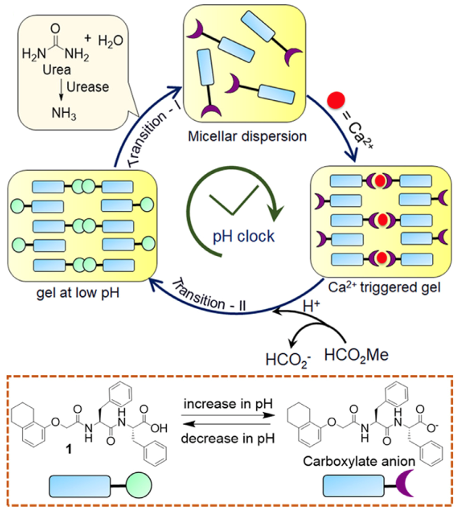
Figure 1. Schematic diagram of the molecular system involved in this work and the dynamic evolution of the stable hydrogel system.
To achieve a stable gel form, the authors introduced another element, calcium ions, into this system. Calcium ions can complex with the carboxylate anions formed in the system at high pH, allowing the system to also form a gel at high pH. As shown in Figure 2c, the introduction of calcium ions allows the system to maintain a gel state across different pH ranges. The authors tracked and characterized the real-time changes in the system’s pH, mechanical properties, and microscopic structure, with results showing that the molecular assembly behavior and properties of the system dynamically changed and adjusted over time, visually maintaining the gel form of the system in this “steady state.”
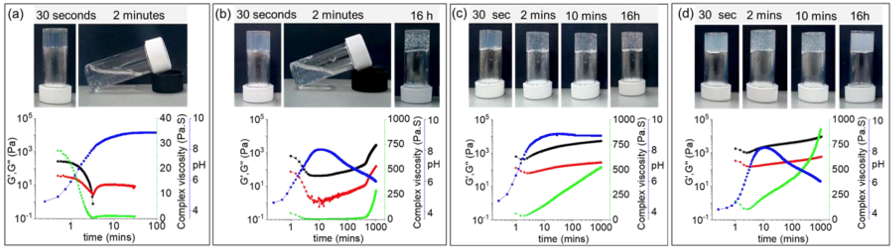
Figure 2: Morphological changes of the gel system under different conditions and changes in system pH (blue), G’ (black), G” (red), and complex viscosity (green) over time.
The authors further demonstrated that by altering a single “micro-stable module,” such as changing the concentration of methyl formate or calcium ions, the dynamic behavior of the gel system could be regulated. For example, increasing the concentration of methyl formate while keeping all other parameters constant significantly reduced the rate of increase in system pH, and the maximum pH value of the reaction medium correspondingly decreased. Changes in the rate of pH variation directly impacted the changes in the mechanical properties of the hydrogel, delaying the decrease of G’ and G”, thus increasing the lifetime of the gel’s primary assembly structure (from about 2 minutes to about 4 minutes).
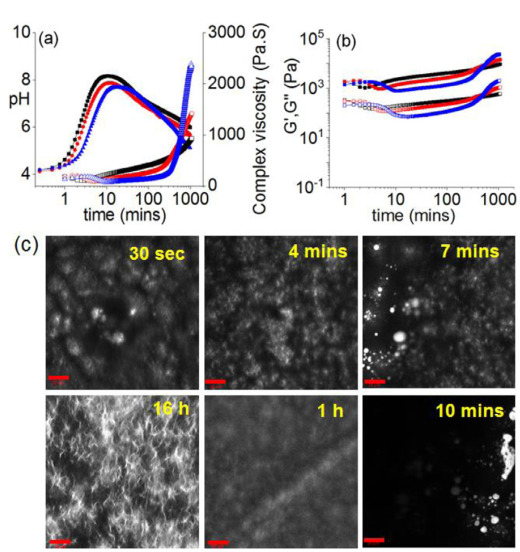
Figure 3: Changes in internal pH, mechanical properties, and microscopic structure of the gel over time when the concentration of methyl formate is increased while keeping all other parameters constant.
This research was published under the title “Mimicking evolution of ‘mini-homeostatic’ modules in supramolecular systems” in Giant.
Original link:
https://doi.org/10.1016/j.giant.2020.100041
Related Progress
Researcher Cheng Yilong’s group at Xi’an Jiaotong University Bioact. Mater.: New progress in skin biomimetic hydrogel dressings.
Ren Fuzeng’s group at Southern University of Science and Technology in AFM: Biomimetic, highly anisotropic, ultra-strong, and bone-conductive mineralized wood hydrogel composites for bone repair.
Professor Liang Qionglin’s team at Tsinghua University Nat. Protoc.: A combinatorial microfluidic platform for easily preparing flowable hydrogel microtubule biomimetic structures.
Soft Mechanics Laboratory at Southern University of Science and Technology: Biomimetic design strategies for elastomer-hydrogel composite structures.
ACS Nano: Combining catalysis to prepare biomimetic, tough, adhesive, self-healing, and antibacterial hydrogels based on lignin.

Disclaimer: Some materials are sourced from the internet, and the purpose of reproduction is to convey more information and share, which does not imply endorsement of their views or verification of their authenticity, nor does it constitute other suggestions. It only provides a communication platform and is not responsible for its copyright. If there is any infringement, please contact us for timely modification or deletion. Email: [email protected]


We Invite Contributions
Experts and scholars are welcome to provide manuscripts (papers, project introductions, new technologies, academic exchanges, institutional news, conference information, recruitment, and enrollment, etc.) to [email protected], and please indicate detailed contact information. Polymer Technology® will push the information in a timely manner and also publish it on the China Polymer Network.
Welcome to Join WeChat Group To meet the requirements of colleagues in the polymer industry-academia-research, we have successively opened dozens of special exchange groups, including a group for polymer experts and scholars, as well as groups for polymer industry technology, entrepreneurs, PhDs, graduate students, media journals, and associations, covering the entire polymer industry or field. Currently, we have gathered thousands of top experts, scholars, technical personnel, and entrepreneurs from research institutes and corporate R&D centers at home and abroad.
To apply for group entry, please first add the review WeChat account PolymerChina (or long press the QR code below), and please be sure to indicate: polymer + name + unit + title (or degree) + field (or industry), otherwise it will not be processed. Qualifications will be reviewed before entry into the relevant professional group.

Click here to read the original text for more information.