 Produced by Zhien Smart Chip
Driven by the trends of high integration, low power consumption, and standardization in automotive electronic systems, Bluetooth Low Energy (BLE) is becoming an important choice for short-range communication.
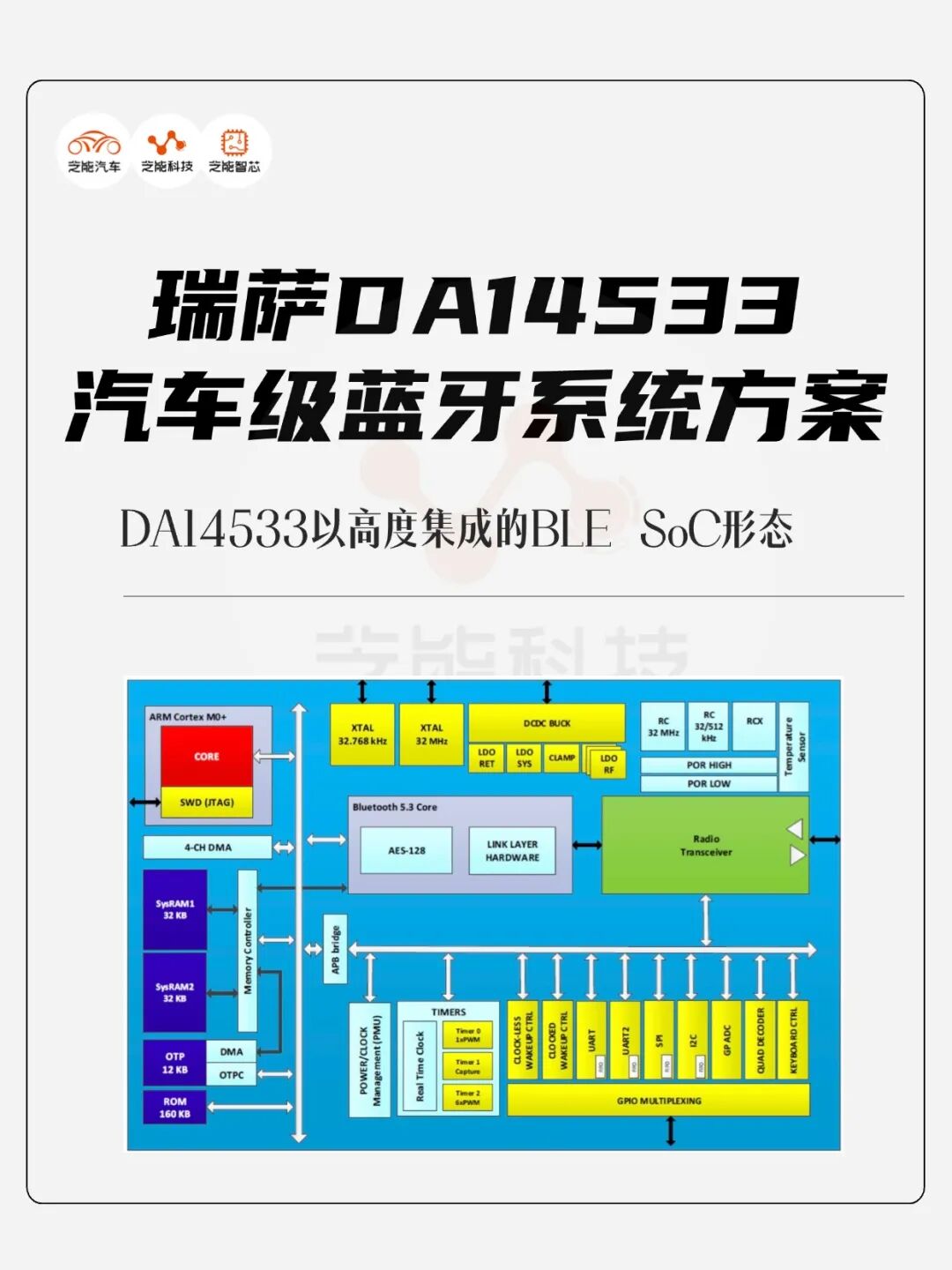
As Renesas’ first automotive-grade BLE chip, the DA14533 has been optimized for area, power consumption, and system complexity, specifically designed for scenarios sensitive to size, battery life, and cost, such as TPMS.
This article analyzes the practical application of the DA14533 in automotive tire pressure monitoring systems, discussing its system advantages and key technical details, and rationally assesses the trend of short-range wireless connectivity in automotive systems.
 Part 1
Evolution of System Connectivity:
DA14533
Engineering Implementation in In-Vehicle Bluetooth Scenarios

As automotive electronic architectures gradually evolve towards centralized and domain-controlled systems, the role of in-vehicle wireless communication becomes increasingly important.
The launch of the DA14533 is timely; its small size, high integration, and low power characteristics make it an ideal choice for deploying BLE communication modules in automotive applications.
In typical scenarios such as tire pressure monitoring systems (TPMS), traditional solutions often use dedicated RF protocols at 433MHz or 315MHz, which typically require dedicated receivers, repeaters, and independent antennas. While these solutions have low power consumption, they tend to have high system redundancy and costs.
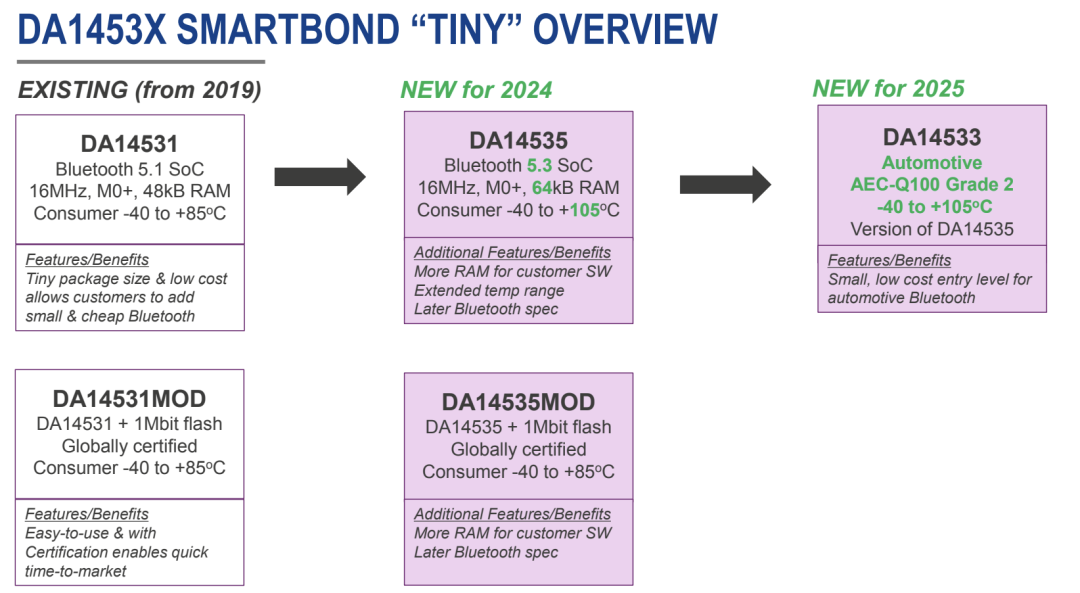
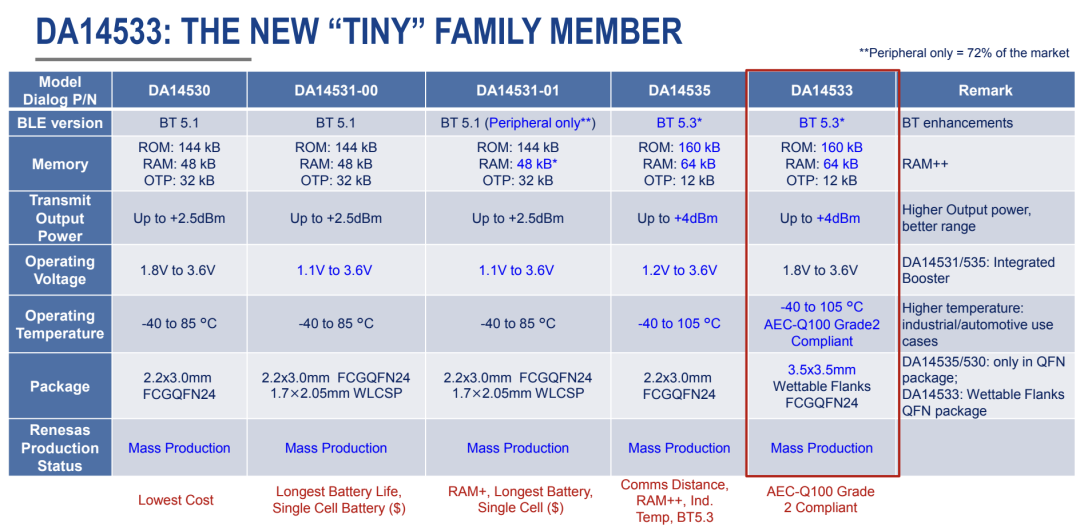
The DA14533 adopts the Bluetooth 5.3 protocol, combined with Renesas’ mature low-power RF architecture, requiring only 3.5mA of transmit current, 2.1mA of receive current, and as low as 550nA of sleep power consumption.
In applications like tire pressure monitoring, which are extremely sensitive to power consumption, the combination with external DCDC buck power management circuits allows the entire sensor node to maintain extremely low energy consumption in a sleep state without needing to wake up, ensuring battery life reaches several years.
Additionally, its 64kB RAM and 160kB ROM meet the storage requirements for the Bluetooth protocol stack and simple data processing, avoiding the need for external Flash, thus improving integration and reliability.
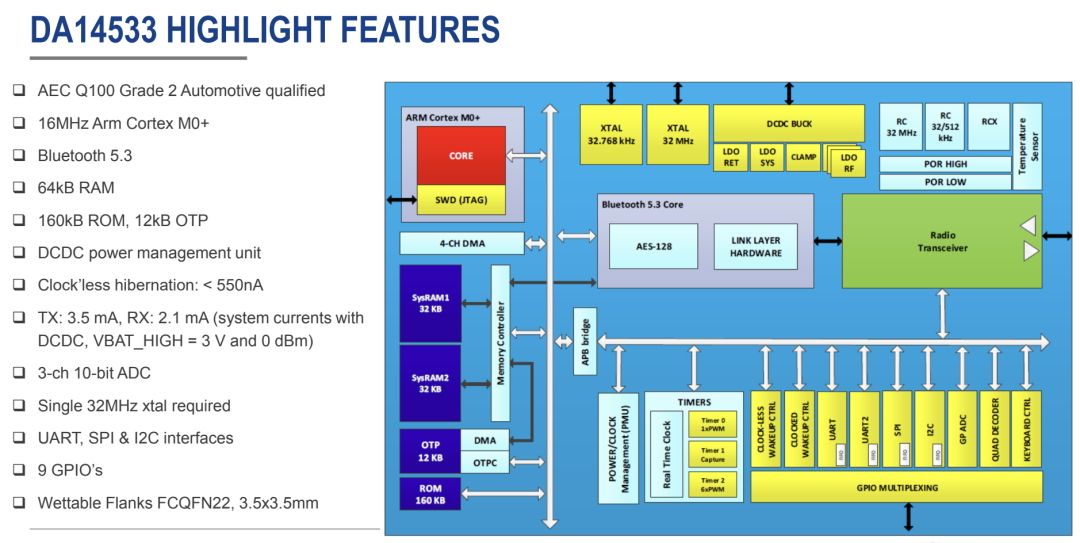
From a system integration perspective, the DA14533 supports multiple communication interfaces including UART, SPI, and I2C, allowing direct connection to the digital interface of pressure sensors or analog signal acquisition through the built-in 10-bit ADC.
Its 9 GPIOs can support peripheral functions such as wheel speed signal input and battery voltage detection, further expanding its adaptability in automotive sensor nodes.
The 3.5×3.5mm Wettable Flanks package used by the DA14533 meets automotive-grade production requirements, facilitating AOI detection and simplifying the soldering process;
Its AEC-Q100 Grade 2 certification and wide temperature adaptability from -40°C to +105°C also make it suitable for harsh environments near chassis or wheel hubs, providing a dual solution for compliance and reliability.
In the TPMS scenario, the DA14533, through its BLE communication capabilities, high integration, and low power characteristics, replaces traditional dedicated RF solutions, not only reducing system complexity and material costs but also enhancing data manageability (such as OTA updates and bidirectional communication), while also possessing strict automotive-grade certification guarantees.
Its simple structure and flexible adaptation make it suitable for large-scale deployment, especially as OEMs push for upgrades to software-defined vehicle (SDV) architectures, significantly enhancing the practicality and standardization potential of Bluetooth in the in-vehicle basic communication chain.
 Part 2
Small Package, Big System:
Cost Control and Flexibility in Embedded Design
Beyond TPMS, the expansion capabilities of the DA14533 in other in-vehicle scenarios are also noteworthy. Applications such as digital keys, cabin control panels, and environmental sensing nodes require high demands on cost control and board space for typical low bandwidth, low data volume but stable connection applications.

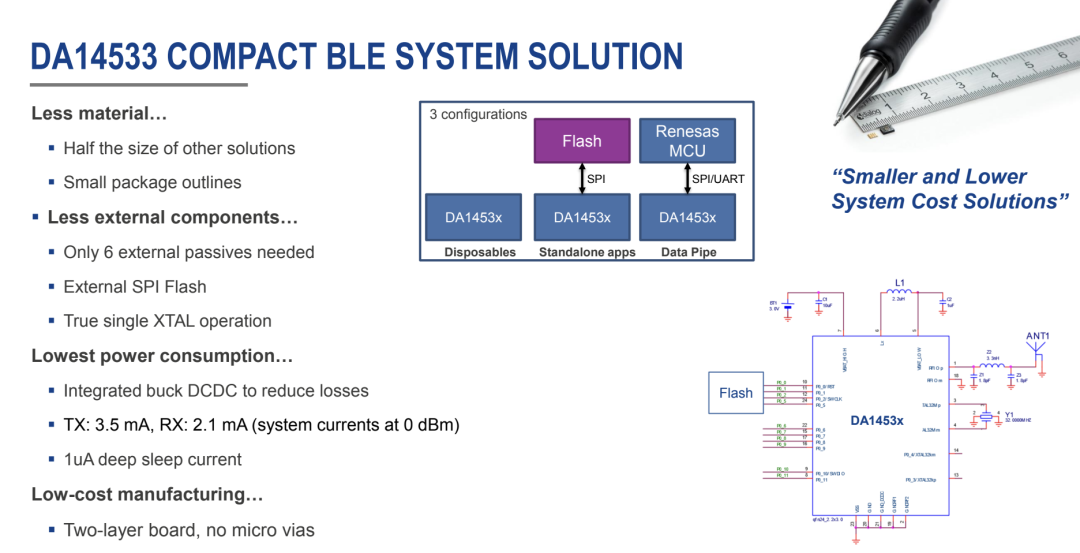
The hardware design of the DA14533 fully embodies the minimalist concept. It requires only a single 32MHz main crystal to complete Bluetooth communication and a single DCDC module for system power supply.
In the recommended design, only 6 passive components and one external SPI Flash are needed to form a complete system, supporting customers in customizing ROM functions, data logging, or quick start logic based on application needs. It also supports two-layer PCB design, further lowering the manufacturing threshold for small sensor nodes.

In terms of functional configuration, Renesas has also developed three preset application modes for the DA14533: Disposable mode, Standalone apps mode, and Data Pipe mode, corresponding to different workloads and system management structures.
For example, in the car key system in the shared mobility sector, a low-latency communication channel can be established between the phone’s Bluetooth based on the Data Pipe mode, while retaining data signature and encryption algorithm functions, ensuring cost control while safeguarding information security.
In terms of regulatory compliance, the DA14533 has also passed the EU Radio Equipment Directive (RED 2014/53/EU) requirements and provides support for SDK6.0.24 and the Cybersecurity Integration Guide, enabling customers to have a clear regulatory compliance path from the early stages of product design, avoiding significant rework in later development stages.
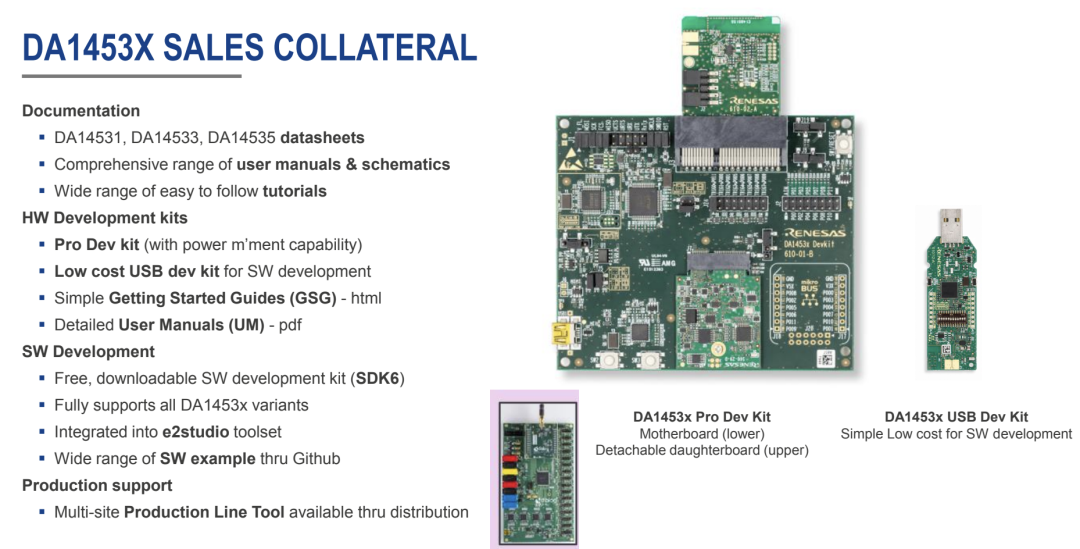
In small Bluetooth systems, the DA14533 significantly reduces design and production costs with its compact package, simplified peripheral components, and highly integrated power management.
At the same time, it provides a compliant software support system and an expandable hardware platform, ensuring controllability and flexibility from development validation to mass production, especially suitable for cost-sensitive manufacturing and diverse application scenarios in automotive edge nodes.
Summary
The trend of decoupling software and hardware drives traditional sensor nodes towards more modular, communicative, and standardized evolution. The DA14533 launched by Renesas is a representative BLE SoC that aligns with this trend. It achieves a high balance between physical size, power design, communication performance, and system compatibility, allowing multiple low-speed communication subsystems in vehicles to be uniformly deployed under the BLE protocol stack, significantly reducing hardware redundancy and system heterogeneity.
From a technical perspective, the DA14533, leveraging mature RF technology, system power control, and peripheral minimization design, realizes a replicable and scalable deployment path for embedded wireless systems; from a market perspective, its automotive-grade certification and cost structure meet the core constraints in large-scale applications of automotive electronics.