|
Intrahepatic cholangiocarcinoma (ICC) originates from the epithelial cells of the intrahepatic bile ducts. Among primary liver malignancies, the incidence of ICC is second only to hepatocellular carcinoma, accounting for 10% to 15% of primary liver cancer. |

Recommended Suggestions
1) It is recommended to use a combination regimen of gemcitabine and platinum-based drugs, and if conditions permit, to additionally combine with durvalumab monoclonal antibody. (Evidence level 1, strong recommendation)
2) For patients in good physical condition, a three-drug combination chemotherapy regimen (GCS or albumin-bound paclitaxel + gemcitabine + cisplatin) or a sequential immunotherapy and targeted therapy regimen based on chemotherapy has a high efficacy rate and conversion rate, with strong real-world clinical evidence. Phase III clinical trials have been approved (trebananib monoclonal antibody combined with lenvatinib and GEMOX regimen), and it is recommended to choose as appropriate. (Evidence level 3, moderate recommendation)
Note: Gemcitabine + Cisplatin + Tegafur (GCS)
Recommended Suggestions 16
1) For patients who experience tumor progression after first-line treatment with gemcitabine combined with cisplatin, it is recommended to use the FOLFOX regimen for second-line treatment (Evidence level 1, moderate recommendation). It is also possible to try a combination regimen based on irinotecan, such as irinotecan combined with capecitabine or liposomal irinotecan combined with 5-fluorouracil and leucovorin. (Evidence level 3, moderate recommendation)
2) It is recommended that ICC patients undergo genetic testing. For those with FGFR2 fusion or rearrangement, it is recommended to use pemigatinib (Evidence level 3, strong recommendation). For those positive for NTRK fusion, it is recommended to use entrectinib or larotrectinib (Evidence level 3, strong recommendation); for IDH1 mutation patients, avapritinib is recommended as appropriate. (Evidence level 1, moderate recommendation)
3) For ICC patients with unknown driver genes, targeted combination immunotherapy such as trebananib monoclonal antibody combined with lenvatinib can be selected after systemic chemotherapy, and related clinical studies are actively exploring this. (Evidence level 3, moderate recommendation)
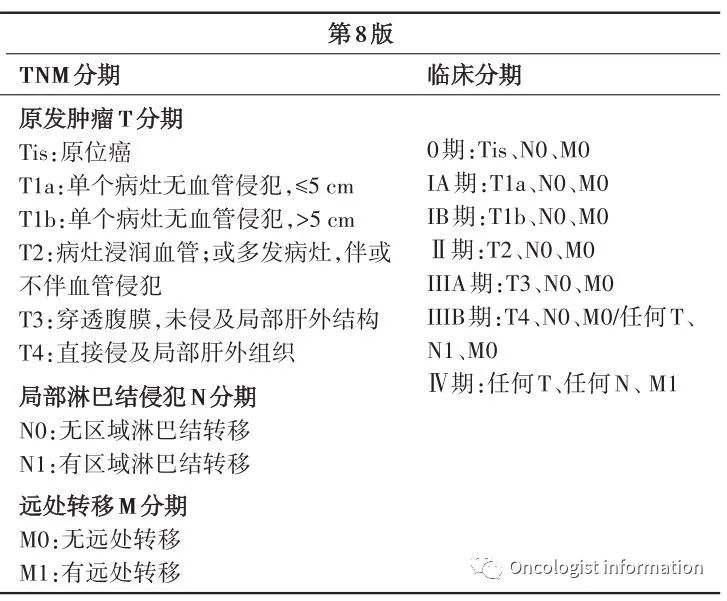
Appendix: The 8th Edition of the American Joint Committee on Cancer (AJCC) TNM Staging System for Clinical Staging of Intrahepatic Cholangiocarcinoma
References: Chinese Anti-Cancer Association Liver Cancer Professional Committee Cholangiocarcinoma Collaboration Group. Guidelines for Diagnosis and Treatment of Primary Liver Cancer: Expert Consensus on Diagnosis and Treatment of Intrahepatic Cholangiocarcinoma (2022 Edition). Chinese Journal of Digestive Surgery, 2022, 21(10):1269-1301.
Download: https://www.dxy.cn/bbs/newweb/pc/newPost?boardId=87