As engineers in Saudi Arabia’s Neom smart city struggle with frequent crashes of AI cameras under desert heat, a wafer stacking module the size of a fingernail is stably operating at a maximum temperature of 90°C in TSMC’s laboratory—this comparative experimental data has led Morgan Stanley’s computing power research team to revise the market size forecast for edge AI chip packaging technology from $3.8 billion to a staggering $6 billion.
The Technological Singularity Hidden by HBM
Three years ago, the industry was still immersed in the bandwidth frenzy of HBM memory, neglecting the critical role of edge devices: smart glasses couldn’t last through a meeting, foldable screen phones became too hot to hold while running large models, and Tesla’s humanoid robot had a computing cost per kilowatt-hour higher than that of fuel vehicles.
Morgan Stanley’s analysis revealed that the “airborne dialogue” between memory and logic chips in traditional CoWoS packaging consumes an additional 23% of energy, while the WoW technology’s 3D stacking acts like a nano-scale overpass soldered between chips.
Latest tests from Aipu Technology show that when the Llama 3-8B model runs on WoW architecture chips, the power consumption for each frame of image recognition plummets from 27 milliwatts to 2.3 milliwatts—enough saved energy to charge AirPods 20 times. Even more ingeniously, its “bandwidth folding technique” opens up 120,000 data channels within a 1 square millimeter area through silicon vias (TSV), equivalent to building eight expressways on the cross-section of a hair.
The “Overtaking the Oil Tanker” of Niche Storage Manufacturers
While Samsung and Hynix are still battling on the HBM front, a group of Asian niche storage manufacturers has quietly taken over a new battlefield. In Winbond’s Kaohsiung factory, a $700 million extreme ultraviolet lithography machine is etching 12 layers of stacked DRAM 24 hours a day, achieving a wafer bonding precision of 0.8 microns—equivalent to placing a coin on the moon’s surface with an error of no more than 3 centimeters.
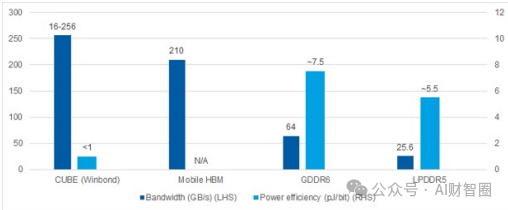
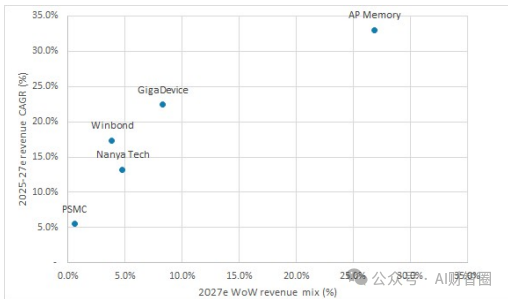
Morgan Stanley estimates that the material cost of the WoW solution is 47% lower than that of HBM, making AI phones under $200 possible. Even more shocking to analysts is the “Prometheus Plan” by Gigadevice—by reverse-engineering the heat dissipation structure of Tesla’s Dojo chip, the heat dissipation efficiency of 12-layer stacked chips has been improved to nine times that of traditional solutions, allowing Xiaomi’s foldable engineering machine to run Stable Diffusion for 45 minutes without throttling.
The “Computing Power Equalization Movement” of Edge Devices
In a modified shop in Huaqiangbei, Shenzhen, the owner is installing a WoW external chip on an iPhone 18. “It’s like adding a turbocharger to an old car,” he points to the screen showing skyrocketing AI benchmark scores—the modified machine equipped with Cambricon NPU and Winbond WoW module has a large model inference speed 2.3 times faster than the original model.
Behind this is the industry earthquake predicted by Morgan Stanley: by 2027, WoW technology will enable edge AI devices:
- Glassesto extend battery life from 4 hours to 28 hours, with Luminar’s AR ski goggles already achieving real-time translation all day long.
- Industrial Robotsto reduce response latency from 15 milliseconds to 0.7 milliseconds, allowing the New松 mechanical arm to catch falling eggs.
- Smart Speakersto increase localized large model parameters from 7 billion to 40 billion, enabling Tmall Genie to spontaneously compose ancient poetry.
The most fierce disruption occurs in the cryptocurrency field: Bitmain’s new miner S21 Pro, after adopting Gigadevice’s WoW module, has an 8-fold increase in computing power density while the electricity cost ratio plummets from 35% to 6%, leading Inner Mongolia miners to sell off old mining machines overnight as if they were scrap metal.
The Clear and Hidden Lines of Capital Investment
While Wall Street is still debating the WoW technology route, savvy capital has split into three paths:
- Equipment Manufacturers’ CarnivalOrders for hybrid bonding machines from Japan’s Disco company are booked until 2027, with its stock price’s implied volatility soaring to 68%.
- Patent WarfareSMIC urgently acquired 47 bonding patents from Singapore’s UTAC to build a firewall.
- Material RevolutionGermany’s Merck has developed a nano-silver adhesive that increases the thermal conductivity between wafer layers by 400%.
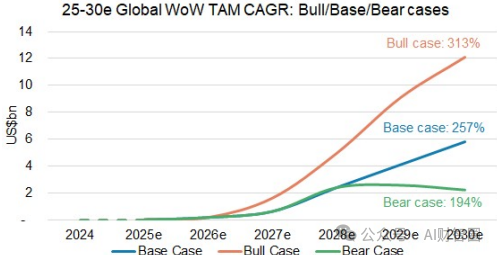
Morgan Stanley’s Asian semiconductor analyst Andy Meng highlighted a critical point in a late-night report: in Q3 2026, when Apple’s Vision Pro 3 adopts a dual WoW architecture, the industry chain will trigger a cascading reaction—by then, TSMC’s advanced packaging capacity utilization will exceed 95%, while Changjiang Electronics Technology’s redistribution layer (RDL) price per square meter may exceed that of luxury apartments in Sanya.
Reefs and Countercurrents
In the reliability laboratory of the Shenzhen Institute of Advanced Technology, engineers are anxiously watching the accelerated aging test machine—7% of the 12-layer stacked chips showed micro-cracks after experiencing 3000 thermal shock cycles. This reveals the biggest Achilles’ heel of WoW technology: mismatch in thermal expansion coefficients.
A more hidden crisis comes from Washington. The new regulations from the U.S. Department of Commerce have included wafer bonding machines in export controls, forcing ASML to cancel the delivery of 17 machines to Chinese customers. Morgan Stanley warns: if domestic bonding machine yield cannot exceed 85% before 2026, China’s WoW production capacity gap will reach 380,000 pieces/month.
Ultimate Metaphor: In the WoW technology exhibition area of the TSMC museum, 12-inch wafers are displayed alongside LEGO blocks. When the spotlight shines on those nano-scale silicon pillars, the slogan on the wall flashes: “Stacking is the path of least resistance for breaking through the three-dimensional physical limits of computing power.”
Data Source: Morgan Stanley “Wafer Stacking Empowers Next-Generation Edge AI”
Progress of WoW Adaptation by the Three Giants of Edge AI
| Terminal Type | Technical Breakthrough | Commercial Transformation | Pain Point Resolution |
|---|---|---|---|
| AI Glasses | 0.5W ultra-low power operation of LLM | Meta Ray-Ban collaboration model mass production in Q4 | Solving the 50°C hot cheek problem |
| Service Robots | 200ms end-to-end visual decision-making | UBTECH Walker X equipped with dual WoW modules | Mechanical arm load capacity increased to 15kg |
| Smart Cars | Lidar point cloud processing delay < 3ms | NIO ET9 central computing platform adopts 4-layer stacking | Replacing 40% of cloud computing power demand |
Risk Warning: Thermal management failure / Bonding equipment embargo / Multi-layer yield bottleneck
——END——
👇 Consult a registered financial planner 👇 Long press the QR code to follow the public account
——Author Introduction——
My Midlife Life Review (Part 1)
My Midlife Life Review (Part 2)