Flexible pressure sensors have garnered significant attention due to their vast application potential in cutting-edge fields such as humanoid robotics, biomedical applications, and human-machine interaction. Among these, capacitive pressure sensors have become a research hotspot due to their low power consumption and high stability. However, their performance, particularly in terms of sensitivity and linearity, has long been constrained by traditional design approaches. This limitation significantly restricts their application in complex scenarios that require precise force feedback and dynamic control.
To address this challenge, the team led by Hu Youfan and Peng Lianmao from the School of Electronics at Peking University proposed a novel “contact-dominated localized electric displacement field enhancement” design strategy. This strategy cleverly designs the sensor structure to achieve ultra-high sensitivity, excellent linearity, and a wide sensing range across a broad pressure spectrum. The design comprises two core elements: a hierarchical micro-structured electrode made of robust conductive composite materials and a metal coating, and a dielectric layer with high capacitance per unit area achieved through thin layers or high-k materials. This design allows the capacitance change of the sensor to be primarily dominated by the localized enhanced electric field in the contact area, thereby breaking through the performance bottleneck of traditional sensors.
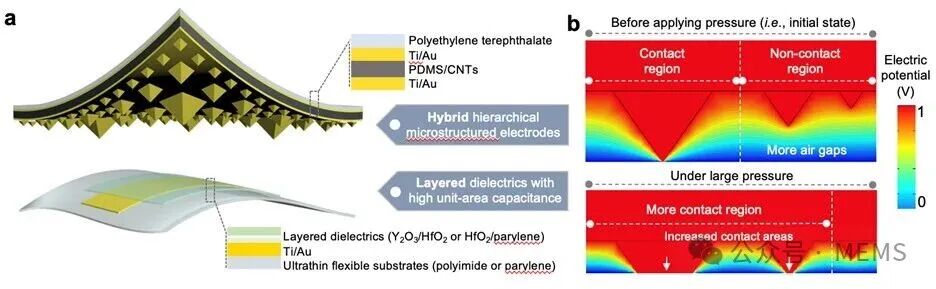
Figure 1: Contact-dominated localized electric displacement field enhanced pressure sensor. a. Schematic diagram of the sensor structure, showing the hierarchical micro-structured electrode and the dielectric layer with high capacitance per unit area. b. Cross-sectional view of the potential distribution before and under high pressure.
The sensor developed by the team exhibits world-leading performance. Its pressure response (normalized capacitance change) exceeds 3000, surpassing the previous record by more than an order of magnitude; the sensing range exceeds 1 MPa, with some devices reaching up to 2 MPa. Notably, this sensor achieves a sensitivity of up to 9.22 kPa⁻¹ and an almost perfect linearity (R² value of 0.9998) within a wide pressure range of 0-100 kPa. Additionally, the sensor demonstrates excellent mechanical robustness, ultra-high resolution for small pressures (0.1 Pa), and rapid response capability (approximately 15 milliseconds).
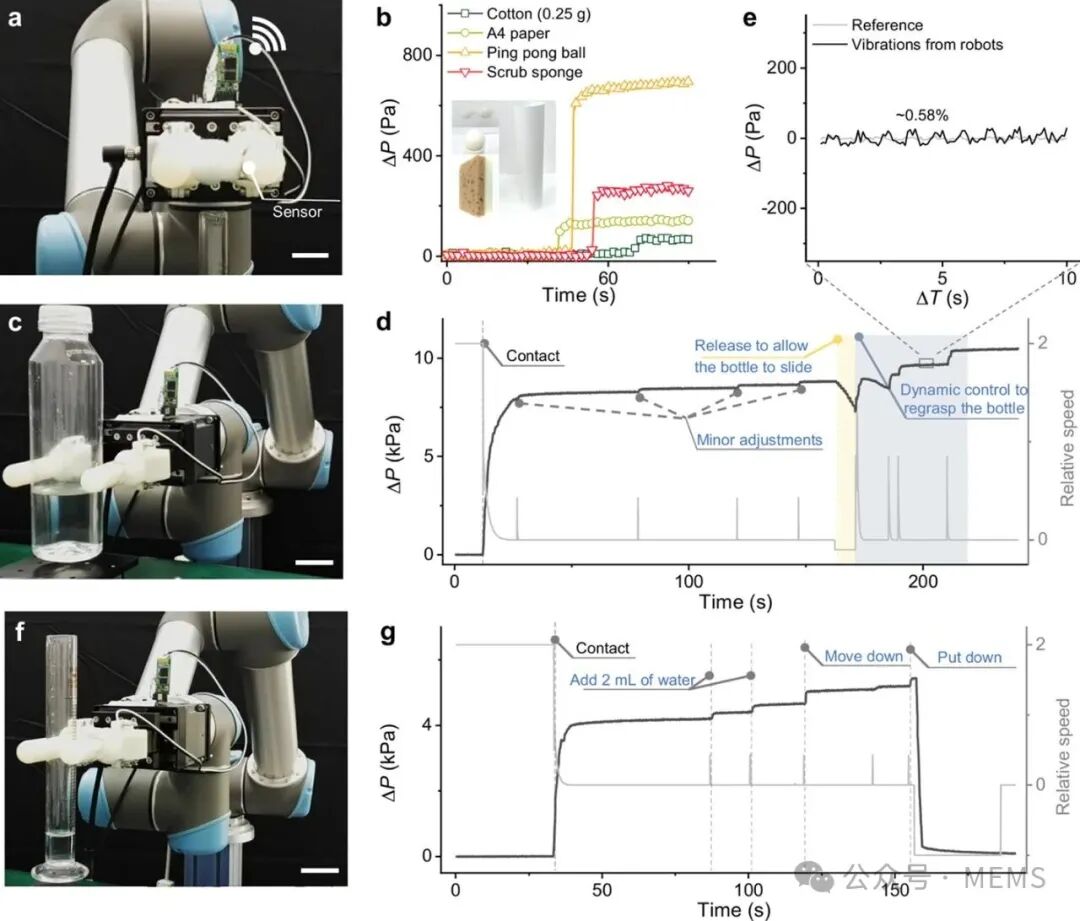
Figure 2: Performance characterization of the contact-dominated pressure sensor. a-c. Curves showing the relationship between normalized capacitance change and pressure, demonstrating its ultra-high response and excellent linearity. d. Compared to various previous micro-structured pressure sensors, this design achieves breakthroughs in both sensitivity and response range. e. Pressure response at low pressures, capable of distinguishing one-tenth of the normalized capacitance change at ~1 Pa (i.e., ~0.1 Pa).
The research further reveals the working mechanism of this design. The hierarchical micro-structure ensures that at different pressures, new micro-structures are always involved in contact, keeping the material’s strain within the linear region and ensuring a wide range of linear response. The hybrid electrode design of “conductive composite materials + metal coating” cleverly addresses the issue of thin metal layers easily cracking and failing under deformation, ensuring stable and reliable signals. Based on its outstanding performance, the team integrated this sensor with flexible low-dimensional semiconductor transistors, achieving an electrical response of up to 4×10⁵ at a low operating voltage of 2.66 volts, fully utilizing the transistor’s switching ratio and significantly enhancing the signal-to-noise ratio of the integrated device.
The team demonstrated the immense potential of this technology through two typical application scenarios. In fluid physical property assessment, a robotic arm equipped with this sensor can accurately measure the hydrostatic pressure of different liquids, thereby estimating their density and capturing minute dynamic changes caused by surface tension of droplets. In robotic manipulation tasks, a robotic hand integrated with this sensor can adaptively control the gripping force based on the stiffness of the object, stably grasping both soft cotton and hard ping pong balls without deformation, and even dynamically adjusting during object slippage, with a pressure resolution an order of magnitude higher than that of human skin.
Figure 3: Application of pressure sensors in precise robotic control. a. Photo of a robotic hand equipped with the sensor grasping cotton. b. Dynamics of pressure changes during the grasping of various objects. c. Photo of a robotic hand equipped with the sensor grasping a bottle filled with water. d. Pressure changes and speed adjustments during the grasping and lifting of the bottle, as well as during slippage. e. Measurement pressure changes caused by mechanical vibrations detected by the sensor. f. Photo of a robotic hand gripper equipped with the sensor grasping a graduated cylinder filled with water. g. Pressure changes and speed adjustments of the gripper while grasping the graduated cylinder.
The related results were published online in Nature Communications on August 29, 2025, under the title “Contact-dominated localized electric-displacement-field-enhanced pressure sensing.” This research was supported by the National Key R&D Program, the National Natural Science Foundation, and the Key Laboratory of Nano Devices Physics and Chemistry of the Ministry of Education. Postdoctoral researcher Ma Chao from Peking University, master’s student Ye Huaidong from the Hunan Advanced Sensing and Information Technology Research Institute, master’s student Shi Xiaowei from Southeast University, and doctoral student Chen Yufan from Peking University are co-first authors of the paper, with Associate Professor Hu Youfan and Academician Peng Lianmao as co-corresponding authors. This achievement provides critical technical support for the development of next-generation high-performance flexible electronics, intelligent robotics, and human-machine interaction systems, and is expected to promote innovative applications in a broader range of fields.
Paper link:
https://doi.org/10.1038/s41467-025-63018-9
★ Source: MEMS ↑ ★ Please cite the above source↑Disclaimer: This article is for informational purposes only and is for reference only. If there are issues related to the content, copyright, and other matters, please contact us, and we will address them immediately. If any platform reprints this article, they will be responsible for the content of the reprint, and Xiangrun Instrumentation will not be responsible for secondary dissemination caused by reprints.