✅ Author Profile: A Matlab simulation developer passionate about research, skilled in data processing, modeling simulation, program design, complete code acquisition, paper reproduction, and scientific simulation.
🍎 Previous reviews, follow the personal homepage: Matlab Research Studio
🍊 Personal motto: Investigate things to gain knowledge, complete Matlab code and simulation consultation content via private message.
🔥 Content Introduction
In fields such as marine exploration, underwater engineering, and biological research, underwater images are key carriers for information acquisition. However, the underwater environment is complex and unique, with issues such as light attenuation, scattering, and water turbidity severely affecting image quality, leading to color distortion, blurred details, and low contrast, making it difficult to meet subsequent analysis and application needs. Underwater image fusion enhancement technology integrates multi-source image information and optimizes visual effects, becoming a core means to solve this problem, and has shown significant application value in various fields.
1. Technical Principles of Underwater Image Fusion Enhancement
The core reason for the degradation of underwater image quality stems from the characteristics of light propagation underwater: when natural light propagates in water, it is absorbed and scattered by water molecules and suspended particles, leading to the rapid attenuation of red wavelength light (images tend to appear blue-green), detail information being obscured by scattering (resulting in blurred images), while also experiencing background noise interference. Traditional single-image enhancement techniques (such as histogram equalization and the Retinex algorithm) can improve local contrast but struggle to simultaneously address color distortion and detail loss.
The core idea of underwater image fusion enhancement technology is **”multi-source complementarity, information integration”**: by acquiring multiple images of the same underwater scene (such as images taken with different exposures, different polarization directions, and different sensors), fusion algorithms extract the “advantageous information” from each image (such as clear edges, accurate colors, and low-noise areas), and then enhancement algorithms optimize the details and visual effects of the integrated image, ultimately outputting a high-quality image that possesses high contrast, true colors, and rich details.
From a technical process perspective, it mainly consists of three steps:
- Image Preprocessing: Denoising and registration of the input multi-source underwater images (ensuring multiple images correspond to the same spatial location), eliminating interference caused by shooting angles and equipment errors;
- Multi-source Image Fusion: Using pixel-level, feature-level, or decision-level fusion algorithms to extract effective information from each image and integrate it (for example, using polarized images to suppress scattering noise and high-exposure images to retain dark detail);
- Image Enhancement Optimization: For the fused image, further enhance visual quality and practical value through color correction (repairing color shifts caused by red wavelength attenuation), detail enhancement (sharpening edges, highlighting target features), and contrast adjustment.
2. Core Technologies and Method Classifications
Based on the logical relationships of fusion and enhancement, and algorithm principles, underwater image fusion enhancement technology can be divided into three main categories, each with significant differences in applicable scenarios and effects:
(1) Fusion Enhancement Technology Based on Traditional Algorithms
This type of technology is centered on the logic of “first fusion, then enhancement,” relying on manually designed features and rules, with high maturity and low computational cost, suitable for simple underwater scenes (such as shallow water environments and low turbidity water bodies).
- Pixel-level Fusion Algorithms: Directly integrating the pixel values of multiple images through weighted averaging, typical representatives includeweighted average fusion (assigning weights based on image clarity),pyramid fusion (decomposing images into different resolution levels and fusing details and backgrounds layer by layer). For example, pyramid fusion of a “low-exposure clear edge image” and a “high-exposure color restoration image” of the same target can simultaneously retain edge details and accurate colors;
- Enhancement Optimization Methods: After fusion, typically combined withwhite balance correction (repairing blue-green color shifts),contrast-limited adaptive histogram equalization (CLAHE) (avoiding local overexposure and enhancing detail contrast), addressing the “noise amplification” and “color distortion” issues common in traditional algorithms.
However, the limitations of traditional technology are evident: poor adaptability to complex underwater environments (such as deep water areas and highly turbid water bodies), difficulty in automatically distinguishing “effective details” from “noise interference,” and prone to artifacts in fused images.
(2) Fusion Enhancement Technology Based on Deep Learning
With the development of artificial intelligence technology, deep learning has become a core means to solve complex underwater image problems. This type of technology follows the logic of “end-to-end” or “fusion-enhancement integration,” automatically learning the degradation patterns and optimization features of underwater images through neural networks, suitable for high-difficulty scenarios (such as deep-sea exploration and operations in turbid water bodies).
- Typical Technical Pathways
- Multi-source Image Fusion Network: For example, a fusion model based on convolutional neural networks (CNN) extracts features from different source images through a dual-branch network (such as the “anti-scattering features” of polarized images and the “color features” of RGB images), and then focuses on key information through an attention mechanism to achieve adaptive fusion;
- Fusion-Enhancement Integrated Network: For example, models based on generative adversarial networks (GAN) (such as Underwater GAN, Water-Net) directly output enhanced images after inputting multi-source images into the generator — the generator is responsible for “learning fusion and enhancement rules,” while the discriminator supervises “whether the image quality approaches real underwater scenes,” enhancing the visual authenticity and detail richness through adversarial training;
- Technical Advantages: Can automatically adapt to different underwater environment degradation patterns, effectively suppress scattering noise, repair color distortion, while retaining details of small targets (such as underwater microorganisms and equipment failure points), making it the mainstream technical direction for improving underwater image quality.
(3) Fusion Enhancement Technology Based on Physical Models
This type of technology starts from the physical laws of underwater light propagation, establishing an “image degradation model” to reverse-engineer real scene information, and then combines multi-source image fusion optimization effects, suitable for scenarios with extremely high requirements for image authenticity (such as underwater cultural relic restoration and biological morphology research).
- Core Logic: Based on underwater light propagation equations (such as the Jaffe-McGlamery model), decomposing underwater images into “direct components” (target reflected light, containing real details) and “scattered components” (water body scattered light, causing blurriness); estimating the two components separately using multi-source images (such as images taken from different distances and images with different polarization states), and then fusing the real direct component with the corrected scattered component to achieve image enhancement;
- Technical Characteristics: Strong image authenticity, accurately restoring the physical shape and color of targets (such as the texture of cultural relics and the body color of organisms), but requiring high consistency of physical parameters for multi-source images, high computational complexity, and not suitable for real-time processing scenarios.
3. Typical Application Scenarios and Practical Value
The application of underwater image fusion enhancement technology has penetrated multiple fields, providing key technical support for practical operations by improving image quality and solving demands that traditional images cannot meet:
(1) Marine Resource Exploration and Development
In seabed mineral exploration and oil and gas pipeline inspection, images captured by underwater robots (ROV/AUV) are often blurred due to dim light in deep water areas and water turbidity. By fusing “high-sensitivity low-light images” and “polarized anti-scattering images,” and then enhancing them through deep learning, the corrosion marks on pipelines and the distribution patterns of minerals can be clearly presented — for example, in oil and gas exploration in the South China Sea, this technology helped engineers discover small cracks in pipelines that traditional images failed to identify, avoiding leakage risks.
(2) Underwater Biological Research and Ecological Protection
In marine biological observation, traditional images struggle to accurately restore the colors and behavioral details of organisms (such as the health status of corals and the surface patterns of fish). Fusion enhancement technology based on physical models can restore the true colors of corals (to assess health) and clearly capture the swimming trajectories of fish by fusing “spectral images of different wavelengths” and “high-resolution visual images,” providing precise data for ecological research. For example, a research team utilized this technology in the Great Barrier Reef protection to discover early signs of coral bleaching, providing a time window for intervention measures.
(3) Underwater Engineering and Rescue Operations
In underwater construction inspections (such as piers and dams) and shipwreck rescues, image blurriness caused by turbid water can severely impact operational efficiency. By fusing “sonar images” (providing target outlines) and “optical images” (providing visual details), and then applying real-time enhancement processing, operators can clearly see cracks in structures and the layout of shipwrecks — for example, in a shipwreck rescue operation, this technology helped the rescue team quickly locate trapped individuals inside the ship, shortening rescue time.
4. Current Challenges and Future Development Trends
Despite significant progress in underwater image fusion enhancement technology, three major challenges remain in practical applications: first, insufficient real-time performance, as deep learning models have large computational loads, making it difficult to meet the real-time operational needs of underwater robots; second, poor adaptability to extreme environments, where existing technologies are prone to fusion failure and detail loss in highly turbid and strongly scattering deep water areas; third, difficulties in multi-source data collaboration, as images from different sensors (such as optical, sonar, and polarized) exhibit “modal differences” (e.g., optical images provide visual information, while sonar images provide distance information), making efficient integration challenging.
To address these challenges, future technologies will develop in three directions:
- Lightweight and Real-time: By model compression (such as pruning and quantization) and hardware acceleration (such as GPU/TPU deployment), reduce the computational cost of deep learning models to achieve “real-time fusion enhancement,” meeting the on-site operational needs of underwater robots and diving equipment;
- Breakthroughs in Cross-modal Fusion Technology: Develop cross-modal fusion models based on advanced architectures like Transformers to achieve “semantic-level fusion” of different types of images (optical, sonar, polarized), enhancing image quality in extreme environments;
- Adaptive and Intelligent: Integrate environmental perception technologies to enable systems to automatically identify underwater environmental parameters (such as turbidity and depth) and dynamically adjust fusion enhancement strategies — for example, in highly turbid water, automatically increase the fusion weight of sonar images, while in shallow water environments, prioritize optimizing the color and details of optical images.
5. Conclusion
Underwater image fusion enhancement technology integrates multi-source information and optimizes visual effects, addressing the core issues of underwater image quality degradation, becoming a key supporting technology in marine engineering, biological research, and rescue operations. From traditional algorithms to deep learning, from single scenes to complex environments, continuous iterations of technology have propelled the leap in underwater information acquisition capabilities. In the future, with the development of lightweight, cross-modal, and intelligent technologies, this technology will further break through environmental limitations, providing more powerful tools for human exploration, utilization, and protection of the ocean, supporting the realization of the “Marine Power” strategy.
⛳️ Operation Results
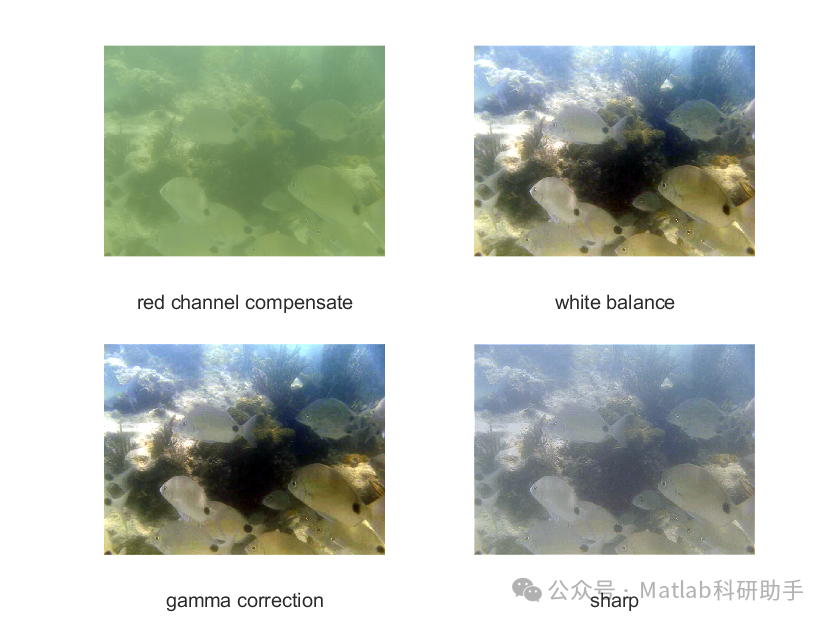
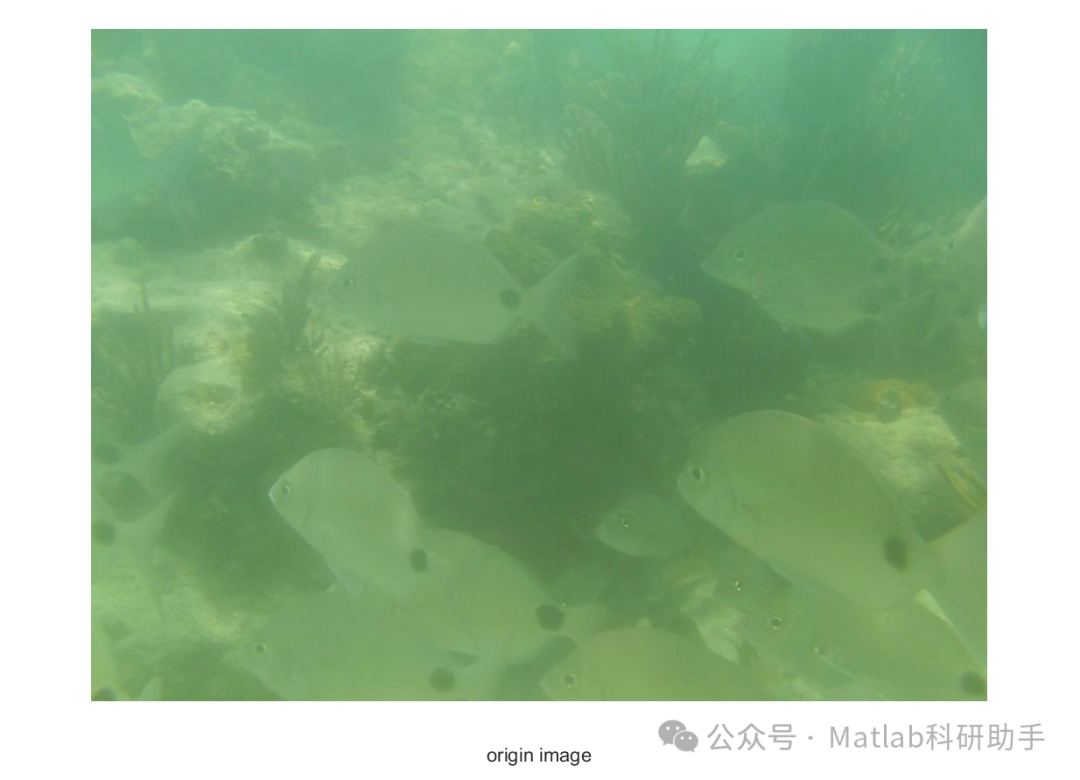
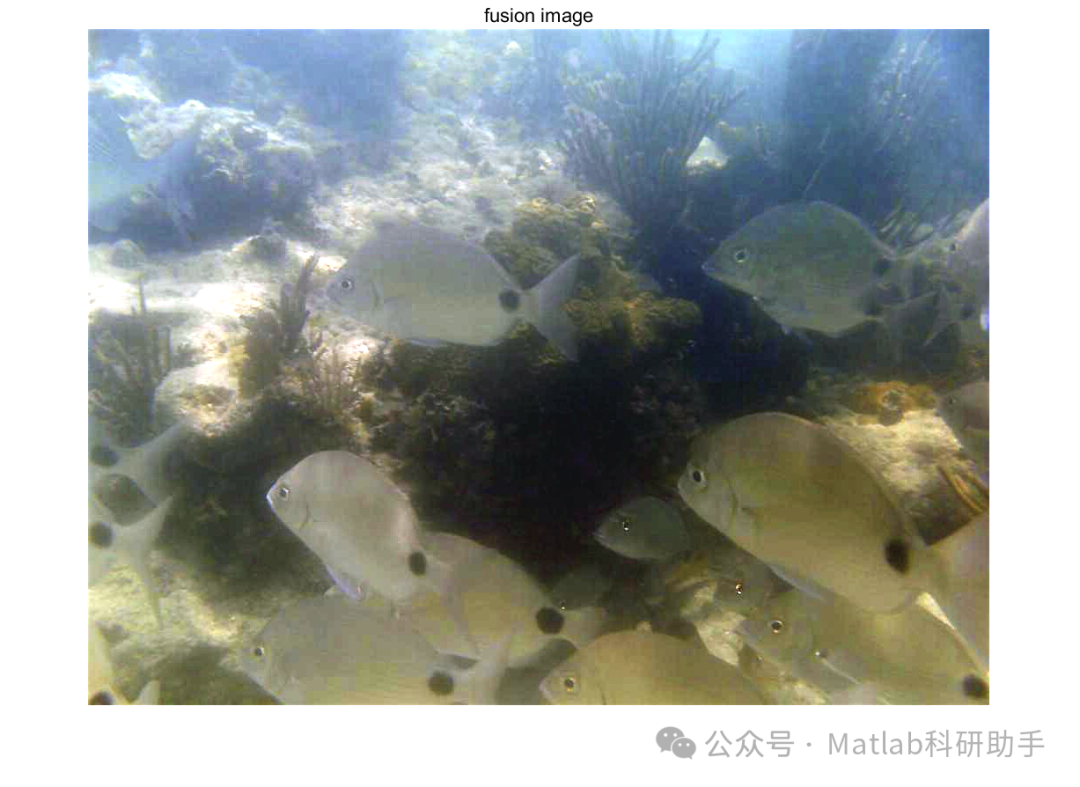
🔗 References
[1] Xu Shengxiang, Xu Yunqing. Application of Matlab in Remote Sensing Image Fusion Algorithms and Quality Evaluation [J]. Computer System Applications, 2007(11):5. DOI:10.3969/j.issn.1003-3254.2007.11.023.
[2] Xu Shengxiang, Xu Yunqing. A Remote Sensing Image Fusion Method Based on IHS and DWT Transformations [J]. Computer Applications and Software, 2008, 25(10):3. DOI:10.3969/j.issn.1000-386X.2008.10.084.
[3] Ma Jinfeng. Research on Multi-source Image Fusion Technology and Applications [D]. Xi’an University of Science and Technology [2025-08-28]. DOI:10.7666/d.y1545662.
📣 Partial Code
🎈 Some theoretical references are from network literature; if there is any infringement, please contact the author for deletion.
👇 Follow me to receive a wealth of Matlab e-books and mathematical modeling materials
🏆 The team specializes in guiding customized MATLAB simulations in various research fields, helping to realize research dreams:
🌈 Various intelligent optimization algorithm improvements and applications
Production scheduling, economic scheduling, assembly line scheduling, charging optimization, workshop scheduling, departure optimization, reservoir scheduling, three-dimensional packing, logistics site selection, cargo location optimization, bus scheduling optimization, charging pile layout optimization, workshop layout optimization, container ship loading optimization, pump combination optimization, medical resource allocation optimization, facility layout optimization, visual domain base station and drone site selection optimization, knapsack problem, wind farm layout, time slot allocation optimization, optimal distribution of distributed generation units, multi-stage pipeline maintenance, factory-center-demand point three-level site selection problem, emergency material distribution center site selection, base station site selection, road lamp column arrangement, hub node deployment, transmission line typhoon monitoring devices, container scheduling, unit optimization, investment optimization portfolio, cloud server combination optimization, antenna linear array distribution optimization, CVRP problem, VRPPD problem, multi-center VRP problem, multi-layer network VRP problem, multi-center multi-vehicle VRP problem, dynamic VRP problem, two-layer vehicle routing planning (2E-VRP), electric vehicle routing planning (EVRP), hybrid vehicle routing planning, mixed flow workshop problem, order splitting scheduling problem, bus scheduling optimization problem, flight shuttle vehicle scheduling problem, site selection path planning problem, port scheduling, port shore bridge scheduling, parking space allocation, airport flight scheduling, leak source localization
🌈 Machine learning and deep learning time series, regression, classification, clustering, and dimensionality reduction
2.1 BP time series, regression prediction, and classification
2.2 ENS sound neural network time series, regression prediction, and classification
2.3 SVM/CNN-SVM/LSSVM/RVM support vector machine series time series, regression prediction, and classification
2.4 CNN|TCN|GCN convolutional neural network series time series, regression prediction, and classification
2.5 ELM/KELM/RELM/DELM extreme learning machine series time series, regression prediction, and classification
2.6 GRU/Bi-GRU/CNN-GRU/CNN-BiGRU gated neural network time series, regression prediction, and classification
2.7 Elman recurrent neural network time series, regression prediction, and classification
2.8 LSTM/BiLSTM/CNN-LSTM/CNN-BiLSTM long short-term memory neural network series time series, regression prediction, and classification
2.9 RBF radial basis neural network time series, regression prediction, and classification
2.10 DBN deep belief network time series, regression prediction, and classification
2.11 FNN fuzzy neural network time series, regression prediction
2.12 RF random forest time series, regression prediction, and classification
2.13 BLS broad learning system time series, regression prediction, and classification
2.14 PNN pulse neural network classification
2.15 Fuzzy wavelet neural network prediction and classification
2.16 Time series, regression prediction, and classification
2.17 Time series, regression prediction, and classification
2.18 XGBOOST ensemble learning time series, regression prediction, and classification
2.19 Transform various combinations of time series, regression prediction, and classification
Directions cover wind power prediction, photovoltaic prediction, battery life prediction, radiation source identification, traffic flow prediction, load prediction, stock price prediction, PM2.5 concentration prediction, battery health status prediction, electricity consumption prediction, water body optical parameter inversion, NLOS signal identification, precise prediction of subway stops, transformer fault diagnosis
🌈 In image processing
Image recognition, image segmentation, image detection, image hiding, image registration, image stitching, image fusion, image enhancement, image compressed sensing
🌈 In path planning
Traveling salesman problem (TSP), vehicle routing problem (VRP, MVRP, CVRP, VRPTW, etc.), drone three-dimensional path planning, drone collaboration, drone formation, robot path planning, grid map path planning, multimodal transport problems, electric vehicle routing planning (EVRP), two-layer vehicle routing planning (2E-VRP), hybrid vehicle routing planning, ship trajectory planning, full path planning, warehouse patrol
🌈 In drone applications
Drone path planning, drone control, drone collaboration, drone formation, drone task allocation, drone secure communication trajectory online optimization, vehicle collaborative drone path planning
🌈 In communication
Sensor deployment optimization, communication protocol optimization, routing optimization, target localization optimization, Dv-Hop localization optimization, Leach protocol optimization, WSN coverage optimization, multicast optimization, RSSI localization optimization, underwater acoustic communication, communication upload and download allocation
🌈 In signal processing
Signal recognition, signal encryption, signal denoising, signal enhancement, radar signal processing, signal watermark embedding and extraction, electromyography signals, electroencephalography signals, signal timing optimization, electrocardiogram signals, DOA estimation, encoding and decoding, variational mode decomposition, pipeline leakage, filters, digital signal processing + transmission + analysis + denoising, digital signal modulation, bit error rate, signal estimation, DTMF, signal detection
🌈 In power systems
Microgrid optimization, reactive power optimization, distribution network reconstruction, energy storage configuration, orderly charging, MPPT optimization, household electricity
🌈 In cellular automata
Traffic flow, crowd evacuation, virus spread, crystal growth, metal corrosion
🌈 In radar
Kalman filter tracking, trajectory association, trajectory fusion, SOC estimation, array optimization, NLOS identification
🌈 In workshop scheduling
Zero-wait flow shop scheduling problem NWFSP , permutation flow shop scheduling problem PFSP , hybrid flow shop scheduling problem HFSP , zero idle flow shop scheduling problem NIFSP, distributed permutation flow shop scheduling problem DPFSP, blocking flow shop scheduling problem BFSP
👇