Traditionally, laboratories in various countries have used the Thomas (Thomas) 1Ω standard resistor to maintain their representation of ohms. However, in many laboratories, the quantum Hall effect resistance standards are replacing these traditional resistance standards. According to international agreements, starting from January 1, 1990, the definition of ohm has been linked to the von Klitzing constant and the quantum Hall effect (QHE). This allows national laboratories to represent ohms through the quantum Hall effect. The uncertainty of the QHE representation of ohm compared to its SI definition is 0.2ppm. In October 1988, the International Committee for Weights and Measures (CIPM) recommended that all national laboratories adopt the same von Klitzing constant, with the recommended value being: Rk-90 = 25812.807Ω In the physical explanation of the quantum Hall effect, the von Klitzing constantRk is a universal quantity. There is sufficient reason to believe thatRk is a function of the ratio of the fundamental constants h and e, namely: 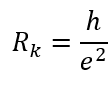 where: e is the elementary charge, h is Planck’s constant.
In 1980, Klaus von Klitzing discovered the quantum Hall effect (QHE). This was a significant discovery in physics, for which he was awarded the Nobel Prize in Physics in 1985. The heart of the QHE device is the Hall bar, which is a planar MOSFET or heterojunction transistor, designed to confine the electron flow to a thin layer at the surface of the tube.
As shown in the figure below, this planar transistor operates in a low-temperature environment below 4.2K, typically between 1-2K. A magnetic field of several teslas is applied perpendicular to the sample plane, while an electron flow is applied along the longitudinal direction of the plane, and the Hall voltage is measured in a direction perpendicular to both the current and the magnetic field.
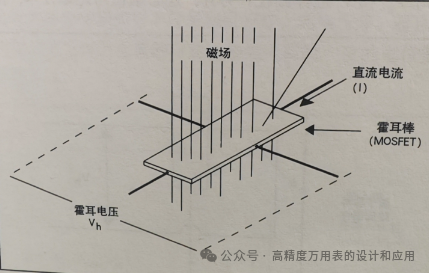
For a given driving current, due to the quantization of electrons, as the magnetic field strength changes, the generated Hall voltage exhibits a constant value in a stepwise manner, rather than a continuous slope. Therefore, small instabilities in the magnetic field strength do not affect the amplitude of the Hall voltage. The relationship between the Hall voltage V and the Hall resistance Rh, is as follows: 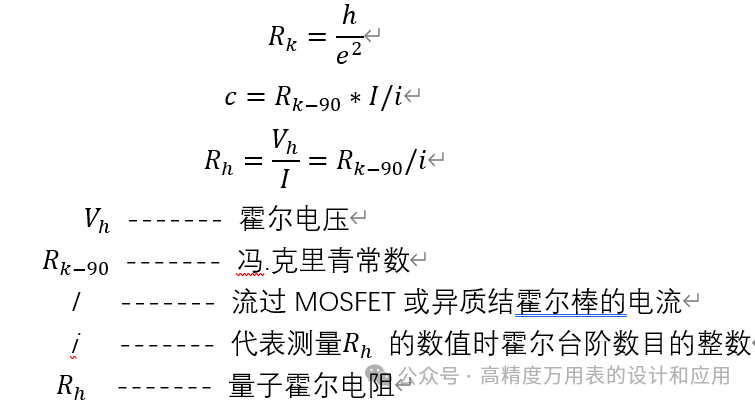
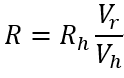
A special potentiometer and null detector are used to transfer the value of Rh from the low-temperature environment inside the Dewar flask to the laboratory’s standard resistors. This device is described in the June 1986 issue of Metrologia, the April 1989 issue of IEEE Transactions on Instrumentation and Measurement, and NIST Technical Note 1263. During the transfer process, the laboratory resistor R and the QHE semiconductor are connected in series along the longitudinal plane, allowing current I to flow through both.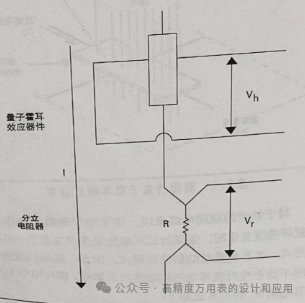 In this case, the value of the laboratory resistor R is: