The development of intelligent electrification in automobiles has led to an increase in the number of automotive controllers (ECUs), with CAN communication becoming the mainstream method for communication between controllers, as shown in the figure below:The vehicle control is divided into body PCAN and power ECAN, with resistors connected at both ends of the CAN bus;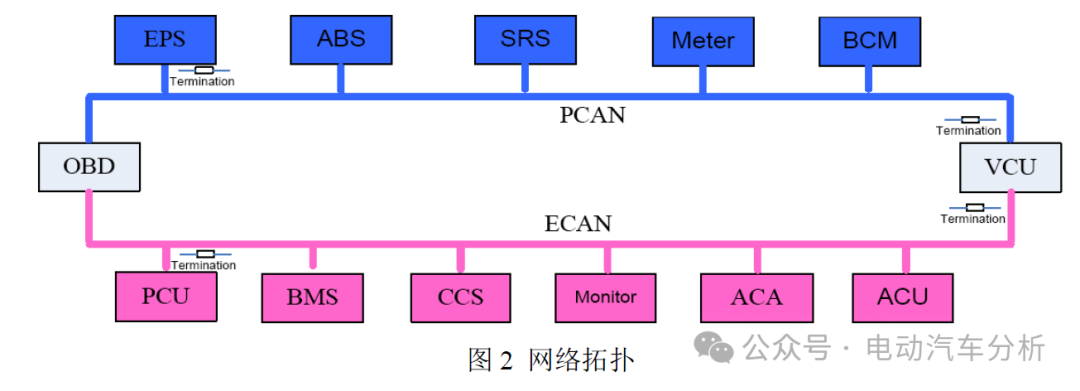
01
Standard ISO11898 Specification
According to the international standard ISO11898-2, a 120Ω terminal resistor is connected at both ends of the bus;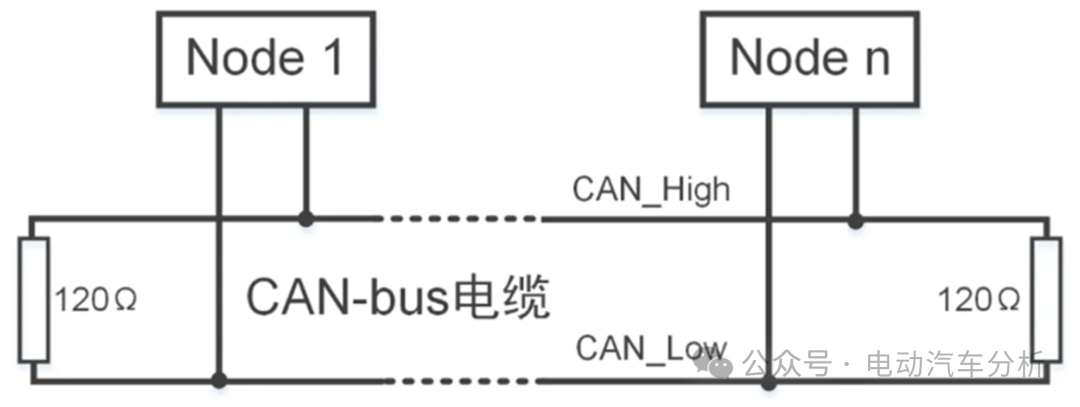
02
Function of Terminal Resistors
The CAN bus is a differential transmission twisted pair, where signals are transmitted in electrical form on the bus. The bus transmission line has a characteristic impedance; if the impedance at the end (terminal) of the transmission line does not match the characteristic impedance, the signal energy cannot be fully absorbed, and part of the energy will be reflected back. This reflected signal will superimpose with the new signals sent subsequently, leading to severe waveform distortion:Resistance Parameters1) Resistance Value:120Ω (the characteristic impedance of the CAN twisted pair is typically 120Ω, providing the highest matching degree)
2) Power:Typically choose 1/4W or 1/2W (based on bus current selection)
3) Type:Preferably select high-precision metal film resistors (±1%)
03
Resistors Connected at Both Ends of the CAN Bus
If each node connects a 120Ω terminal resistor, the total resistance after parallel connection of multiple nodes will decrease (for example, the total resistance of 5 nodes in parallel is 24Ω), which will increase the load on the CAN transceiver, leading to insufficient driving capability and reduced signal amplitude, thus also failing to communicate normally. Therefore,it is strictly prohibited to install terminal resistors at each node, and they must only be installed at the physical ends.In summary, the core function of connecting terminal resistors on the CAN bus is to prevent signal reflection at both ends of the bus, thereby ensuring the reliability and stability of communication.Friends who love cars, please help follow!
Analysis Explanation:
1) Car manufacturers benchmark against competitors, learning good designs to enhance the design level of their models to meet customer needs;
2) Technology is continuously iterating and updating, and the analysis information does not represent the latest technological strength of the enterprise.
Copyright and Disclaimer:
1) The article is welcome to be shared with friends who love cars,for reprints, please contact:EVintelligence
2) Information sourced from the internet aims to convey information and does not represent the endorsement of this account’s views, nor does it assume responsibility for its authenticity;
3) This article is for reader reference only and is strictly prohibited for commercial use.