I discovered a fun modification method for AI toys and would like to share it with all practitioners in the field.This entertaining method can help you go further on the path of AI toy modifications!This sharing represents personal views and is not related to any group or company!Recently, I’ve been tinkering with an AI alarm clock, and tinkering requires disassembling the machine. Out of boredom, I took apart one, as shown in the image below: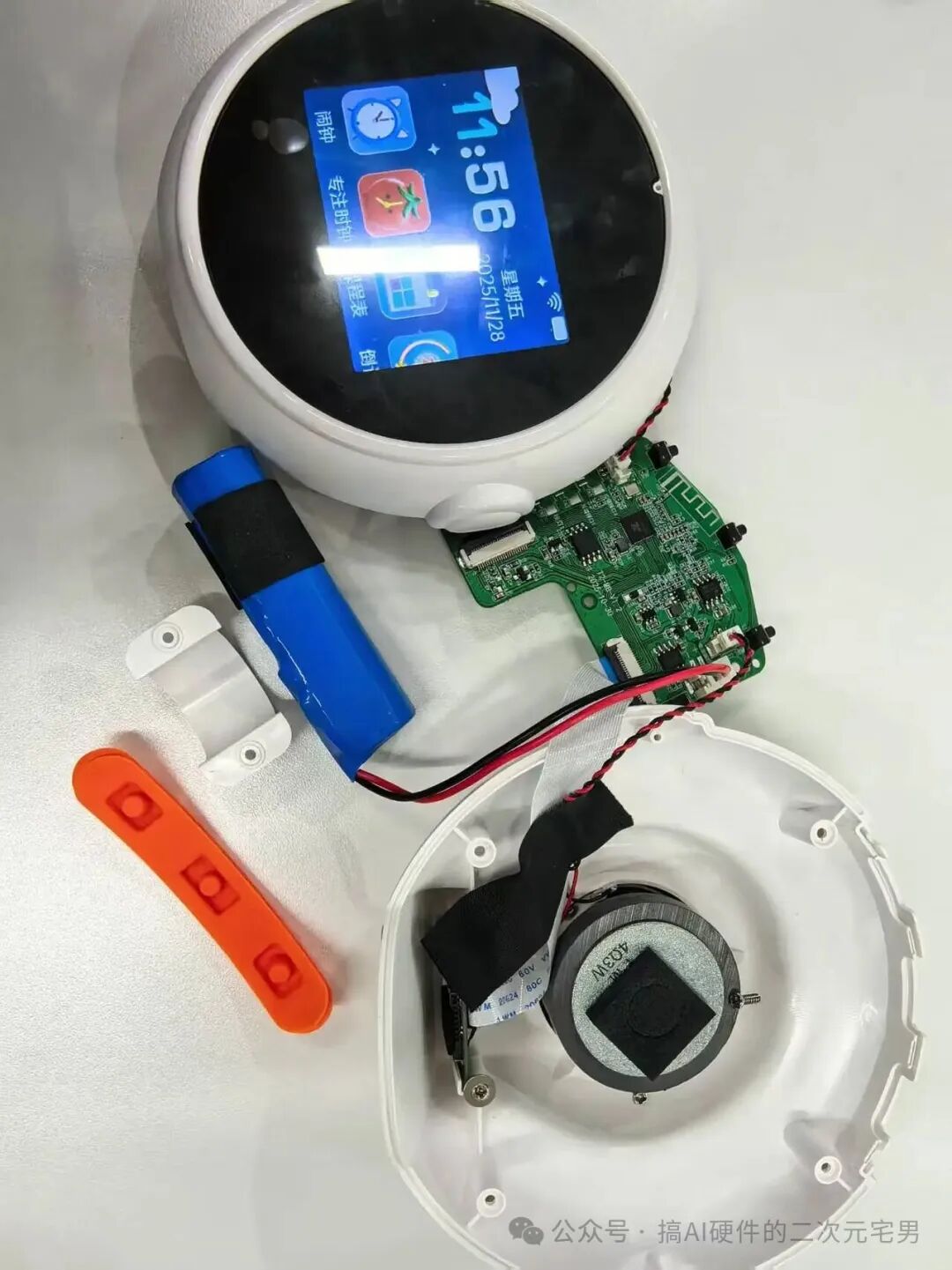 After disassembly, I needed to analyze it and found that the chip in this AI alarm clock is cheaper than the chip used in AI toys.When in doubt, I sent the picture directly to Doubao!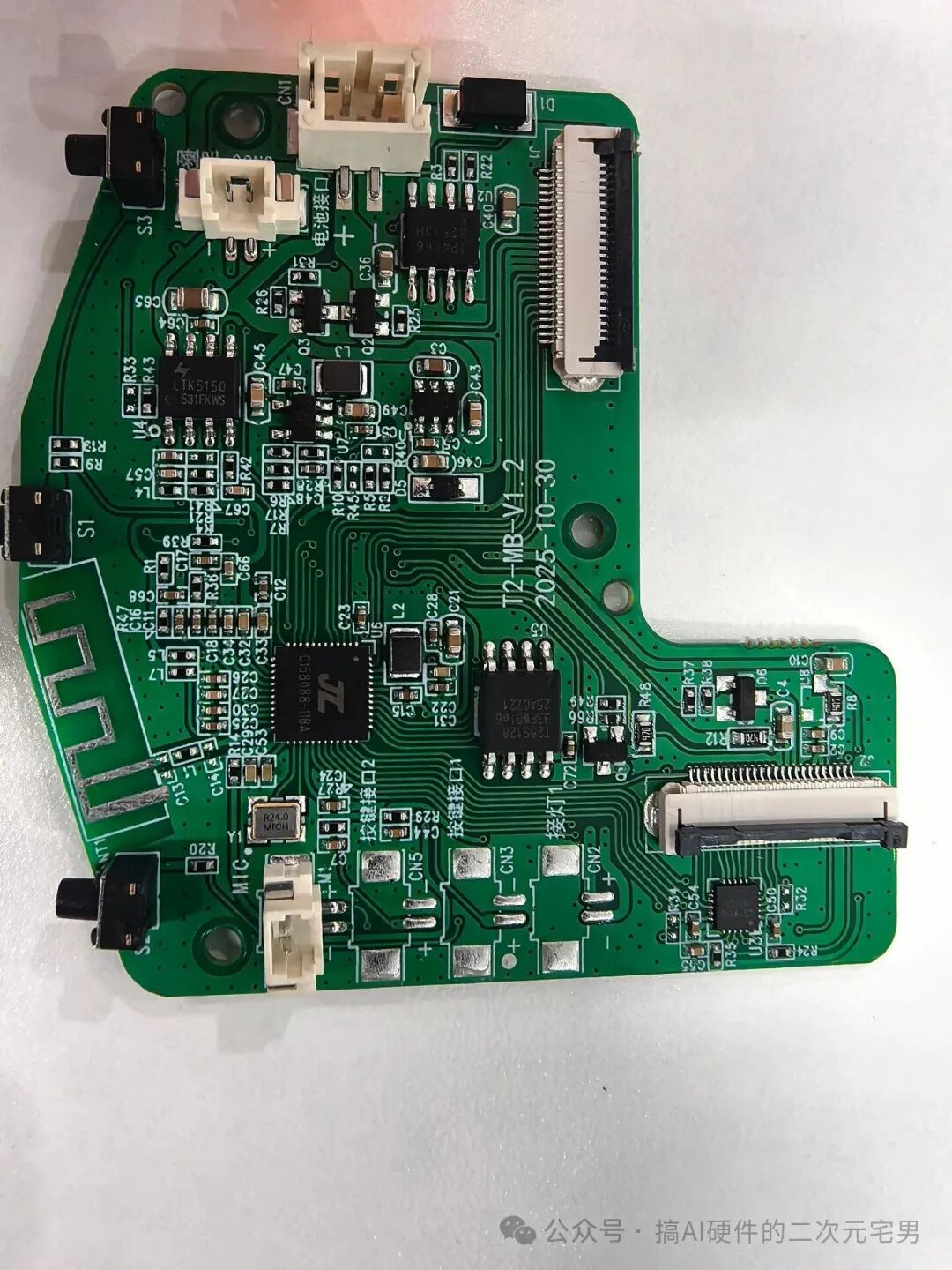
Doubao replied:
This is a consumer electronics control board model T2-MB-V1.2 (production date marked as 2025-10-30), with core functions leaning towardsaudio + button/interface control. Below are the key information breakdown:
1. Core Chip and Function Positioning
- LTK5150: A single-channel Class F audio amplifier chip from Silicon Source, supporting 5V power supply and outputting 3.3W power under a 4Ω load. It features both Class D (high power efficiency) and Class AB (no FM interference) modes, making it a core amplification component for Bluetooth speakers/smart speakers and other audio devices.
- MIC / Button Interface / Light Control Interface: The PCB silk screen clearly labels these interfaces, indicating that the mainboard is responsible for microphone audio pickup, physical button input, and light control, serving as the core board for human-computer interaction + audio output.
- Other chips (e.g., H659/170952): Based on layout and surrounding circuits, they are likely power management (voltage stabilization) and signal conversion auxiliary chips, ensuring stable power supply and signal transmission for the mainboard.
2. Hardware Design Features
- Rich Interfaces: Includes battery interface, multiple connector sockets (for connecting displays/other functional boards), physical buttons (S1/S3), and audio output-related solder points, suitable for “modular assembly” consumer electronics (e.g., portable speakers, smart devices with lights/buttons).
- PCB Technology: Complete green oil coverage, clear silk screen, indicating it is a mass production-grade industrial board with compact routing layout, designed for miniaturization for portable devices.
3. Application Scenario Assessment
Based on the features of audio amplification, microphone, button/light control, and battery interface, this mainboard is likely used for:
- Bluetooth portable speakers/smart speakers
- Handheld/desktop small smart devices with audio output (e.g., early education machines, portable game consoles)
- Audio consumer electronics with light interaction
Feeling that Doubao didn’t analyze the information I wanted, I took a closer photo to analyze the chip information: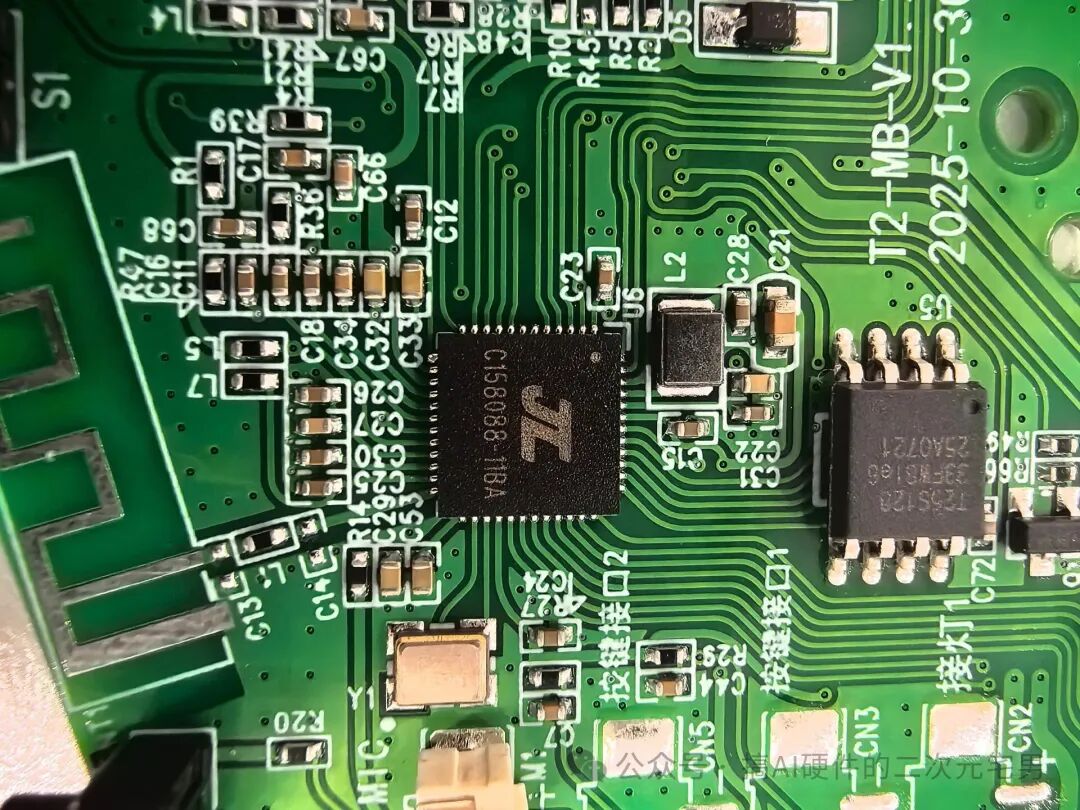
This close-up image allows for a more precise breakdown of the core design and functional details of the T2-MB-V1.2 mainboard:
1. Core Control Chip (marked JL)
- Chip Ownership: This is aJieli (JL) Bluetooth audio SoC (part of the JL701x/AC695x series), which serves as the core brain for Bluetooth speakers/audio devices, integrating Bluetooth communication, audio decoding, button/light control, and microphone pickup into a one-stop solution (corresponding to Jieli’s chip features designed specifically for Bluetooth speakers).
- Silk Screen Interpretation: The reverse display on the chip “C15808810” is the batch/model code, with core capabilities covering Bluetooth 5.0+, audio SBC/AAC decoding, multi-microphone noise reduction (ENC), and light effect synchronization control.
2. Key Peripheral Circuits and Components
- Functional Interfaces:
- “Button Interface 1/2”: Corresponds to physical button inputs (play/pause, volume, mode switching), supporting multiple button combination operations;
- “Light Control 1”: Controls ambient lights/status indicator lights, allowing for lights to pulse with music, Bluetooth pairing/playback status indication;
- “MIC”: Microphone pickup interface, suitable for karaoke, voice calls, and voice control scenarios, supporting environmental noise cancellation (ENC).
- Passive Components:
- Dense capacitors (C12/C23, etc.), resistors (Rxx): Their core functions are power filtering (reducing voltage ripple), signal coupling (audio signal transmission), and impedance matching (ensuring stable operation of the amplifier/main control);
- Golden rectangular crystal oscillator: Provides precise clock frequency for the main control chip, crucial for stable timing in Bluetooth communication and audio decoding.
- Amplifier Chip (LTK5150): A differential input single-channel Class F audio amplifier, outputting 3.3W power under a 4Ω load with 5V power supply, responsible for amplifying the decoded audio signal to drive the speaker, balancing efficiency (Class D) and sound quality (no FM interference).
3. Circuit Design Details
- Anti-Interference Design: Audio signal traces are thin and far from power traces to reduce noise interference; power traces are wide and short to minimize voltage drop, ensuring stable power supply to the amplifier;
- Packaging and Technology: The main control chip uses QFN packaging (no pins/wings), providing good heat dissipation and compact size, suitable for the miniaturization needs of portable speakers;
- Mass Production Features: Component designators (Cxx/Rxx) and interface function silk screen markings are clear, indicating industrial-grade mass production design, facilitating production, testing, and maintenance.
4. Overall Positioning
This mainboard is aportable Bluetooth audio device control board with light interaction (most likely a karaoke speaker/ambient light speaker), integrating Bluetooth connectivity, audio decoding and amplification, human-computer interaction (buttons/microphone), and light effect control, serving as the core control unit for this type of consumer electronics.
Since we’ve analyzed the core parts, there’s no need to check prices on 1688! Just ask Doubao to tell me the cost price!
| Component Name | Unit Price Range for 10k Batch (Yuan) | Remarks |
|---|---|---|
| 2.7-inch TFT Color Screen Module | 5~8 | Consumer-grade small size color screen with driver IC |
| T2-MB-V1.2 Bluetooth Audio Mainboard | 8~12 | Includes Jieli SoC, LTK5150 amplifier, and other core components |
| 1500mAh 18650 Consumer-grade Battery Cell | 2~3.5 | Regular capacity battery cell suitable for portable devices |
| 4Ω/3W Internal Magnetic Speaker | 2~3.5 | Specifications matching the mainboard audio amplifier |
| Plastic Shell (Top and Bottom Covers) | 3~5 | Injection molded parts, price after sharing mold costs in bulk |
| Multi-button Silicone Keypad Component | 0.5~1 | Orange functional button silicone part |
| Auxiliary Materials (Wires/Screws, etc.) | 1~2 | Wires for connections, fixing screws, and other accessories |
| Assembly Processing Fee | 2~3 | Includes labor/equipment costs for soldering and component assembly |
| Total Cost (Hardware + Assembly) | 26~37 | Excluding R&D, mold, logistics, and other indirect costs |
Adding 2 Yuan for packaging, 2 Yuan for logistics, and about 5 Yuan for software license fees, plus a factory profit margin of 10%-15% (with mold costs shared among quantities and R&D costs included in the license), if it’s an overall OEM factory, the cost price of a product is around 45-55 Yuan.By the way, don’t forget to add 13% VAT! The total cost of the alarm clock is about 60 Yuan.Of course, there are supply chain experts who can optimize the cost to around 50 Yuan, but I think it’s unnecessary; firstly, the industry ecosystem needs to operate healthily.As new entrants in the AI toy industry, we just need to know a rough range.Then we can calculate the business model:Typically, the pricing method is three times the cost, so a product costing 60 Yuan would have a reasonable retail price of 180 Yuan. According to the inertia of Chinese e-commerce, this could be sold for 179 Yuan or 199 Yuan.199*0.5=99.5 Yuan (assuming you supply at 50% discount)(99.5-60)/99.5=39.7% gross margin.You earn 39.5 Yuan per unit, and if you can sell10,000 units, you would earn a total of 395,000 Yuan.Net profit can be calculated based on your own expenses, such as salaries, rent, social security, etc.This is the calculation method used in traditional large enterprises.If you are a small startup team without other R&D and labor costs, and you are not very interested in making a lot of money, just making a little money is more comfortable than working, you can try this formula:129*0.5=64.5 Yuan(assuming you supply at 50% discount)(64.5-60)/64.5=6% gross marginYou earn 4.5 Yuan per unit, and if you can sell100,000 units, you would earn a total of 450,000 Yuan.If you are quite charming or have very rare connections, you can supply at 60% or 70% discount, which allows your product’s retail price to drop further.Or you can go directly to consumers without considering any discount supply, but you need to factor in your advertising and other promotional costs.With such a modification experience, you can try the traditional toy industry: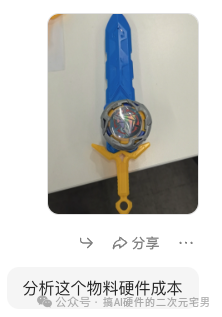
| Component Name | Unit Price Range for 10k Batch (Yuan) | Remarks |
|---|---|---|
| Blue Sword Body (ABS Injection) | 1.8~2.5 | Large size ABS plastic part, regular injection molding process |
| Yellow Sword Handle (ABS Injection) | 0.8~1.2 | Small size ABS plastic part, simple structure |
| Gyro Core Component | 2.5~4.0 | Includes: – Metal weight ring (zinc alloy/iron ring): 1.5~2.5 Yuan – Plastic gyro shell: 0.5~0.8 Yuan – Colorful stickers/laser sheets: 0.3~0.5 Yuan – Bearings/rotating shaft: 0.2~0.2 Yuan |
| Launcher with Built-in Spring/Gear Set | 1.2~1.8 | The core driving component for spinning the gyro |
| Small Hardware Parts (Screws/Clips) | 0.1~0.3 | Auxiliary hardware parts for fixing components |
| Total Material Cost (Hardware Only) | 7.2~10.0 | Pure material cost, excluding other expenses |
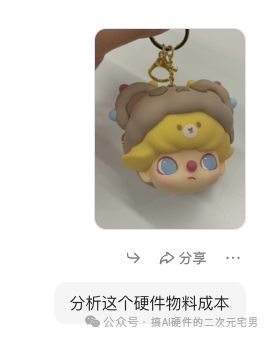
| Component Name | Unit Price Range for 10k Batch (Yuan) | Remarks |
|---|---|---|
| Main Shape Component (Soft Rubber/Resin) | 2.5~4.0 | Includes: – PVC/soft rubber material: 1.0~1.5 Yuan – Multi-color injection/painting (spray painting + pad printing): 1.5~2.5 Yuan (coloring the face/details is the core cost item) |
| Metal Keychain Component | 0.8~1.5 | Includes: – Metal key ring (gold plated): 0.3~0.5 Yuan – Lobster clasp + chain (gold plated): 0.5~1.0 Yuan |
| Small Decorative Parts (Colorful Accents) | 0.2~0.5 | Colorful beads on the head |
| Total Material Cost (Hardware Only) | 3.5~6.0 | Pure material cost, excluding other expenses |
Bubble Mart sells a necklace for 79.9 Yuan, and there is a reason for that!We should learn from them!When everyone sees in articles on public accounts or other social media that “some AI toy” has sold out, or “some AI toy” has sold 300,000 units, feel free to use my method for some entertainment.The above only represents my personal views, purely for entertainment purposes, and should be used as a reference for analysis in the industry. It does not represent the company or group. Please provide guidance and feedback!