In the consumer market of 2025, AI toys are reshaping the industry landscape at an unimaginable speed, becoming a new consumption hotspot across all age groups and ushering in a “golden age” for the AI toy industry. At the intersection of technology and humanity, creating truly warm connections may be the ultimate vision and value destination of the AI toy industry.
Total word count: 3400 words
Estimated reading time: 7 minutes
01
Industry Trend: When the Second Dimension Meets AI Toys
We are a startup team from Zhejiang University and Alibaba. At the beginning of 2025, we observed that the entire second-dimensional trendy toy industry has maintained a growth rate of over 20% for three consecutive years. The reason behind this billion-dollar market surge is the technological inclusivity brought by open-source large models like DeepSeek—overall development and invocation costs in the AI agent industry have decreased by several times, paving the way for widespread commercialization. We believe that the maturity of technology on the supply side of the AI toy industry matches well with the growth of the market on the demand side, so our team began developing the AI companion toy project in May this year.
At the beginning of our startup, we first considered how to define the attributes and direction of companion AI toy products. To this end, we conducted in-depth market research.
Currently, the most popular AI products on the market can be divided into four main categories: learning machines, children’s watches, dictionary pens, and story machines. Among them, the domestic annual shipment of learning machines is over 3.5 million units, while the overseas annual shipment is over 8 million units; children’s watches have a domestic annual shipment of over 25 million units and an overseas annual shipment of over 35 million units; dictionary pens have a domestic annual shipment of over 5 million units and an overseas annual shipment of over 2 million units; story machines and companion robots have a domestic annual shipment of over 8 million units and an overseas annual shipment of over 12 million units. From the shipment data, it can be seen that the popularity of story machines and companion robots is high, but what truly meets children’s needs are hardware products like the Xiaotiancai children’s watch, which have both AI attributes and ecological attributes.
For AI products, learning assistance is the primary need for parents, with language ability development being particularly crucial. At different age stages, parents have different needs for language ability development. For example, when children are 3-4 years old, parents hope to focus on developing basic communication skills, while by the age of 7-8, they hope to improve their children’s English proficiency.
02
Precise Positioning: Entering the Market with “Handmade Robots”
Initially, we also focused on English learning robots, but soon realized that almost all products could meet this condition, making it difficult for us to create a truly differentiated advantage. A turning point appeared in our observation of the open-source community. We noticed that although there are many excellent open-source hardware projects, many handmade projects that meet the demand for hands-on creation are not open-source. Many craft enthusiasts are passionate about creating unique works by hand, which made us feel that perhaps “handmade creation” is where the next trend lies.
To validate this idea, we filmed many short videos of handmade toys and posted them on social media. To our surprise, each video received good organic traffic and user interaction, which undoubtedly confirmed market interest.
Thus, we began to think about whether we could create a children’s toy that integrates AI intelligence and the warmth of handmade creation. To this end, we quickly developed a series of courses, bringing experiential classes to children at the Zixuan Campus of Hangzhou Xihu Primary School and the Central Primary School of Yixihara Town in Xinjiang. During the teaching process, children showed a high acceptance of “handmade creation”.When children, under the guidance of teachers, assembled parts into talking robots, the sparkle in their eyes made us more confident that this would be the right path.
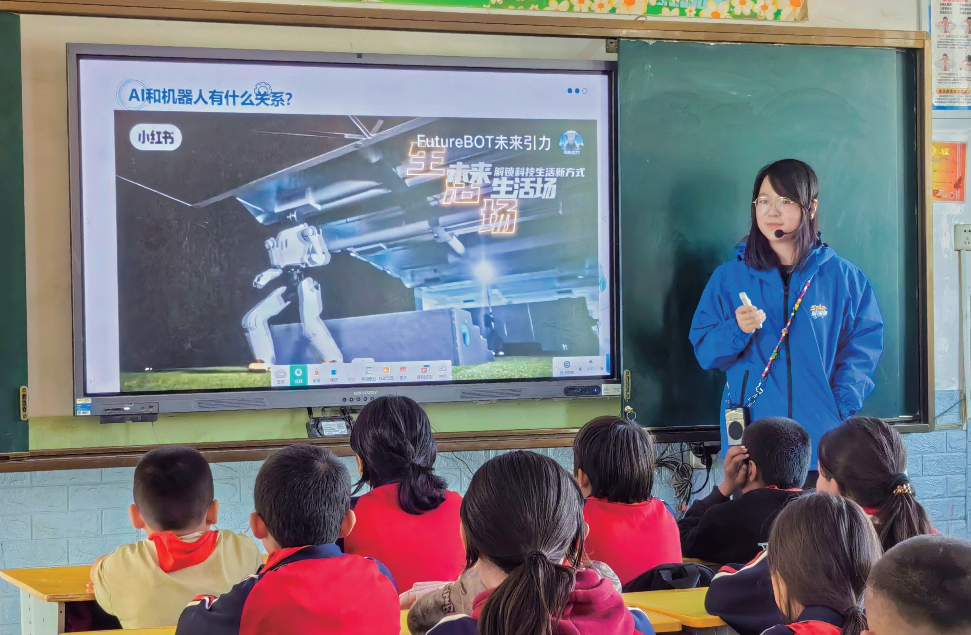
▲ Yuejie Chuangwan popularizing AI knowledge at the Central Primary School of Yixihara Town in Xinjiang
Especially parents of children aged 8-12 are very eager to use such products to initiate their children’s science and technology education. Thus, we defined the form and attributes of the product to allow children to enjoy a more convenient and safer handmade robot experience, enhancing the intelligent attributes of AI toys while retaining the fun of hands-on creation. This tangible sense of achievement is our core competitive advantage, distinguishing us from purely software or finished toys.
03
Technological Breakthrough: From “Cold Machines” to “Understanding Partners”
True AI product innovation should break through simultaneously in both hardware and software dimensions. Compared to traditional smart toys, our product’s core concept is to create a “nurturing” AI partner—not only allowing children to assemble parts but also involving them in the nurturing process, giving life to an AI companion robot.
Once children complete the assembly, they are eager to take this AI partner they created home to accompany them. Each child has unique expectations for their ideal partner, so we designed eight personality roles for the LEGO assembly AI robot product, with more types continuously being added. These personality roles include the 8-year-old mech pilot “Xingbao”, who is brave and curious; the 24-year-old abstract boy “A Che”, who has a jumping mind and “reads and replies chaotically”; the female tech blogger “Bella”, who is calm, rational, and gentle; and the humorous talk show host “Old Zhang”, who comments on various phenomena in a witty manner. The different personality roles provide children with diverse choices, essentially meeting the companionship needs of different groups, and users can freely switch through a mobile app. If users have special needs, we can also customize personality roles.
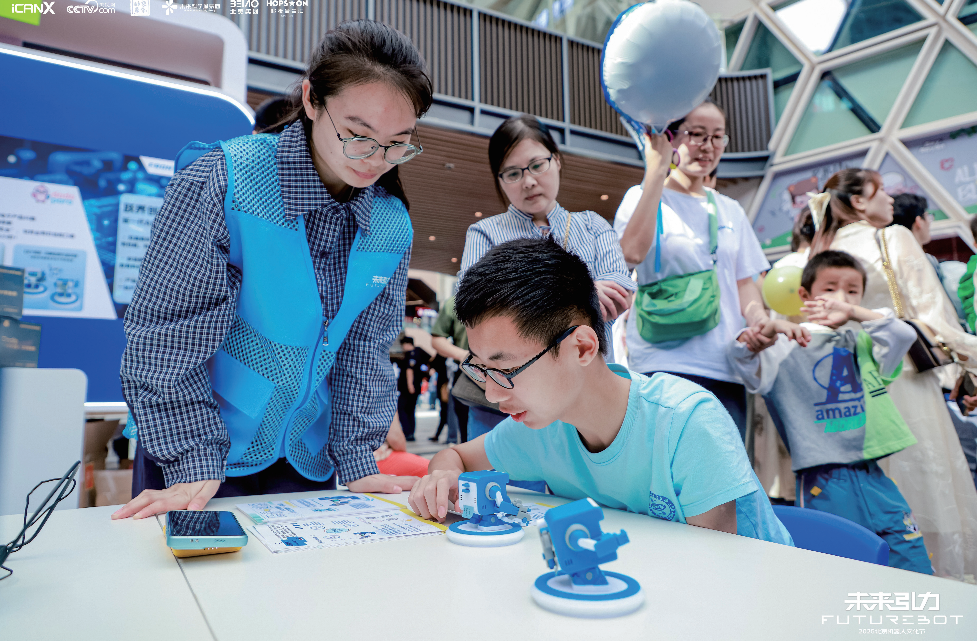
▲ 2025 Beijing Robot Culture Festival
The pain point of traditional smart toys lies in their monotonous responses and cold human-machine interaction, lacking emotional and personalized elements, which stems from their underlying logic lacking support from large models. When children ask questions like “How was I born?” or “How did I grow up?”—questions full of imagination—traditional smart toys often have no answer.
What we are developing is a truly “user-understanding” AI companion toy, with its underlying logic based on large models like DeepSeek and Tongyi Qianwen. In terms of technological advantages, we have the capability to self-develop vertical domain models and a professional model definition system. The product not only possesses long-term and short-term memory capabilities but also features rapid access and ultra-low latency, along with emotional perception abilities.
For example, when a user asks this AI robot, “What is your function?” its response is: “I am like a person picking up shells by the sea, chatting with you and sharing your thoughts.” It is evident that it has its own personality, knows where it lives, and can even recognize the user’s current mood based on the tone of the question, communicating in a naturally realistic voice. Whether asked to compose poetry in the tone of Lin Daiyu or to discuss the meaning of life, this AI partner can provide a thoughtful and personalized response within one second. This deep interaction allows every child to have a unique companionship experience.
04
Scene Expansion: From Toys to Educational Tools
Currently, our LEGO assembly AI companion robot has been applied in various scenarios including science and technology education, trendy collectibles, plush toys, cultural tourism marketing, and anime IP, and the team is continuously expanding new application scenarios and functions.
In addition to our own teaching classes, we are expanding the product boundaries from three dimensions. First is the life scenario: allowing children and parents to use the AI partner to create learning plans, design healthy recipes, accompany scientific exercises, and help complete daily tasks; second is the educational scenario: collaborating with schools to use the AI partner as a teaching tool in science and technology classes to guide students in problem-solving; third is the social scenario: collaborating with science museums and communities to conduct AI robot interactive experiences and create collective creation workshops. Recently, we partnered with the Ningbo Science Exploration Center to create its first self-owned IP AI assembly robot for science popularization research, AI teaching, and personalized interaction, allowing children to learn about various exhibition hall knowledge through Q&A, making the children’s science popularization experience more vivid and interesting.
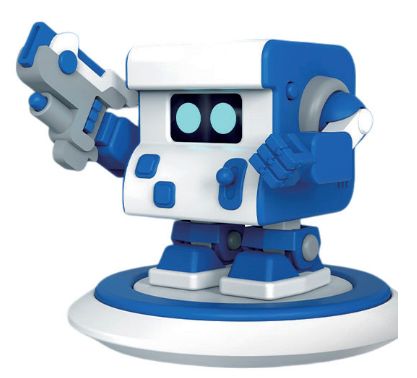
▲ dodopara AI desktop pet robot DIY assembly version
Moreover, we have found that AI companion toys are not only loved by children but also show great potential in the elderly care sector. With the acceleration of population aging, the emotional companionship needs of the elderly have become a social issue that cannot be ignored. The emotional loneliness faced by elderly people living alone or in empty nests is becoming increasingly prominent, while AI companion toys can be on duty 24 hours a day, providing personalized interaction and infinite patience. We are exploring partnerships with elderly care institutions to introduce age-appropriate AI companions into elderly care service scenarios, using technology to warm the lives of the elderly.
05
Value Leap: Redefining the Toy Industry
Currently, the traditional toy experience is undergoing transformation, with AI toys evolving from static items to digital personality carriers that provide emotional companionship and deep interaction. In the future, this transformation will reshape industry value from five dimensions:
1
Value Leap: From “Items” to “Emotional Partners”.Breaking through the limitations of traditional plush toys that lack deep interaction, upgrading products to be conversational, memorable, and empathetic digital emotional carriers, enhancing emotional added value, driving product premium and long-term repurchase willingness.
2
Deepening Connections: Nurturing Personality Evolution, Building Exclusive Emotional Connections.Based on the AI personality growth mechanism of “Budding – Progress – Shaping”, endowing roles with memory accumulation and personality development trajectories. Users participate in nurturing through daily interactions, witnessing role growth, establishing unique emotional bonds, and strengthening cultural identity and usage stickiness.
3
Highlighting Individuality: “Emotional Healing + Personality Development” Dual-Track Mechanism.Roles dynamically exhibit unique personalities in interactions, achieving high recognition and strong immersion in personality experiences, stimulating users’ sense of belonging and desire for social sharing.
4
Commercial Value Addition: Opening Sustainable Revenue Channels.Breaking the single sales model, expanding diverse monetization paths, enhancing single product pricing space and collectible value. Deriving subscription services, activating high-value cooperation opportunities such as digital content, co-branding events, and IP licensing, constructing a composite revenue channel of “hardware + services + ecosystem”.
5
Ecological Incubation: Data-Driven IP Testing Ground.Based on real behavioral data, providing real-time feedback on role interaction performance, agilely iterating personality settings and behavior models, becoming an intelligent testing platform for incubating derivative roles or exploring new forms of IP, accelerating the sustainable evolution and commercialization exploration of the IP ecosystem.
Founded in 2003, the magazine “Hangzhou” focuses on the central work of the municipal party committee, discusses hot topics, records, interprets, promotes, and appreciates Hangzhou, always leading the national urban party publication front. Since its inception, it has received numerous honors, such as the article “As a City of Competitions and Conferences, Rising an International Hangzhou” in the magazine’s “Perspective” column winning the third prize in the 2023 Zhejiang News Award for newspapers and magazines, and the “Perspective” column being rated as an excellent column in the seventh East China region journal awards.
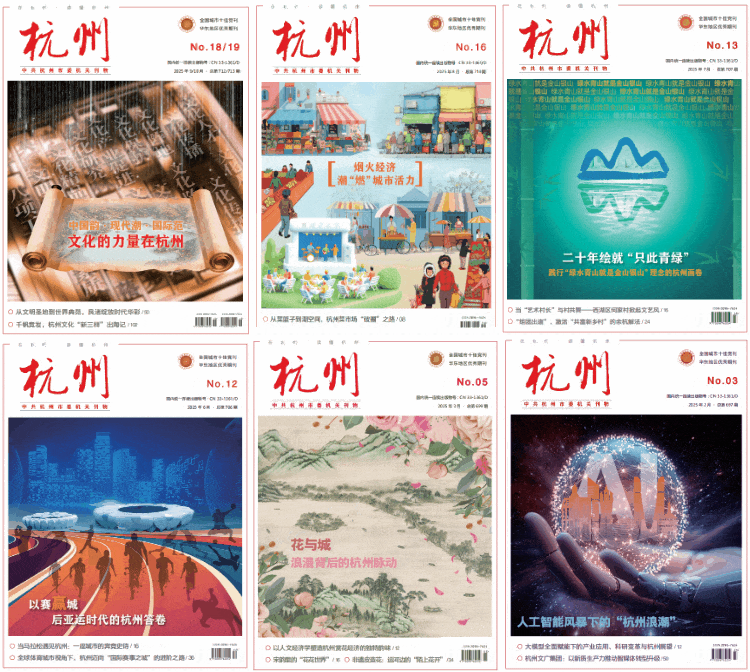 How to subscribe to the magazine “Hangzhou”? “Hangzhou” magazine is a publicly distributed bi-monthly publication,ISSN CN33-1361/D,annual subscription price is 360 yuan.For subscriptions, please contact: Teacher Xu 0571-85253918Welcome all major institutions and enterprises to subscribe!
Author | Jiang Yizhuo
The author is the founder of Hangzhou Yuejie Chuangwan Technology Co., Ltd.
Layout | Mao Ting
Review | Zhang Weiwei Jin Lishan Han YidanThis article was published in the 20th issue of “Hangzhou” magazine in 2025.
 Long press the QR code to follow the public account:Hangzhou Magazine