Source | Jiemian NewsReporter | Li BiaoEditor | Wen Shuqin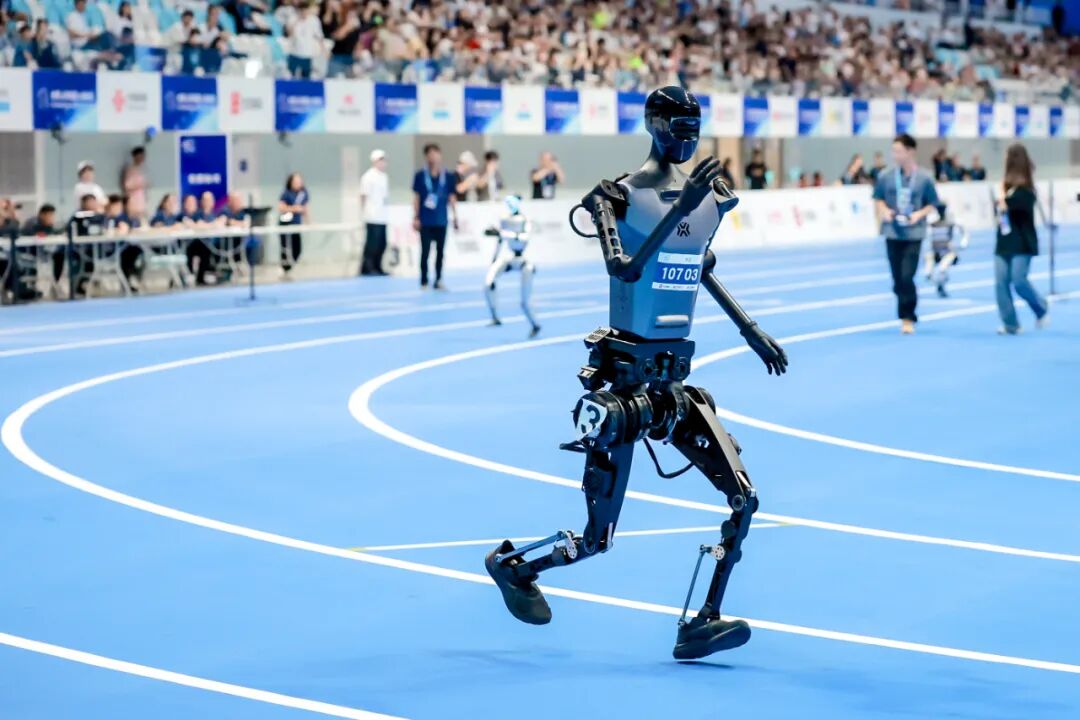 Embodied Tian Gong Ultra participated in the Robot Sports Games Image source: Beijing Humanoid Robot Innovation Center
In the recently concluded 100-meter race at the Robot Sports Games, the “Embodied Tian Gong Ultra” robot from the Beijing Humanoid Robot Innovation Center (jointly established with the National Land and Resources Ministry) won first place with a time of 21.50 seconds, also securing silver medals in the 400-meter and 1500-meter races. Unlike all other robots in the competition, this robot did not use remote control and had no human pacer, completing the race “on its own”.
In the half marathon held in Yizhuang, Beijing, in April this year, the “Embodied Tian Gong Ultra” robot also participated and ultimately won the championship.
At that time, the team had already attempted to eliminate the robot’s remote control, using wireless sensing technology to achieve semi-autonomous control. During the half marathon, a human pacer ran ahead, wearing a special UWB tag (note: a type of ultra-wideband wireless communication technology that allows for precise positioning within a range of 10-30 centimeters). The “Embodied Tian Gong Ultra” robot was equipped with a wireless transmitter, responsible for sending and receiving wireless signals, and then used algorithms to maintain a relatively fixed distance and angle from the pacer, following closely behind throughout the race, with staff on-site for emergency protection.
Tang Jian, CTO of the Beijing Humanoid Robot Innovation Center, revealed to the media after the half marathon that the center is developing fully autonomous navigation technology, which is expected to be available soon, with hopes of seeing the Tian Gong running without guidance at next year’s robot marathon.
This time, showcasing the results of fully autonomous navigation at the Robot Sports Games, Tang Jian stated in an exclusive interview with Jiemian News that the demonstration at the competition was only a small part of the center’s complete solution. In his view, the sports field environment is relatively special, as the robot only needs to run along the two boundary lines of the track, and the fully autonomous navigation solution publicly released by the center achieves this as a “dimensionality reduction attack”.
“Removing the remote control and achieving fully autonomous navigation is a necessary condition for the industry to take root,” Tang Jian believes. Whether entering factories or homes in the future, robots with fully autonomous navigation must be able to explore new environments independently without a remote control. In this process, robots need to build real-time maps, make autonomous decisions on movement routes, and identify and avoid various obstacles in the real environment.
The Beijing Humanoid Robot Innovation Center was officially registered at the end of 2023. Before joining Beijing Humanoid, Tang Jian taught at Syracuse University in the United States, receiving a series of honors such as IEEE Fellow and ACM Distinguished Scientist, as well as multiple top awards including the 2019 IEEE Communications Society William Bennett Paper Award. He has served as an editorial board member for several top international journals and as chair or vice-chair of technical committees for multiple international conferences. He later entered the industry, serving as Chief Scientist of Intelligent Control at Didi and Chief AI Officer at Midea.
“AI-driven system control can be simply explained as ‘using AI’s end-to-end approach to control various systems’, just like smartphones, cars, and smart homes; robots are also a type of system.”
However, in Tang Jian’s view, the current “AI content” of robots is far from sufficient. Referring to the industry’s current analogy of human “brain-cerebellum-trunk” to the robot’s “decision-making-motion control-execution” system, he notes that while the motion control and performance of robots in the “cerebellum” and “trunk” have made significant progress in the past two years, the AI capabilities in the “brain” part are still very basic. “Insufficient AI capability has also led to the failure of robots to truly scale up.”

Below is the transcript of the interview with Tang Jian, edited for clarity.
▎”No Remote Control + Fully Autonomous Navigation” is a Necessary Condition for Robot Industrialization
Jiemian News: In the running competition at the Robot Sports Games, the most obvious change in the Tian Gong robot is the absence of remote control. Was this the goal we most wanted to achieve before the competition?
Tang Jian: This is not everything we want to achieve. Our complete humanoid robot autonomous navigation solution aims to enable robots, especially humanoid robots, to quickly move autonomously in a new environment.
Participating in the sports event to achieve autonomous running only utilized a small part of our entire solution’s capabilities, as the sports field environment is relatively special; the robot only needs to run along the two boundary lines of the track, and this capability is a subset of our complete autonomous navigation solution, which can be considered a dimensionality reduction attack.
Jiemian News: Most robots from companies in the industry currently require manual remote control. Is fully autonomous navigation a significant breakthrough for the entire industry?
Tang Jian: Before, humanoid robots basically did not have fully autonomous navigation.
Achieving fully autonomous navigation is quite challenging. If we simply compare it to autonomous driving:
First, autonomous driving generally faces two objects: cars and pedestrians. The environment for robots is much more complex, with various objects present, many of which are small, and in special environments, there may be some stacking situations. Moreover, it is not enough to identify the types of objects; it is also necessary to accurately identify their positions and orientations, which poses significant challenges for algorithms.
Second, autonomous vehicles have only four wheels, while humanoid robots generally have at least dozens of joints. After planning a path, it is quite difficult to strictly control the robot’s movement along that path, as tracking the path is challenging due to the high degrees of freedom.
Jiemian News: There is also some skepticism from the public regarding remote control. Many netizens feel that if someone is controlling it from behind, the technology is not that impressive anymore, and some say humanoid robots are just “remote-controlled toys”. From an industry perspective, how do you objectively view the issue of remote control?
Tang Jian: Objectively speaking, I believe that fully autonomous navigation is a necessary condition for the industrialization of robots.
Fully autonomous navigation requires robots to autonomously explore new environments, build maps, and avoid obstacles in real-time, which is a very necessary condition, right? If industrialization requires someone to use a remote control, it loses the meaning of building robots.
However, on the other hand, there are some misunderstandings about remote control from the public.
For example, when a remote-controlled robot navigates through obstacles, the control of the robot’s entire body movement is managed by algorithms; remote control mainly provides commands for forward, backward, left, and right movements. It is impossible for a person to control all the joints of the robot’s body throughout the entire process.
So even with a remote control, there is still a part of the control that is algorithm-based.
Jiemian News: What stage are we at in developing the fully autonomous navigation solution?
Tang Jian: We have already achieved breakthroughs, and we will definitely continue to iterate.
Just like autonomous driving, achieving completely driverless operation on the streets was technically possible more than a decade ago. However, everyone has continued to iterate because there are still many corner cases that need to be resolved for stability and safety.
The sports event is a demonstration; as I mentioned earlier, the sports field is a relatively special scenario where the robot only needs to detect the two boundary lines of the track and run along them, which is relatively orderly. In more complex real-life scenarios, such as factories and shopping malls, the environment becomes more complicated. After achieving movement under fully autonomous navigation, completing specific operational tasks in various real scenarios will be even more challenging.
Jiemian News: You compared autonomous driving to the robot’s fully autonomous navigation. If we refer to the six levels of classification in the autonomous driving industry (L0-L5), which level does fully autonomous navigation correspond to?
Tang Jian: It actually corresponds to L4, where it can operate autonomously in most situations, but there may still be some corner cases that cannot be resolved, requiring human intervention.
Jiemian News: Are you satisfied with the results of this Robot Sports Games?
Tang Jian: Overall, I am quite satisfied. We achieved one gold, three silver, and one bronze in the athletics competition, and also one gold, three silver, and one bronze in the scene competition, with both competitions being evenly matched.
The athletics competition mainly tests the robot’s movement and balance capabilities. In fact, we previously participated in the marathon and the Zhongguancun Simulation Robot Competition, where we achieved very good rankings, which have fully demonstrated our robots’ excellent performance in motion.
This time, we also invested a lot of effort in participating in some scene competitions. The scene competitions are mainly to lay the groundwork for practical applications and reflect our hope to develop robots that are both capable of running and being useful.
In this event, we participated in three tasks: material sorting, transportation, and commercial welcoming services, using a single robot, “Tian Yi 2.0”, in all three competitions. In the material sorting task, Tian Yi 2.0 significantly outperformed other robots in terms of completion time and task completion rate. In the material transportation and welcoming service tasks, Tian Yi 2.0 directly competed against industrial robots that are tall, robust, and equipped with industrial chassis. We essentially achieved operational efficiency with the humanoid Tian Yi 2.0 that is very close to that of industrial-grade robots, and the final results validated Tian Yi 2.0’s strong generalization capability, also proving our software and hardware technology’s generalization ability.
Jiemian News: Do you think more companies in the industry will follow suit with fully autonomous navigation?
Tang Jian: I believe that at the next sports event and the next marathon, most companies will likely remove the remote control and allow robots to run autonomously.
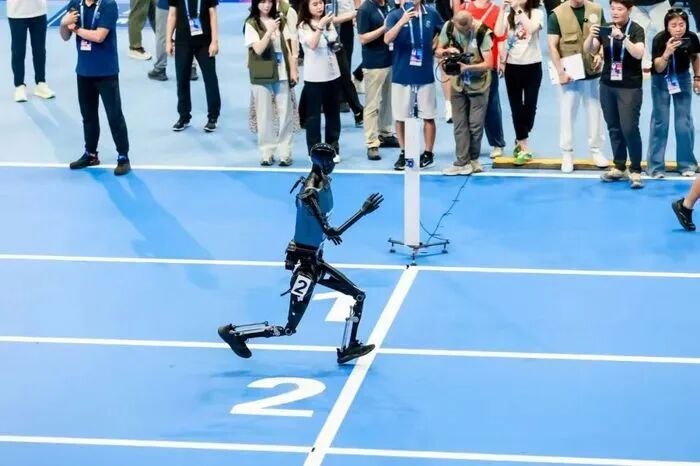
Image source: Beijing Humanoid Robot Innovation Center
▎ The Generalization Ability of Embodied Intelligent Algorithms is the Biggest Bottleneck in the Industry
Jiemian News: This year’s World Robot Conference saw over 50 humanoid robot companies, showcasing a variety of products, technological routes, and commercial application scenarios, making the industry very lively. Some media summarized that “the robot industry has everything, but there is no consensus”. What is your view on this?
Tang Jian: If you attended the conference, you should have seen that the humanoid robot industry is mainly divided into two types of companies: one type focuses on the robot body and motion control, with clients primarily from educational institutions and research institutes, where customers buy their robot products for secondary development, and some are also used for performances and exhibitions. The other type consists of an increasing number of companies targeting industrial applications, showcasing some work scenarios used in real production processes, which currently seem to be converging, such as warehouse box moving and sorting materials on logistics conveyor belts.
Currently, there may be some consensus on what each of these two types of companies is doing and exploring.
Jiemian News: From your perspective, what is the biggest consensus in the robot industry right now?
Tang Jian: Personally, I believe that the biggest bottleneck is the need to improve the generalization ability of embodied intelligent algorithms. This is the core issue, without exception.
Jiemian News: Yu Shu Wang Xingxing also mentioned at the World Robot Conference that compared to the often-discussed data scarcity issue, the biggest challenge in the robot industry is the “embodied intelligent model”. Do you agree with his viewpoint?
Tang Jian: What he refers to as insufficient model capability actually points to the model architecture.
The model’s structure, how many layers it has, how the layers are connected, how many parameters there are, and what activation functions are used in each layer, all of these are collectively referred to as model architecture, which indeed needs to be broken through. Because the current embodied intelligent models, including VLA models and VLM models, are still following the architecture of large language models without any breakthroughs.
Regarding models, besides architecture, there is another overseas star robot company, PI (Physical Intelligence), whose co-founder Sergey Levine talks about the model’s recipe, which mainly refers to training methods and training data. This is also very important. You can create a particularly impressive architecture, but without data to train it into a high-performance model, it is of little use.
Therefore, I believe both aspects are needed: improvements in data and model capabilities.
Jiemian News: Are there other capabilities of robots that need improvement?
Tang Jian: In some other areas, such as work efficiency, load capacity, endurance, and the stability and reliability of hardware, there is still room for improvement. However, I categorize these as linear bottlenecks. Linear bottlenecks mean that as time progresses, they will continue to improve and eventually reach a satisfactory level.
As for the previously mentioned insufficient generalization ability of embodied intelligent algorithms, I call it a nonlinear bottleneck, meaning you do not know when you will truly break through this bottleneck.
Jiemian News: Regarding the often-discussed data scarcity issue in the robot industry, what scale of data would be considered sufficient, or will there be a turning point similar to how Li Feifei established the ImageNet dataset for deep learning?
Tang Jian: There is currently no conclusion.
Jiemian News: Is there currently no breakthrough in the innovation of the embodied intelligent model architecture, similar to the breakthrough of the Transformer architecture in large language models?
Tang Jian: Currently, many embodied model architectures are constructed based on the Transformer architecture of large language models.
Taking the most popular VLA model (Vision-Language-Action Model) as an example, its basic architecture is very similar to that of large language models, using the VLM multimodal large language model as the base, which is based on the Transformer architecture, and then a head (note: a module responsible for specific task output in the model, in VLA, an action generation-related module is added) is connected in front, which is generally also based on the Transformer architecture.
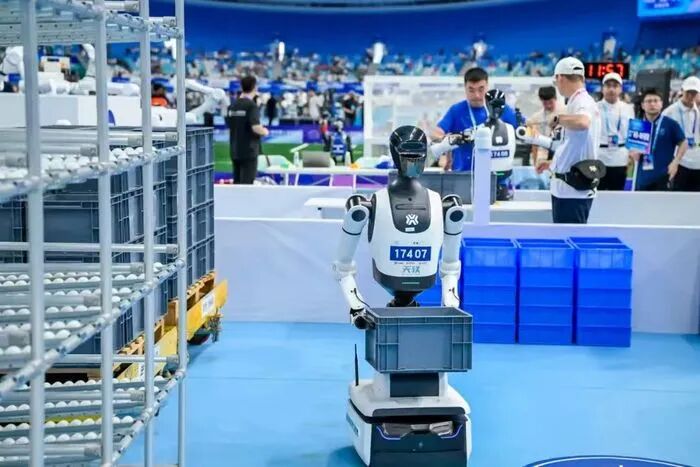
Robot “Tian Yi 2.0” participating in the material handling task in the scene competition
Image source: Beijing Humanoid Robot Innovation Center
▎ The “AI Content” of Robots is Still Insufficient
Jiemian News: Since last year, the robot industry has seen a concentrated explosion. From your experience in this industry, what do you think is the biggest change that has occurred?
Tang Jian: Before joining the Beijing Humanoid Robot Innovation Center, I taught at American universities until 2018, with a major research focus on AI-driven system control, which is a more academic concept. In simple terms, it means using AI methods to control various systems end-to-end. Cars are one type of system, and robots are also a type of system, along with wireless network systems, IoT devices, and cloud computing systems I previously worked on. The core is to use AI methods for end-to-end control systems.
Now that I have joined Beijing Humanoid, I am mainly focused on humanoid robots. Humanoid robots are perhaps the most difficult and challenging projects in the robot industry.
Through these years of development, I believe the biggest change in humanoid robots is the significant improvement in mobility. Now robots can walk and run without major issues, can smoothly navigate through obstacles, and perform complex dance movements; their flexibility and balance are no longer problematic. This lays a solid foundation for the industrialization of robots because, just like a person, if they cannot move, it is impossible to talk about work.
Currently, the technology route for motion control in the robot industry has also converged, with most being based on reinforcement learning to develop motion control algorithms for good generalization.
Jiemian News: From the perspective of your research specialty in AI control systems, do you think the current AI content of robots is sufficient?
Tang Jian: Not enough. It is precisely because the AI capability is insufficient that robots have not truly scaled up.
Jiemian News: Regarding the industrialization of robots, many companies have been discussing mass production. Some companies can ship 100 units per month, while others expect to ship thousands of units in a year. How is mass production defined in the robot industry now?
Tang Jian: As previously mentioned, there is a type of company in the industry that targets educational and research institutions, mainly delivering robots for secondary development, used in teaching, performances, and exhibitions. Some of the more outstanding companies have already achieved sales of hundreds or even thousands of units, and Beijing Humanoid is also doing this.
However, the customer demand for these companies is generally quite scattered. For example, some universities order 1-2 units at a time, and there are also rental companies that place orders to rent to other corporate clients for performances, typically ordering about 5-10 units at a time.
To truly achieve mass production in a specific industry, such as logistics or automotive, and to drive the entire industry’s essential business needs, resulting in orders of thousands or even tens of thousands of units, is what can be considered true large-scale mass production.
I believe that within one or two years, or by the end of next year, there will definitely be outstanding companies that will successfully implement large-scale mass production in one or multiple industry scenarios.
Source: Jiemian News