To achieve SAE L4/L5 fully autonomous driving features in the 2021/2022 annual vehicle models, various sensor redundancy systems must be applied. Today’s semi-autonomous driving systems use a variety of radar and camera systems with different quantities and designs. The development of high-performance, cost-effective laser detection and ranging systems that can detect information within a radius of 300 meters is still in the research phase. Most automotive manufacturers believe that to achieve fully autonomous driving, the three major sensor systems: cameras, radar, and LiDAR are all indispensable.
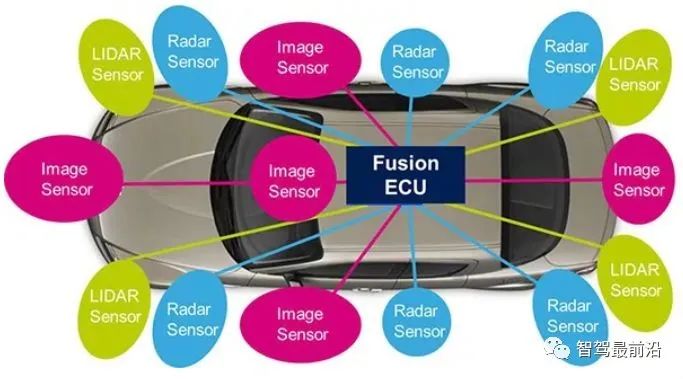
Currently, ultrasonic radar, millimeter-wave radar, and multi-camera systems have been applied in high-end vehicles. As smart driving develops rapidly, environmental perception technology will advance quickly and further enhance collaborative functions. Although sensors are only part of autonomous vehicles, the market prospects are very broad. Therefore, relevant organizations expect that by around 2023, the global market for in-vehicle cameras, millimeter-wave radar, and night vision systems will enter a rapid growth phase.
Cameras: The Wise Eye of Smart Driving
In-vehicle cameras are the foundation for many warning and recognition ADAS functions. Among various ADAS functions, visual image processing systems are quite fundamental and more intuitive for drivers, and cameras are the basis of visual image processing systems, making in-vehicle cameras essential for smart driving.
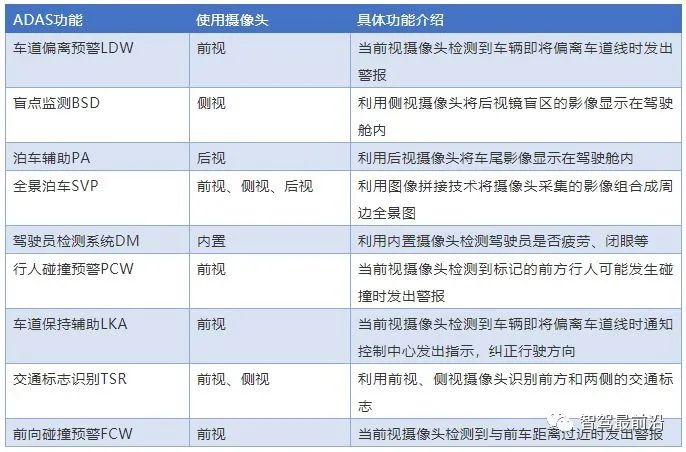
Lane Departure Warning (LDW), Forward Collision Warning (FCW), Traffic Sign Recognition (TSR), Lane Keeping Assistance (LKA), Pedestrian Collision Warning (PCW), Surround View Parking (SVP), Driver Fatigue Warning, and many other functions can be achieved with cameras, some of which can only be realized through cameras.
ADAS Functions Achievable by Cameras
The price of in-vehicle cameras continues to decline, and in the future, multiple cameras per vehicle will become a trend. Compared to in-vehicle radar and other sensors, cameras are more cost-effective and easier to apply widely. Tesla’s Autopilot 2.0 hardware system includes 8 cameras, and multiple cameras per vehicle will become a trend in the future.
According to the requirements of different ADAS functions, the installation positions of cameras vary. Based on their installation positions, they can be categorized into four parts: front view, side view, rear view, and built-in. To achieve a full set of ADAS functions in the future, a vehicle needs to be equipped with at least 5 cameras. According to estimates from the GGII (Gaogong Industry Research Institute), as the penetration rate of ADAS increases, the market size of cameras is expected to grow from 2 billion yuan in 2016 to 5.8 billion yuan in 2020, with a compound annual growth rate of 30%.
The Continuous Decline in In-Vehicle Camera Prices
The front view camera is used most frequently, and a single camera can achieve multiple functions. Through algorithm development and optimization, a single front view camera can accomplish multiple tasks, such as driving record, lane departure warning, forward collision warning, and pedestrian recognition. In the future, it is also expected that more ADAS functions can be integrated through algorithms.
Front view cameras are typically wide-angle lenses installed on the vehicle’s interior rearview mirror or at a high position on the windshield to achieve a longer effective distance.
Side view cameras replacing rearview mirrors will become a trend. Due to the limited range of rearview mirrors, when another vehicle is positioned outside this range at a diagonal rear, it becomes “invisible”; this area outside the range is called a blind spot. The existence of blind spots significantly increases the likelihood of traffic accidents. Installing side view cameras on both sides of the vehicle can effectively cover blind spots. When a vehicle enters a blind spot, it can automatically alert the driver, which is known as the blind spot monitoring system.
Currently, a new trend has emerged: using wide-angle side view cameras to replace rearview mirrors, which can reduce wind resistance while providing a larger and wider view, preventing accidents in dangerous blind spots. The BMW i8 Mirrorless concept car adopts this design.
Blind Spots of Vehicle Rearview Mirrors
The surround view parking system utilizes multiple cameras around the vehicle to provide a “God’s eye view” for parking. The surround view parking system collects images around the vehicle through multiple ultra-wide-angle cameras installed around the body, and after image processing and stitching, it forms a panoramic overhead view of the vehicle, which is transmitted in real-time to the display device on the center console.
The driver sitting in the car can intuitively see the vehicle’s position and surrounding obstacles from a “God’s eye view,” allowing for smooth parking or navigating through complex road conditions, effectively reducing the occurrence of scratches and collisions.
Image Stitching Technology of the Surround View Parking System
In-vehicle cameras are widely used and relatively inexpensive, making them the most basic and common sensors, with future market potential exceeding 10 billion yuan. Cameras are essential for multiple ADAS functions, and their prices are expected to continue to decline, driving rapid growth in the in-vehicle camera market. According to estimates, global shipments of in-vehicle cameras will grow from 28 million units in 2014 to 83 million units in 2020, with a compound growth rate of 20%.
Based on this estimation, the global market size for in-vehicle cameras is expected to grow from 6.2 billion yuan in 2015 to 13.3 billion yuan in 2020, with a compound annual growth rate of 16%. The main consumption regions are in the Americas, Europe, and Asia-Pacific, with the Asia-Pacific region expected to become the fastest-growing market.
Estimated Demand for In-Vehicle Cameras in China in 2022
The camera industry chain mainly consists of lens groups, CMOS (Complementary Metal-Oxide Semiconductor), DSP (Digital Signal Processor), and module packaging.
In recent years, the rapid growth of smartphones has driven the booming development of the camera market; however, since 2014, the growth rate of smartphones has slowed down, and the future growth rate of smartphone cameras is also expected to decelerate. With the rise of the in-vehicle camera market, the production capacity of various links in the smartphone camera industry chain will shift towards the in-vehicle camera industry, and it is expected that the CMOS, lens, and module packaging segments will continue to maintain high growth.

Radar: An Essential Sensor for Distance and Speed Measurement
Radar emits sound waves or electromagnetic waves to illuminate target objects and receives their echoes, thereby obtaining information about the distance, rate of distance change (radial speed), size, orientation, and other characteristics of the target object. Radar was first used in the military and later gradually became civilian.
With the trend of automobile intelligence, radar has started to appear in vehicles, primarily for distance and speed measurement functions. Automotive radar can be categorized into ultrasonic radar, millimeter-wave radar, and laser radar, each with different principles and performance characteristics, suitable for achieving various functions.
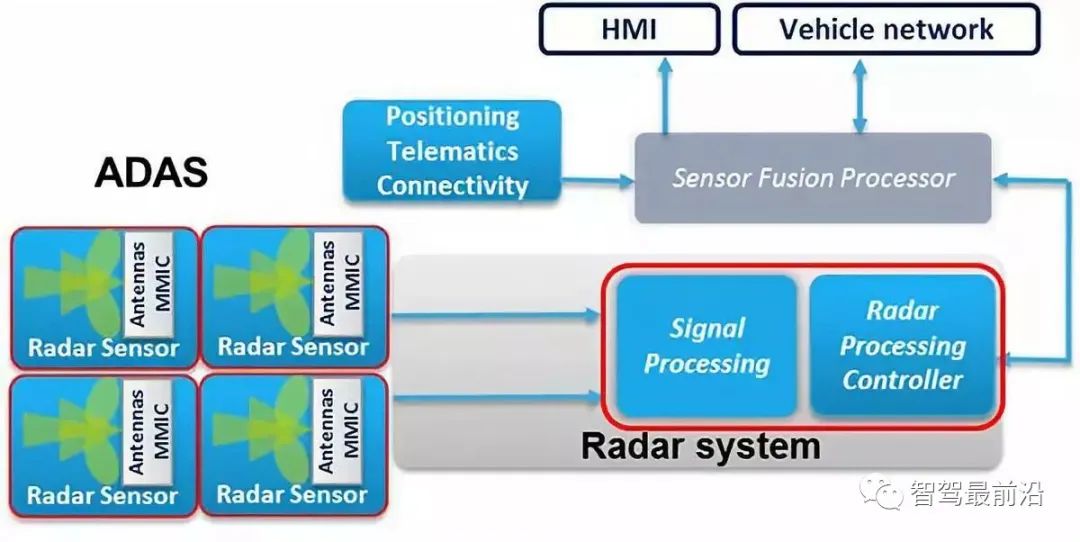
Basic architecture of radar sensors (only for raw data collection)
Ultrasonic Radar
Ultrasonic radar uses an ultrasonic generator within the sensor to produce 40KHz ultrasonic waves, which are then received by a probe that detects the ultrasonic waves reflected back from obstacles. The distance to the obstacle is calculated based on the time difference of the reflected ultrasonic waves. Ultrasonic radar is cost-effective, has a short detection range with high accuracy, and is not affected by lighting conditions, making it commonly used in parking systems.
Automatic parking functions rely on ultrasonic radar. BMW’s latest i-series and 7-series support using the car key to remotely control automatic parking; during the operation, the user only needs to issue forward or backward commands, and the car will continuously use ultrasonic sensors to detect parking spaces and obstacles, automatically operating the steering wheel and brakes to achieve automatic parking.
Millimeter-Wave Radar: The Core Sensor of ADAS
Millimeter waves refer to electromagnetic waves with a wavelength between 1mm and 10mm, corresponding to a frequency range of 30GHz to 300GHz. Millimeter waves have wavelengths between centimeter waves and light waves, thus combining the advantages of microwave guidance and photoelectric guidance.
Millimeter-wave radar is widely used in missile guidance, target surveillance and interception, artillery control and tracking, high-speed communication, and satellite remote sensing. In recent years, as the technology level and cost of millimeter-wave radar have improved, it has started to be applied in the automotive field.
The key technologies of millimeter-wave radar are mainly controlled by foreign electronic companies. A millimeter-wave radar system typically includes antennas, transceiver modules, and signal processing modules, with MMIC (Monolithic Microwave Integrated Circuit) chips and antenna PCBs (Printed Circuit Boards) being the hardware core of millimeter-wave radar.
Currently, key technologies for millimeter-wave radar are primarily monopolized by major component manufacturers like Bosch, Continental, Denso, and Autoliv, especially the 77GHz product technology, which is mastered only by a few companies such as Bosch, Continental, Denso, and Delphi.
LiDAR: Powerful Functionality with Expected Significant Cost Reductions
LiDAR is a high-precision radar technology originally developed for military use and has gained significant attention from military departments worldwide. Compared to conventional radar, LiDAR can provide high-resolution radiation intensity geometrical images, distance images, and speed images. In the civilian domain, LiDAR is also widely used due to its superior performance in distance measurement, speed measurement, and three-dimensional modeling.
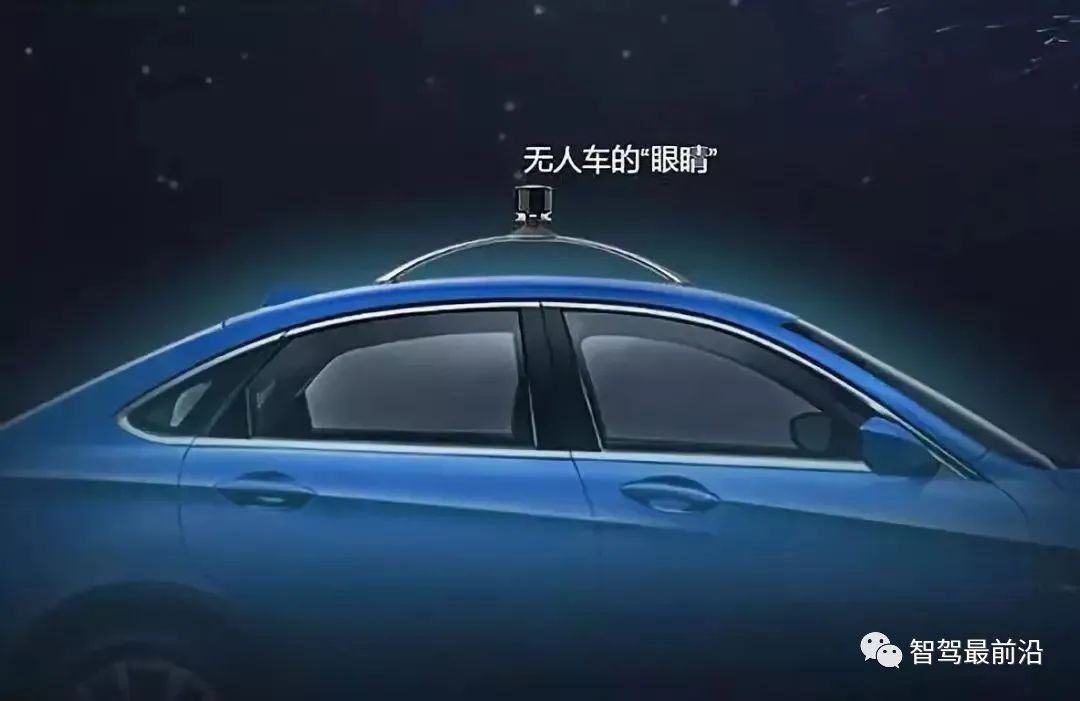
LiDAR has excellent performance and is considered the best technical route for autonomous driving. LiDAR has several significant advantages over other autonomous driving sensors:
1) High Resolution. LiDAR can achieve extremely high angular, distance, and speed resolution. Typically, LiDAR’s angular resolution is no less than 0.1mard, meaning it can distinguish two targets spaced 0.3m apart at a distance of 3km, and can simultaneously track multiple targets; distance resolution can reach 0.1m; speed resolution can be within 10m/s. Such high distance and speed resolution means that LiDAR can obtain very clear images using Doppler imaging technology.
2) High Accuracy. Laser propagates in a straight line, has good directionality, and a very narrow beam with low dispersion, resulting in high accuracy for LiDAR.
3) Strong Resistance to Active Interference. Unlike microwave and millimeter-wave radar, which are easily affected by widely existing electromagnetic waves in nature, there are few signal sources in nature that can interfere with LiDAR, giving it strong resistance to active interference.
LiDAR can be categorized into one-dimensional LiDAR, two-dimensional LiDAR, three-dimensional laser scanners, and three-dimensional LiDAR. One-dimensional LiDAR is mainly used for distance and speed measurement, two-dimensional LiDAR for contour measurement, object recognition, and area monitoring, while three-dimensional LiDAR can achieve real-time three-dimensional spatial modeling.
In-vehicle three-dimensional LiDAR is typically installed on the roof of the vehicle and can rotate at high speeds to obtain point cloud data of the surrounding space, thereby creating a real-time three-dimensional spatial map around the vehicle; simultaneously, LiDAR can measure the distance, speed, acceleration, and angular velocity of surrounding vehicles in three directions. After combining this data with GPS maps, the vehicle’s position can be calculated. This vast and rich data is transmitted to the ECU for analysis and processing, enabling the vehicle to make quick judgments.
This article is reproduced from Automotive Testing and Evaluation, and the views expressed in this article are for sharing and communication purposes only and do not represent the position of this public account. If there are any copyright issues, please let us know, and we will address them promptly.
We welcome angel round and Series A enterprises from the entire automotive industry chain (including the electrification industry chain) to join the group; (Friendly connections include 700 automotive investment institutions, including top-tier organizations; a selection of quality projects will be presented to existing institutions by theme));There are communication groups for leaders of sci-tech innovation companies, automotive whole vehicles, automotive semiconductors, key components, new energy vehicles, smart connected vehicles, aftermarket, automotive investment, autonomous driving, vehicle networking, etc. To join the group, please scan the administrator’s WeChat(Please indicate your company name)