Click the blue text to follow us
 On May 7, 2024, Academician Tang Benzhong/Professor Lin Rongye of Hong Kong University of Science and Technology, and Assistant Professor Guo Zijian of Hong Kong University of Science and Technology published a review titled “Platinum complexes with aggregation-induced emission” in Chemical Society Reviews. Postdoctoral researchers Yang Shengyi (Sheng-Yi Yang) and Chen Yingying (Yingying Chen) from Hong Kong University of Science and Technology are the first authors of the paper, with Guo Zijian (Ryan T. K. Kwok), Lin Rongye (Jacky W. Y. Lam), and Tang Benzhong as co-corresponding authors.The phenomenon of aggregation-induced emission (AIE) refers to the specific molecules that exhibit low or no fluorescence when in monomer form, but their fluorescent properties are significantly enhanced when they form aggregates. Since the introduction of the AIE concept by Tang Benzhong’s team in 2001, there has been rapid development in AIE-functionalized complexes. Among AIE metal complexes, platinum metal complexes have become a promising choice for constructing effective AIE platinum complexes due to their unique optoelectronic properties and biological activities.This review categorizes AIE platinum complexes based on the number of ligands and focuses on the development and performance of AIE platinum complexes with different ligand counts, as well as the impact of platinum ion coordination and ligand structural changes on optoelectronic properties.Furthermore, this review analyzes and summarizes the influence of molecular geometry, stacking models, and aggregation environments on the optoelectronic properties of these complexes, providing a comprehensive overview of the AIE mechanisms exhibited by various AIE platinum complexes. Based on the unique properties of AIE platinum complexes with different ligand counts, this article systematically summarizes their applications in fields such as electronics and biology.Finally, the article discusses the challenges and opportunities for future research on AIE platinum complexes, aiming to provide a comprehensive summary and outlook on the latest developments in functional AIE platinum complexes and encourage more researchers to contribute to this promising field.
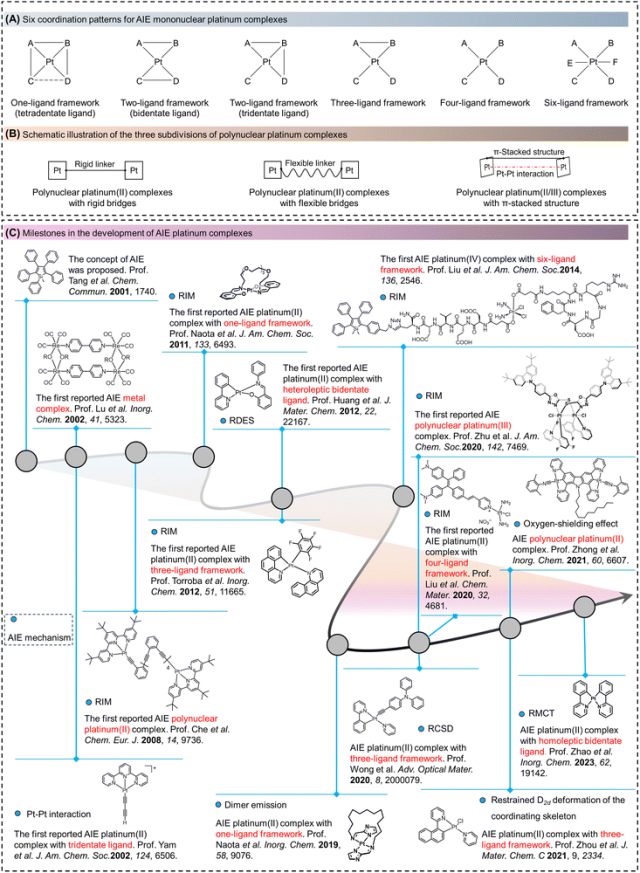 Figure 1. Summarizes six coordination modes of AIE mononuclear platinum complexes, three classifications of multinuclear platinum complexes, and the historical development of AIE platinum complexes categorized by the number of ligands, including corresponding molecular structures and AIE mechanisms.
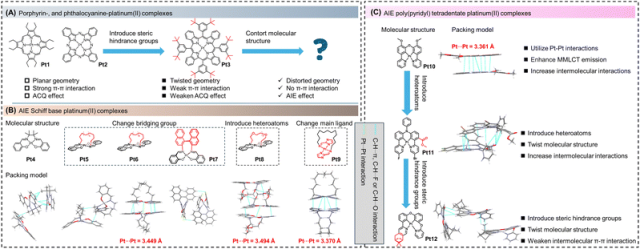 Figure 2. Molecular structures, single crystal structures, and stacking modes of AIE cyclic metal platinum(II) complexes based on different ligands, and how they achieve AIE characteristics through structural adjustments.
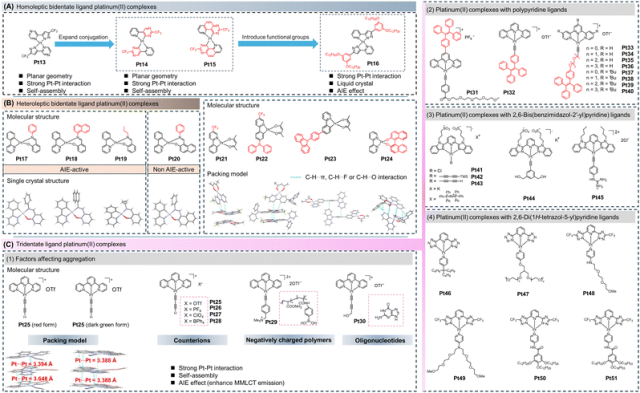 Figure 3. AIE cyclic metal platinum(II) complexes with two ligand frameworks, including the molecular structures, single crystal structures, and stacking modes of uniform bidentate ligands, mixed bidentate ligands, and tridentate ligand complexes, as well as their photophysical behavior in the aggregated state.
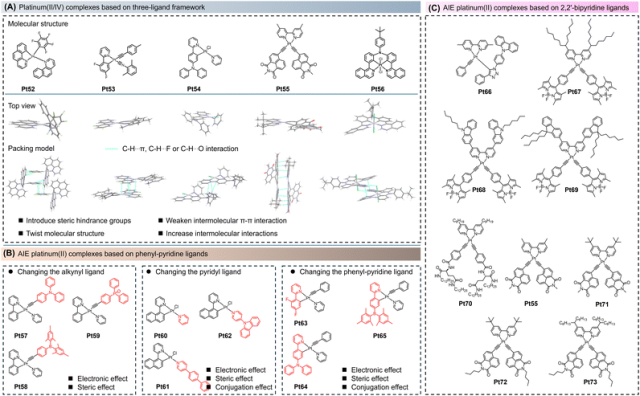 Figure 4. Covers AIE platinum(II) complexes with three ligand molecular frameworks, showcasing their molecular structures, single crystal structures, and stacking modes, and how these structures influence their optoelectronic properties in the solid state.
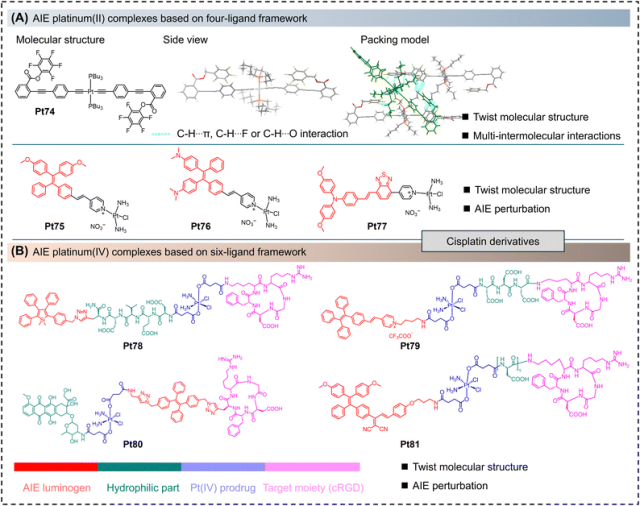 Figure 5. AIE platinum complexes with four and six ligand molecular frameworks, including their molecular structures, single crystal structures, and stacking modes, with a particular focus on the potential applications of these complexes in biomedical imaging and therapy.
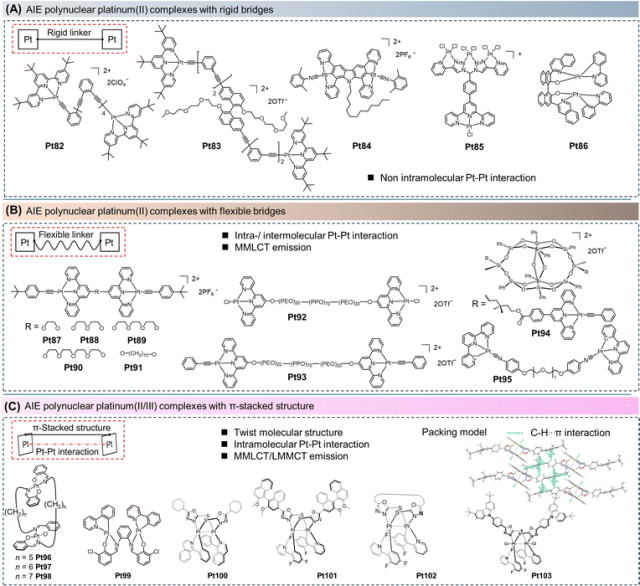 Figure 6. AIE activity of multinuclear platinum(II) and platinum(III) small molecules, including complexes with rigid bridging, flexible bridging, and p-stacking structures, as well as their self-assembly behavior and photophysical properties under different solvents and temperatures.
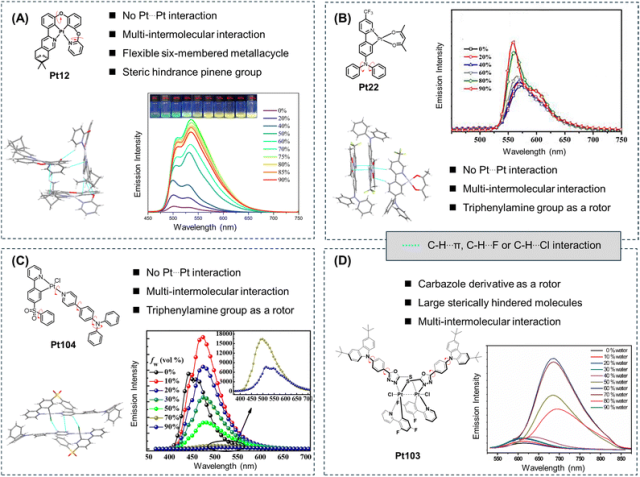 Figure 7. Demonstrates the AIE mechanism of AIE cyclic metal platinum complexes under different ligand frameworks through molecular structures, single crystal structures, stacking modes, and AIE curves, particularly the restriction of intramolecular motion (RIM) mechanism.
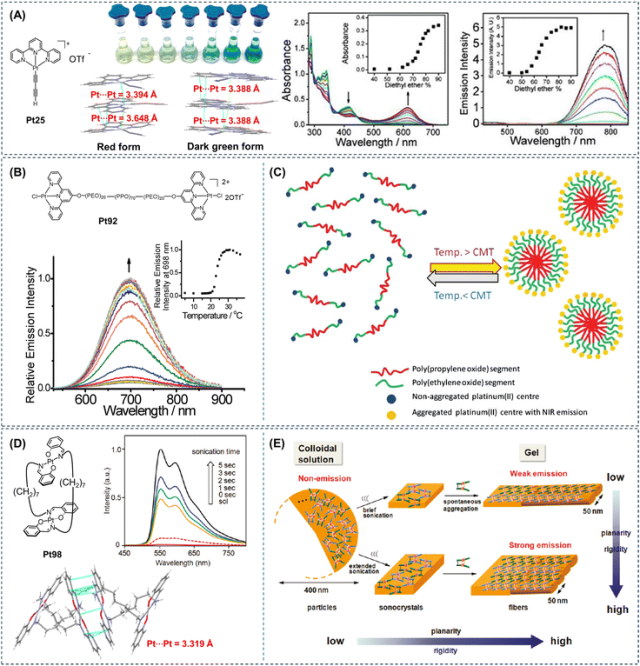 Figure 8. Charts of molecular structures and luminescent properties explaining how the platinum-platinum (Pt-Pt) interactions regulate the self-assembly process of platinum complexes, leading to photophysical properties in the aggregated state that are completely different from the initial state.
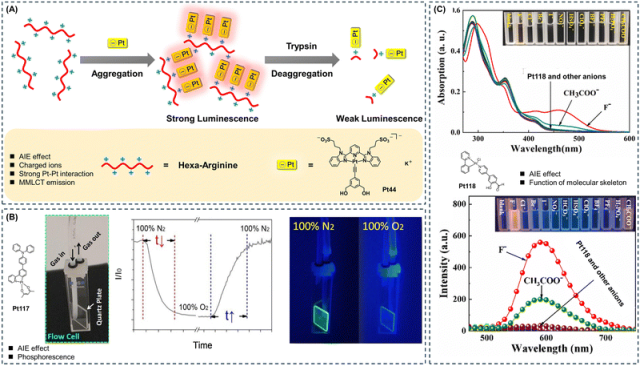 Figure 9. Based on the principle of restricted excited-state structural distortion, demonstrating the AIE mechanism of AIE cyclic metal platinum(II) complexes, particularly the geometric structural changes of molecules in the excited state observed through theoretical calculations and experiments.
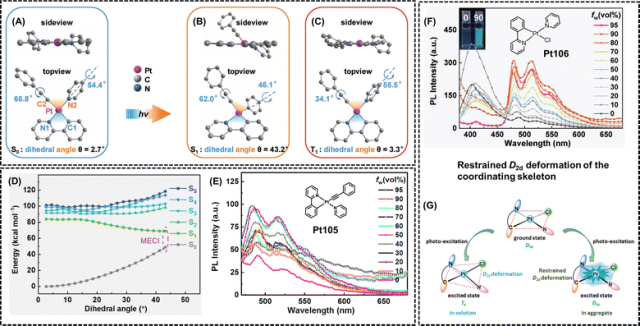 Figure 10. Discusses examples of restricted coordination framework deformation (RCSD) and restricted D2d deformation as AIE mechanisms, explaining these mechanisms through optimized molecular structures and AIE curves.
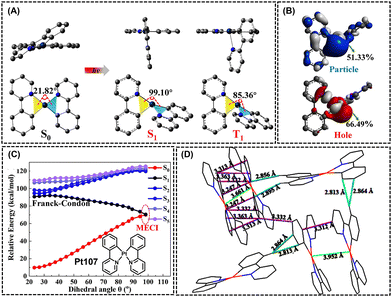 Figure 11. Based on the principle of restricted molecular conformational change (RMCT), demonstrating the molecular structure of the simplest platinum(II) complex (Pt107), the optimized geometric structure in the excited state, and intermolecular interactions in the aggregated state.
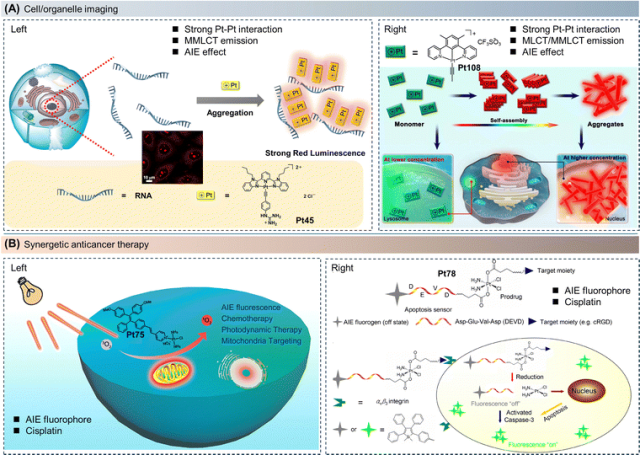 Figure 12. Applications of AIE platinum complexes in cellular/organelle imaging and synergistic cancer therapy, including how they bind to RNA through non-covalent interactions and enhance AIE fluorescence through caspase-3 enzyme-specific peptides.
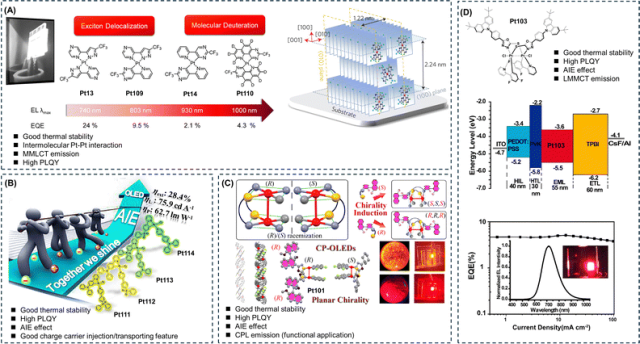 Figure 13. Applications of AIE cyclic metal platinum complexes in the organic optoelectronic field, particularly in constructing efficient OLEDs, including platinum(II) complexes with two and three ligand frameworks, and p-stacked multinuclear platinum(II) and platinum(III) complexes.
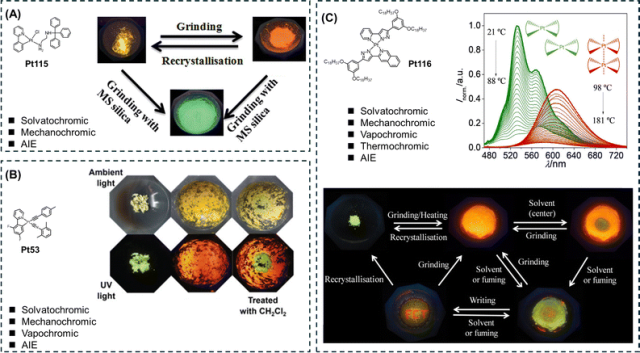 Figure 14. Platinum(II) complexes with multi-stimuli-responsive properties, including their photophysical behavior and self-assembly characteristics under different external stimuli (such as solvents, force, temperature, and vapor).Figure 15. Demonstrates the applications of AIE platinum complexes in detection and sensing fields, including the design and response characteristics of AIE platinum(II) complex Pt118 for continuous label-free luminescent detection of trypsin, constructing luminescent oxygen sensors, and detecting fluoride ions.AIE platinum complexes, due to their diversified structures and unique photophysical properties, have found widespread applications in multiple fields. This article reviews AIE platinum complexes, clarifying the relationship between their molecular structures, photophysical properties, and applications. AIE platinum complexes exhibit a wide variety of molecular types, facilitating the adjustment of molecular structures and photophysical properties to meet different application needs.Future developments of AIE platinum complexes should consider the following points:(1) Compared to AIE fluorescent materials, there is still considerable room for development of AIE platinum complexes, lacking systematic studies, and designing and synthesizing AIE platinum complexes with specific functions is challenging;(2) Research on the AIE mechanism of platinum complexes lags behind that of AIE fluorescent molecules, necessitating more in-depth studies on the AIE mechanisms of AIE platinum complexes or other metal complexes;(3) When studying the physicochemical properties of AIE platinum complexes, the impact of changes in aggregation environments, solvent systems, concentrations, and stimulus response conditions on molecular performance should be considered;(4) Expanding the applications of AIE platinum complexes is crucial, such as using them as electrocatalysts;(5) Research on multinuclear platinum complexes needs to be further advanced, including improving yields, utilizing their inherent long-wavelength absorption or emission to expand applications, and addressing solubility issues;(6) In AIE research, future work needs to further develop the scientific connotation of aggregates, expand research methods and characterization techniques for molecular aggregate properties, and promote innovation in aggregate research paradigms.
Original link
https://pubs.rsc.org/en/content/articlelanding/2024/cs/d4cs00218k
Related Progress
Academician Tang Benzhong, Professor Sun Jianwei, Professor Lin Rongye Angew: Ligand Interstitial Anchoring Strategy Helps Significantly Improve MOF Quantum Yield
Disclaimer: Some materials may come from the internet, and the purpose of reprinting is to convey more information and share, which does not imply endorsement of their views or verify their authenticity, nor does it constitute other advice. It only provides a communication platform and is not responsible for copyright. If there is any infringement, please contact us for timely modification or deletion. Original articles are welcome for individual forwarding and sharing; for publications or media, please contact us for reprints. Contact email: [email protected]

Scan the QR code | Follow us
WeChat ID: Chem-MSE
Inviting Submissions
Experts and scholars are welcome to provide manuscripts related to chemistry, chemical engineering, materials science and engineering, and biomedical engineering for academic-industry-research collaboration to [email protected], and please specify detailed contact information. The Chemical and Materials Science Society will promptly select and push them.