In recent years, the development of airspace has become a common goal worldwide.
On one hand, thanks to the advancements in Low Earth Orbit (LEO) satellite technology, the satellite communication (SATCOM) industry, represented by Starlink, is experiencing rapid growth. There is an urgent demand for SATCOM in areas with poor signal, such as at sea, in deserts, on mountains, or in forests, as well as in applications like airborne, marine, and emergency scenarios; on the other hand, driven by manufacturers, eVTOL has become quite popular in recent years, gaining favor among global customers in manned and industrial applications.
It is under the impetus of these applications that a term known as “low-altitude economy” has come to the forefront. According to a report from the China Center for Information Industry Development, it is expected that by 2025, the low-altitude economy market in China alone will reach 1.5 trillion yuan, and by 2035, it is expected to reach 3.5 trillion yuan. This illustrates the fervor surrounding the “low-altitude economy”.
To achieve the above goals, comprehensive, real-time, and reliable communication connections are indispensable.
Low-altitude Communication: Numerous Challenges
As mentioned above, low-altitude communication can be divided into two categories: one is low-orbit satellite communication, which differs from traditional ground-based communication by using satellites in Earth orbit as relays to receive signals from ground stations (or terminals), amplify and process them, and then downlink them to other ground stations; the other is ensuring that eVTOL can maintain connectivity while flying at low altitudes, supporting real-time big data transmission and remote intervention.
In both cases, there are core demands for reliability, low cost, and support for large-scale deployment.
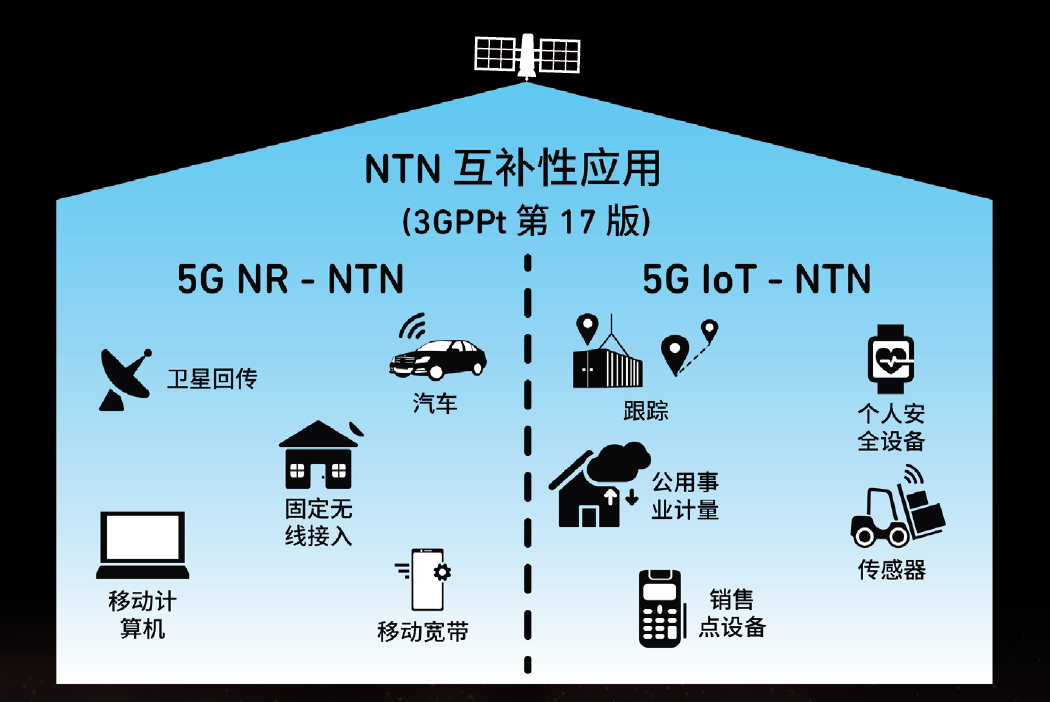
Taking satellite communication as an example, it has been reported that as the number of satellites deployed increases, the market has raised higher requirements for the components used in the signal chain, necessitating them to have higher efficiency, more compact size, and more reliable performance, covering everything from RF power amplifiers to low-noise amplifiers to beamforming ICs (BFIC). Meanwhile, cellular communication is becoming part of the satellite ecosystem. With the introduction of 5G wireless technology in the 3GPP Release 17, 5G systems can serve Non-Terrestrial Networks (NTN). NTN aims to expand global network coverage, especially in rural and remote areas, and facilitate direct connections between mobile devices, the Internet of Things (IoT), and commercial autonomous vehicles with satellites. This integration allows the satellite industry to fully leverage the scale effects of the 5G ecosystem.
To achieve these goals, ground station flat antennas become crucial, with the BFIC as a core component being of utmost importance.
In satellite communication, in the past, we often used mechanical scanning antennas or fixed antennas (the “dish”) to complete ground reception for satellite communication. Since most application scenarios were fixed at that time, this method was sufficient. However, as devices like airplanes and ships began to use satellite communication, traditional antennas struggled to capture satellite signals. At this point, active phased array antennas can play a significant role—quickly switching between satellites or between low and high orbit satellites to ensure stability.
From a principle perspective, these antennas consist of multiple coherently fed fixed radiators. To form an electronic beam, each radiator is fed with an appropriate phase, thereby forming a coherent beam in the desired direction in the far field. It utilizes the variable phase control of each radiator to scan the beam to specific angles in space, as shown in the figure below. This electronic beam steering without moving parts is managed by the IC (the BFIC) on each radiating element.
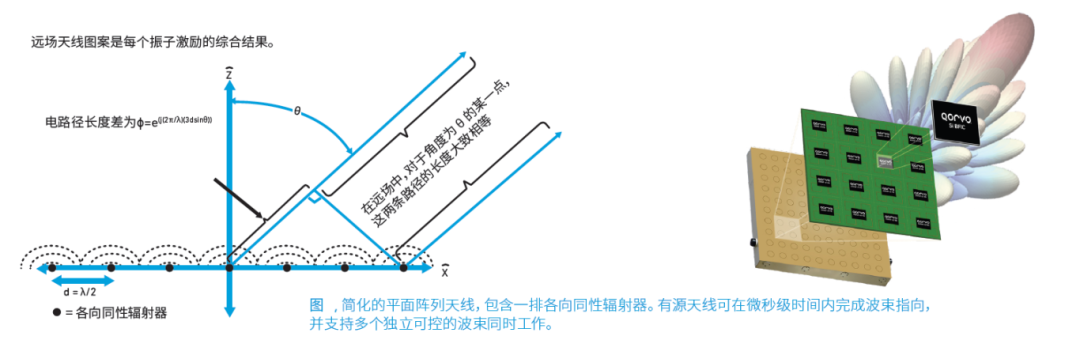
In other words, the amplitude and phase control of each antenna element in the antenna array is achieved through the BFIC, thereby forming, directing, or switching the RF beam.
For such chips, it is necessary to consider not only thermal management and power consumption control, but also integration density/size/weight limitations. Additionally, circuit board/interconnect and layout challenges, phase/amplitude calibration and beam accuracy, cost and manufacturing/mass production challenges, as well as link/system-level integration challenges are also issues that the BFIC must face.
As a chip supplier with extensive experience in the communication field, Qorvo can provide broad support for this.
Qorvo’s Comprehensive Empowerment
It has been reported that benefiting from the company’s wide range of highly reliable RF products, Qorvo can provide high-performance components for the uplink and downlink systems of satellite communication. In response to market demand, Qorvo has also launched a new silicon-based beamforming IC (BFIC) that supports Ku and Ka bands, built on commercial CMOS technology.
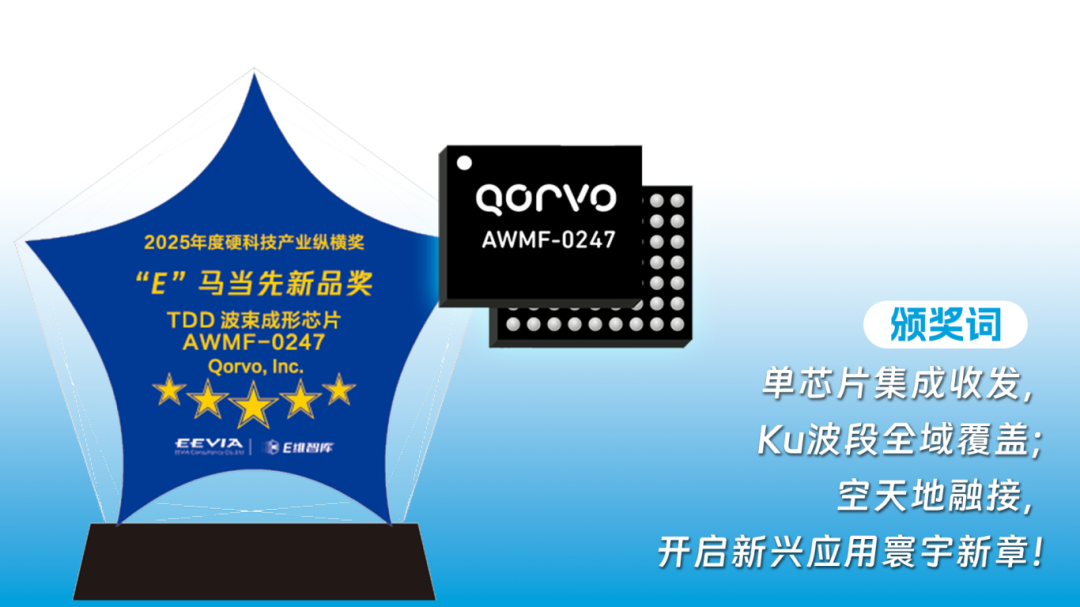
Qorvo Ku-band TDD beamforming chip AWMF-0247
Won the E-Intelligence 2025 “E” New Product Award
Qorvo states that silicon is the most suitable manufacturing technology for BFIC, as it not only facilitates the production of highly integrated single chips to accomplish complex functions but also has costs comparable to gallium arsenide and gallium nitride. Additionally, advantages such as significantly improved link budget, higher EIRP and EIS, better SNR and data rates, low deployment costs and power consumption, and unified platform design are highlights of Qorvo’s BFIC.
For Ku-band applications, Qorvo has launched corresponding receive (Rx) and transmit (Tx) beamforming ICs to meet the growing demand for high-speed, reliable satellite communication. In a compact and stable design, these ICs also provide advanced features including full polarization flexibility, precise beam steering, and built-in temperature stability without the need for external low-noise amplifiers (LNAs) or complex calibration.
In response to the growing demand for Time Division Duplex (TDD) terminals, Qorvo has also introduced a new Ku-band beamforming chip, whose TDD architecture supports simultaneous transmission and reception operations with a single antenna array, effectively reducing system size and complexity, and aiding in the design of low-profile electronic scanning terminals. With the release of this new product, Qorvo further expands its existing SATCOM product portfolio, providing complete and scalable solutions for TDD and Frequency Division Duplex (FDD) terminal architectures.
Qorvo states that these chips can adapt to LEO, MEO, GEO, and other multi-orbit satellite systems. Each IC integrates four dual-polarization channels, supporting independent phase and gain control, and real-time adjustment of beam direction to track satellite signals. Thanks to this high-integration design, the BFIC can significantly reduce the number of terminal chips, lowering the size, weight, and power consumption of the equipment.
With the support of these chips, the CPE terminal antennas, which connect users directly to satellites, can transition from traditional parabolic (dish) antennas to AESA or phased array antennas, enhancing the connection experience. Their unique advantages also allow developers to integrate various technologies into more compact and lightweight designs, offering consumers more possibilities.
In addition to this BFIC, Qorvo’s deep accumulation in RF front-end devices over the past thirty years also enables the company to provide comprehensive support for the needs of satellite communication. Thanks to the company’s expertise in GaAs, GaN, SAW, BAW, CMOS, and SiGe processes and products, Qorvo can offer reliable support for satellite communication across the entire link.
In Conclusion
As an important part of this wave of technological innovation, China is providing substantial support for the low-altitude economy.
Since being included in China’s “National Comprehensive Transportation Network Planning Outline” at the beginning of 2021, and being emphasized in the 2023 Central Economic Work Conference, China has been making great efforts in the development of the low-altitude economy. Starting in 2024, the low-altitude economy will be included in the government work report for two consecutive years. With its industrial characteristics of “strong chains, broad integration, and deep radiation”, it is gradually becoming a new track for competition across the country.
With this collective effort, a technological revolution from the ground to space is unfolding grandly. Qorvo, with its product layout across multiple fields, is providing strong empowerment for connectivity capabilities in ground and space applications.