1. Market Value Soars: Google Aims for the $4 Trillion Milestone
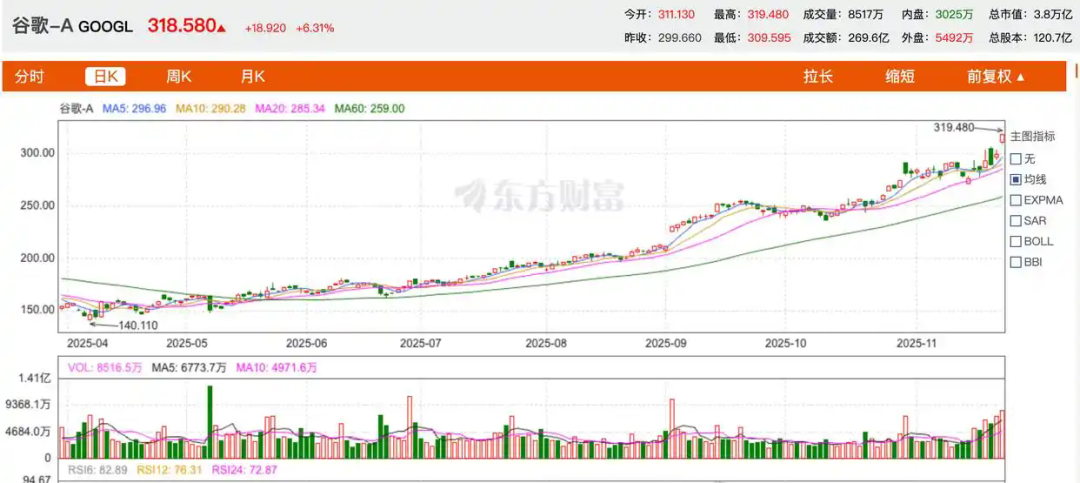
On the evening of November 25, Google (GOOGL.US) saw its stock surge over 4% in pre-market trading. If this increase holds at market open, its total market value will surpass the $4 trillion mark for the first time. Previously, Nvidia, Apple, and Microsoft had achieved this milestone, but Microsoft has since fallen behind. By the close of trading on November 25, Google’s stock had risen over 6%, closing at $318.58 per share, with a market value exceeding $3.8 trillion, surpassing Microsoft and ranking among the top three in total market value on the U.S. stock market. Over the past month, Google’s stock has increased by over 20%, and year-to-date, it has risen by more than 67%.
2. New Model Release: Google Makes a Comeback, Reshaping the AI Landscape
Within a week, Google released its new models, Gemini 3 Pro and Nano Banana Pro, sparking excitement in the AI community and successfully making a comeback, overshadowing OpenAI and achieving new all-time highs in market value. The Gemini 3 series models may represent a significant milestone in Google’s AI strategy over the past two years. Since the release of ChatGPT at the end of 2022, Google had been trailing OpenAI in the AI race, but now these new models could reshape the landscape, especially as OpenAI’s GPT-5 has been criticized as being more hype than substance, allowing Google to gain the lead.
Google announced that Gemini has over 650 million monthly active users, with the AI overview feature supported by it reaching over 2 billion users per month. ChatGPT has nearly 800 million weekly active users, still leading, but the gap is continuously narrowing.
3. TPU Chips: Google’s Strategic Shift with Significant Market Potential
The surge in Google’s stock price may be supported by its TPU chips. On November 25, it was reported that Google is marketing its self-developed TPUs to customers, with potential client Meta planning to invest billions of dollars to integrate Google TPUs into its data centers starting in 2027, and is also considering leasing computing power from Google Cloud as early as next year.
TPUs are machine learning acceleration chips specifically designed by Google for AI tasks, deployed internally since 2015. Previously, they were primarily limited to Google’s own cloud data centers and were only rented out to companies running large-scale AI workloads. Now, Google is directly deploying these chips in customer data centers, marking a significant strategic shift. Senior executives within Google Cloud have stated that expanding TPU market adoption could capture 10% of Nvidia’s annual revenue share.
4. Market Reaction: Google’s ‘Combination’ Favored, Competitors’ Stock Prices Adjust
Amid ongoing skepticism regarding the trillion-dollar collaborations surrounding OpenAI, Nvidia, Oracle, and others, discussions about an AI bubble continue. Over the past month, stock prices of related companies have adjusted, with Nvidia’s stock dropping 13% from a peak of $212 per share on October 29; Microsoft has declined 14% in the past month; and Oracle’s stock surged to $345 per share after signing a $300 billion computing power contract with OpenAI, but has since fallen by about 40%.
In contrast, the stock price of Broadcom, a partner of Google’s TPU chips, surged, closing up 11.1% on Monday, marking its best single-day performance since April 9. Goldman Sachs’ trading desk noted that the combination centered around Google and Broadcom is showing a strong trend of replacing the ‘OpenAI chain’, with investors re-betting on Google Cloud infrastructure and self-developed chip ecosystems. Overseas investment firm Loop Capital upgraded the rating of Google’s parent company from ‘Hold’ to ‘Buy’, raising the target price from $260 per share to $320. Previously, Berkshire Hathaway made a significant investment in Google, becoming its tenth largest stock holding.
5. Full-Stack Solution: Google’s ‘Ace’, Future Outcomes Uncertain
In three years, Google has moved from catching up to leading the market. The CTO of Google DeepMind stated that a differentiated full-stack technology solution is key, with each link from hardware to infrastructure to model research being interconnected. Google covers four major areas: chips, cloud, large models, and applications, possessing self-developed TPU chips and cloud services, which allows it to control costs and create a commercial cycle; in terms of product distribution channels, it has over 2 billion global users through the Android system, Google Search, and office suites, enabling AI to directly reach a vast user base.
The AI battle is still in its early stages, and whether Google will emerge as the final winner remains uncertain. However, compared to cash-burning AI unicorns, conservative investors may prefer to place their bets on Google.
–END–