With the development of smart aquaculture, modern farming technologies are gradually moving towards data-driven, automated, and remote management directions. To meet the operational efficiency requirements of smart aquaculture, a stable, secure, and high-speed network environment has become an essential infrastructure. In this article, we will explore how to utilize intelligent networking devices to build a smart aquaculture network, analyzing their application scenarios and advantages in intelligent farming systems through practical cases.
1. Network Requirements for Smart Aquaculture
Smart aquaculture factories need to integrate multiple systems while achieving automation and intelligence:
Intelligent farming systems
Recirculating Aquaculture Systems (RAS)
Water quality monitoring sensors (pH, dissolved oxygen, ammonia nitrogen, temperature, etc.)
Intelligent feeding systems
Environmental control systems
Lighting control and temperature regulation devices
Data collection terminals and central control platforms
Remote operation and fault diagnosis
Remote monitoring and adjustment of device parameters through IoT platforms
Data interconnection between multiple sites
The above scenarios impose the following requirements on the network environment:
High bandwidth and low latency: Ensuring smooth operation of water quality monitoring, high-definition video transmission, and real-time alarms.
Reliable multi-link redundancy: Preventing data upload failures or remote control failures due to network interruptions.
Flexible remote access: Supporting efficient collaboration between aquaculture factories and remote technical teams.
2. Core Functions of Intelligent Networking Devices
The Aurora intelligent networking device is a high-performance industrial-grade WiFi 6 router that supports distributed networking and point-to-point communication, featuring the following key characteristics:
Multi-link aggregation and dynamic traffic distribution
Supports multi-link access via fiber, wired broadband, and 4G/5G networks, ensuring high reliability and stability of the network.
Dynamic optimization of traffic distribution, prioritizing the transmission of critical data such as water quality monitoring and alarm information.
High-performance wireless network
Supports WiFi 6 technology, with dual-band wireless rates of up to 1800 Mbps, suitable for high-definition video and large data volume transmission.
Can support up to 128 devices simultaneously, meeting the networking needs of multiple devices in smart aquaculture factories.
Industrial-grade design and scalability
Operating temperature range from -20°C to 70°C, suitable for complex environments with high humidity and high temperatures.
Supports SD card and USB interface expansion, facilitating firmware updates and configuration imports.
Security and remote management
Built-in VPN functionality ensures the security of data transmission.
Supports remote login and management, enabling remote fault diagnosis and parameter adjustments.
3. Applications of Intelligent Networking Devices in Smart Aquaculture
1. Edge device access and data aggregation
Intelligent networking devices can serve as edge routing devices in smart aquaculture factories, connecting sensors, cameras, and environmental control devices to upload collected data to the central control platform.
Application scenarios
Connecting water quality monitoring sensors to collect real-time data on pH, dissolved oxygen, ammonia nitrogen, etc.
Uploading high-definition video monitoring footage for real-time viewing of pond conditions on the central platform.
Advantages
High bandwidth support ensures rapid upload of large-scale data.
High concurrency capability meets the demand for simultaneous data collection from multiple sensors.
2. Multi-link redundancy and network stability
Smart aquaculture factories are often located in areas far from cities, with complex network environments. Intelligent networking devices achieve network redundancy design by supporting fiber and 4G/5G multi-link access, ensuring high availability of the network.
Application scenarios
Main link uses fiber network, backup link uses 4G/5G network, automatically switching to backup link when the main link is interrupted.
Through dynamic traffic distribution, prioritizing the transmission of alarm information and critical data.
Advantages
Dynamic switching ensures the network is always online.
Flexible networking, particularly suitable for smart farming scenarios in remote areas.
3. Remote operation and intelligent management
Through the remote management capabilities of intelligent networking devices, suppliers and technical teams can monitor device status in real-time, quickly complete fault diagnosis and parameter adjustments, significantly reducing manual operation and maintenance costs.
Application scenarios
Suppliers access the network devices of smart aquaculture factories via 5G networks to diagnose issues and provide solutions.
Remotely adjusting the operating parameters of feeding and oxygenation devices to improve farming efficiency.
Advantages
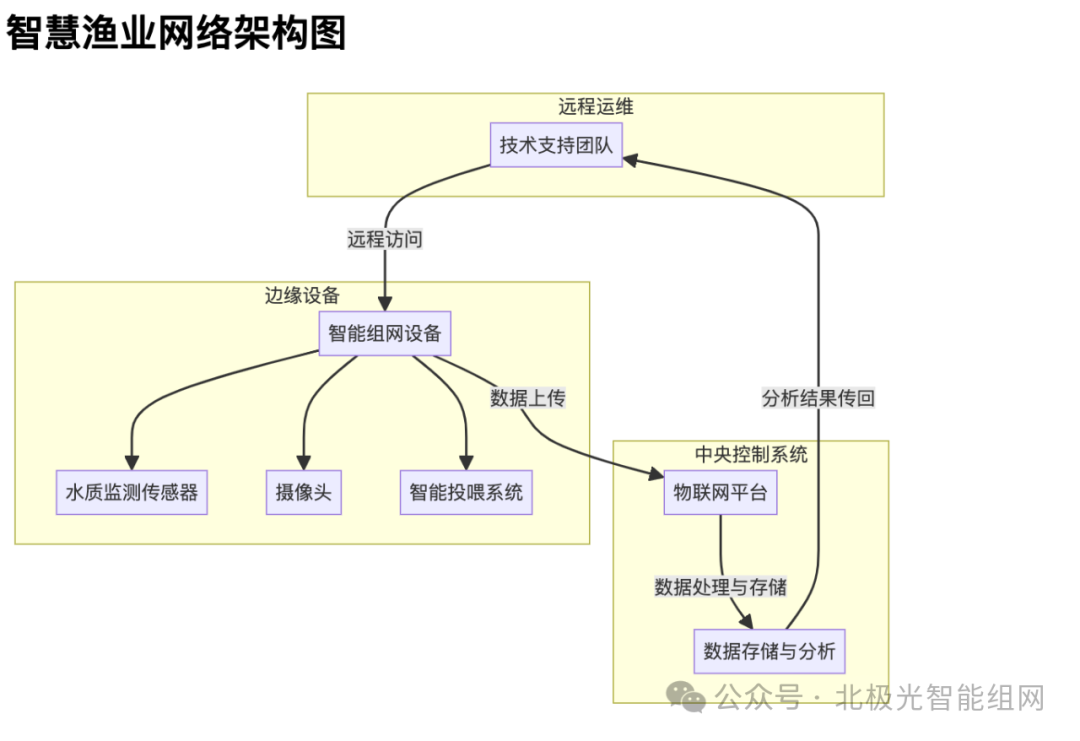
Efficient and convenient remote management reduces the need for manual on-site intervention.
Supports centralized management of devices across multiple locations, enhancing operational efficiency.
4. Technical Advantages of Intelligent Networking Devices
High performance and stability
Dual-band wireless technology provides greater bandwidth and lower latency, suitable for high-frequency data transmission scenarios.
Industrial-grade design ensures long-term stable operation of devices in harsh environments with high humidity and high temperatures.
Flexible expansion and compatibility
Supports multiple wireless protocols (802.11a/b/g/n/ac/ax), compatible with various terminal devices.
Multi-WAN/LAN interface design meets the needs of complex network topologies.
Low power consumption and environmental friendliness
Maximum power consumption is less than 24W, energy-saving and environmentally friendly, in line with modern sustainable development concepts.
Security assurance
Built-in VPN encryption functionality ensures the security and privacy of data transmission.
Supports enterprise-level network security protection to prevent unauthorized access.
5. Case Study: Deployment of Intelligent Networking Devices in a Smart Aquaculture Factory
Project Background
A smart aquaculture factory produces 800,000 pounds of mandarin fish annually, involving multiple system modules such as water quality monitoring, intelligent feeding, and environmental control. To enhance data and automation levels, intelligent networking devices were deployed as the core network nodes.
Deployment Plan
Deploy intelligent networking devices in the farming area to connect water quality sensors and cameras.
Configure 4G/5G backup links to ensure high network availability.
Monitor device operating status through a remote management platform, achieving rapid fault diagnosis and resolution.
Implementation Results
Data transmission efficiency significantly improved, with real-time water quality monitoring and video surveillance.
Network interruption rate decreased by 80%, greatly enhancing operational stability.
Operation and maintenance costs reduced by 30%, with remote management functionality effectively minimizing manual intervention.
6. Conclusion
Intelligent networking devices play a crucial role in the network architecture of smart aquaculture, providing strong support for the intelligence and data-driven nature of farming systems with their high performance, flexibility, and reliability. By deploying these devices, aquaculture factories can achieve more efficient resource utilization, more precise environmental control, and more stable operational management, providing valuable experience for the digital transformation of the industry.